
English Video to Korean Translator: Dub Captioned Videos in Chrome
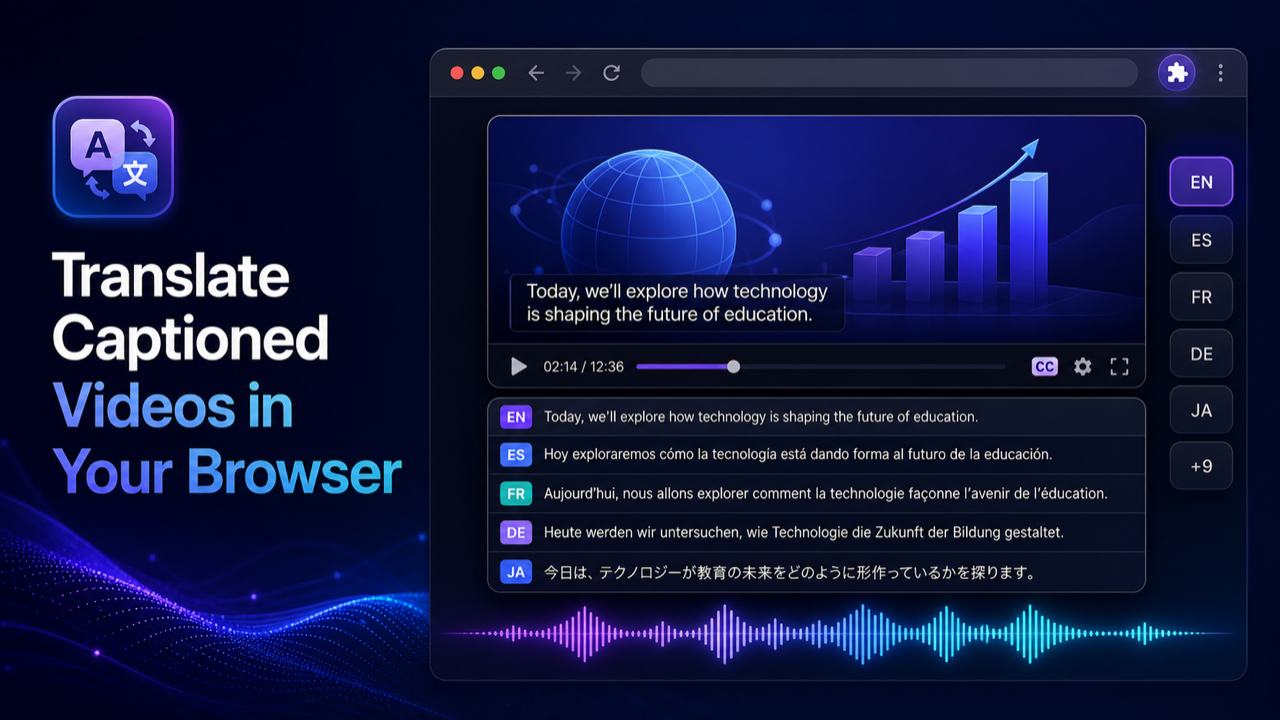
If the English video you want to watch has captions, a browser extension can work as an english video to korean translator while the video plays. It reads the caption track, translates each line into Korean, generates a Korean voice track, and plays that track in sync with the video while the original English audio drops to a lower volume. Nothing gets downloaded or re-uploaded, and you stay on the page where the video lives.
What you need before you start
The extension used here is Unlimited Universal Video Translator, a Chrome extension. Check three things first:
- Desktop Chrome. Mobile browsers are not supported.
- A video with captions. The extension translates existing captions. It does not listen to the audio and transcribe it, so a video with no captions at all will not work.
- A player the extension can read. It has been tested on YouTube, YouTube Shorts, Udemy, Coursera, edX, TikTok, TED, Vimeo, Khan Academy, gamedev.tv, Zenva, and Domestika. Many other sites with captioned HTML5 players work as well, but a site outside that list is untested, so try it before you count on it.
On YouTube, auto-generated captions count, so check the CC button before giving up on a video. If the button is grey or missing, the video has no caption track to work from.
How to translate english video into korean, step by step
- Install the extension from the Chrome Web Store and open the English video.
- Turn captions on in the player. On YouTube, click the CC button or open Settings (the gear) > Subtitles/CC and pick English.
- Click the Dub button that appears on the video.
- In the on-video controls, choose Korean as the target language, then pick the mode, the translation engine, and the voice.
- Press play. You will hear Korean speech over a quieter English track. You can also show translated Korean subtitles if you want to read along.
The free path uses Standard mode, Google Translate for the text, and on-device Piper speech generation that runs inside the extension. Speech generation on this path is not sent to a remote text-to-speech service, and you do not need an account. There is also an optional "Free Online" voice, which you have to pick yourself and which needs an internet connection.
About Korean voices
Korean voice availability depends on the engine you select and on the voices installed on your system. The free local voice catalog does not cover every language and voice style, so open the voice list after picking Korean and see what is actually offered on your machine. If nothing there suits you, PRO adds cloud voices, browser and OS voices, and premium local voices, which widens the choice for Korean. PRO also adds a real-time mode, LLM translation, and the option to bring your own key for an AI provider.
If you only want Korean text and no audio, YouTube can already do that on its own: Settings > Subtitles/CC > Auto-translate > Korean turns the English caption track into Korean subtitles.
What changes between English and Korean
English and Korean are far apart in grammar, so a line-by-line machine translation needs a bit more tolerance than, say, English to Spanish.
Speech levels and who the video is for
Korean grammar marks politeness in the verb ending, and English has no direct equivalent. The same English sentence can come out in the formal register (hamnida-che), the everyday polite register (haeyo-che), or casual speech (banmal). The English source gives the translator no clue which one the speaker "meant", so the engine chooses, and it may switch between lines.
Pick the register based on who will watch:
- Lectures, courses, and work training: formal or polite endings fit.
- Vlogs, gaming, and casual YouTube: polite haeyo-che is the safe middle ground. Banmal can sound rude to a viewer who does not know the speaker.
- Content for children or close friends: casual speech may fit, but you cannot count on a machine to pick it.
The extension has no switch that forces one speech level. You can compare engines instead: the free path uses Google Translate, and PRO's LLM translation may phrase lines differently. Run a minute of the video through each and keep whichever sounds better for your audience.
Pronouns, names, and technical words
English says "you" constantly, while Korean usually drops the pronoun or uses a title or name. A literal translation sometimes produces "dangsin" for "you", which sounds stiff or even confrontational in many contexts. When you hear it, you can generally read it as "you" and move on.
Personal names and brand names get written out in Hangul by sound, and the spelling can vary from line to line. Technical terms in programming, design, or finance often have an English loanword that Korean speakers actually use, and the machine sometimes swaps in a native Korean term that nobody in the field says. Keep the English captions visible on a second screen or read the Korean subtitles alongside the audio if exact terms matter.
Word order and timing
Korean puts the verb at the end of the sentence, so the translated line sometimes runs longer than the English one. The extension syncs each spoken line to the player, but in fast speech the Korean may feel rushed. Lowering the playback speed in the player gives it more room.
Idioms and jokes
"Piece of cake", "hit the ground running", and similar phrases often come out word for word, and puns rarely survive at all. Korean subtitles next to the audio make these easier to spot.
What the extension does not do
The extension does not transcribe videos that have no captions, does not do lip sync or voice cloning, and does not import or export SRT or VTT files. It does not render or download a translated video file, cannot open local files you upload, and does not read text burned into the picture. It also cannot work on DRM-protected streaming services such as Netflix or Prime Video, on live streams, or in mobile browsers.
If you need the opposite direction, see the guide on how to translate Korean video to English. The general setup for a caption-based video translator extension on other sites is covered in its own article.
FAQ
Is there a free english video to korean translator for Chrome?
Yes. The free path of Unlimited Universal Video Translator translates captions with Google Translate and generates speech on your device with Piper, with no account. Whether a Korean voice appears on that path depends on the engine and your installed system voices, so check the voice list after picking Korean.
Can I translate english video into korean if it has no subtitles?
No. The extension needs a caption track it can detect, and it does not transcribe audio. If the video shows no CC option at all, there is nothing for it to translate. Auto-generated captions on YouTube count, so many videos that look uncaptioned still work once you turn CC on.
Will the Korean dub use polite or casual speech?
The translation engine decides, and it may not stay consistent. There is no setting that locks one speech level. Trying the video with a different engine, such as PRO's LLM translation, is the practical way to get phrasing that suits your audience.
Does it work on Udemy and Coursera courses?
Yes, both are on the tested list, along with edX, Khan Academy, and several other course platforms. Turn the course player's English captions on first, then click Dub and choose Korean.
Can I save the Korean version as a file?
No. The Korean audio plays live alongside the original video in your browser. The extension does not export an audio track, subtitles, or a rendered video.