Translate Video to French: Dub English Videos in Chrome
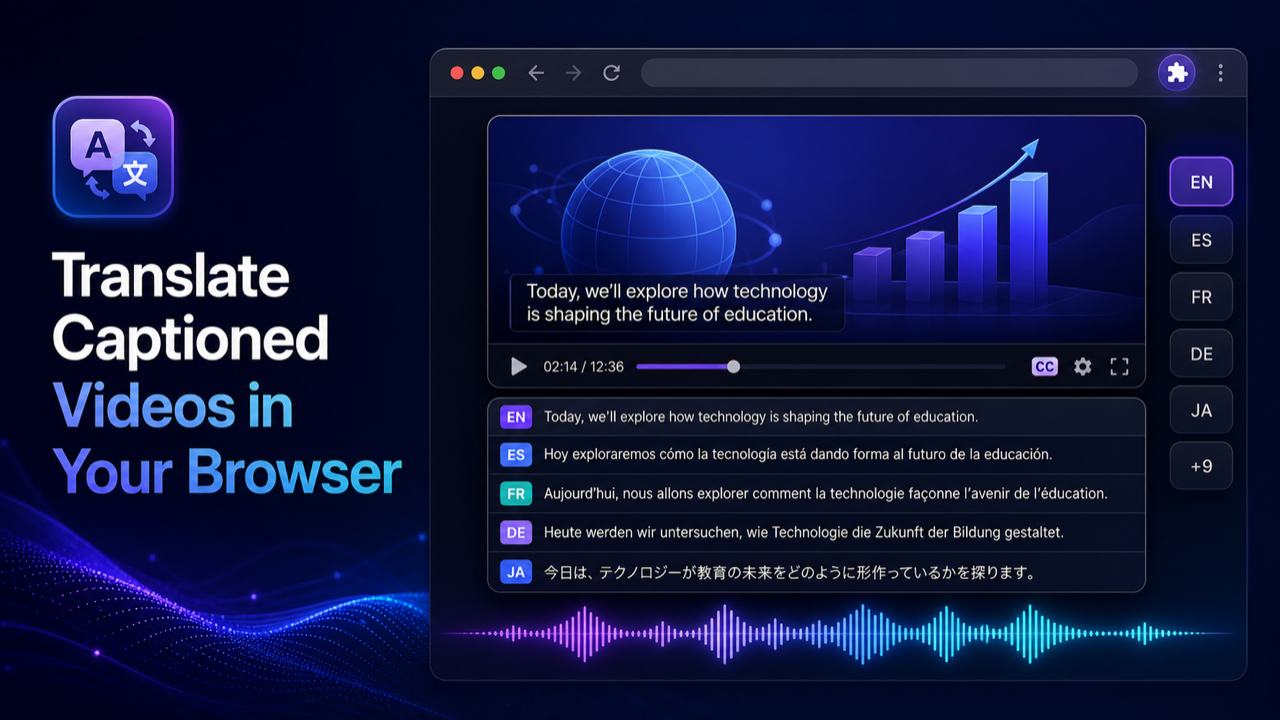
If you want to translate video to French while you watch it, the fastest route in Chrome is to start from the video's captions. Turn the English captions on, translate them into French, and play a French voice track in sync with the player. That is what Unlimited Universal Video Translator does. It never touches the video file: the extension reads the caption track, translates it, generates speech, and plays that speech over the original audio, which it turns down.
Below: what the video needs, the steps, and the French-specific problems to expect before you rely on a machine translation for a lesson or a talk.
What you need first
- Chrome on a desktop or laptop. Mobile browsers are not supported.
- A video with captions. Uploaded or auto-generated captions both work, as long as the extension can detect the track. If a video has no captions at all, there is nothing to translate.
- A regular HTML5 player. Tested and working: YouTube, YouTube Shorts, Udemy, Coursera, edX, TikTok, TED, Vimeo, Khan Academy, gamedev.tv, Zenva and Domestika. Many other captioned HTML5 players work too. If your site isn't on that list, try it, but I can't promise it will work.
The free setup needs no account. It uses Standard mode, Google Translate for the text, and Piper speech generation running on your device inside the extension, so speech generation is not sent to a remote TTS service.
How to translate video English to French, step by step
- Install the extension from the Chrome Web Store and open the English video you want to watch.
- Turn on the English captions in the player (the CC button, or the captions menu on course platforms).
- Click the Dub button that appears on the video.
- In the on-video controls, set the target language to French.
- Choose the mode, the translation engine and the voice.
- Press play. The French speech track follows the player, and the English audio stays audible at a lower volume underneath.
You can also show the translated French subtitles on screen. It helps if you are learning French and want to read the words the voice is saying, or if the voice mispronounces a name and you want to see what was meant.
For a broader look at how the extension behaves on different sites, see how a video translator extension works in Chrome.
Choosing a French voice
Voice availability depends on the engine you pick and, for some options, on the voices installed on your system. The free local voice catalog does not cover every language and voice style, so open the voice list after selecting French and see what is offered there. Don't assume a particular French voice will be present.
If the free list does not give you a French voice you like, PRO adds premium local voices, cloud voices, and browser or OS voices. There is also an optional "Free Online" voice, but you have to choose it explicitly and it needs an internet connection.
What changes when English becomes French
Most of what goes wrong in an English-to-French dub comes from a handful of places.
Tu or vous
English has one "you". French has two: tu for friends, children and informal settings, vous for strangers, formal situations and groups. A caption line like "you should save your file" does not tell the engine which one to use, so the choice can drift between lines, or land on the familiar tu in a formal lecture.
Plain Google Translate does not let you set the register. PRO includes LLM translation and BYOK AI providers, which are worth trying when a consistent vous matters, such as in a university course or a corporate training video. For casual YouTube content the mix-up is usually a small oddity you stop noticing.
French runs longer than English
French sentences usually need more words and syllables than their English originals. "Click save" turns into something like "cliquez sur enregistrer". The dubbed speech still has to line up with the video, because each translated line belongs to a caption that has a start and end time.
Fast English speakers are where you notice it. A presenter who packs a lot into a short caption leaves the French voice a longer sentence for the same slot. Slower lectures and tutorials sound more natural. If a passage gets hard to follow, turn on the French subtitles and read along.
Idioms, names and technical terms
Idioms sometimes get translated word by word, so "it's a piece of cake" may come out as an actual cake. Product names, variable names and people's names may be translated when they shouldn't be, or read aloud with French pronunciation rules. On coding courses you may hear a function name treated as an ordinary French word. The code on screen usually tells you what was meant.
The captions set the ceiling
The French you hear is only as good as the English captions underneath. Auto-generated captions sometimes mishear words, drop punctuation or merge two sentences, and the translation inherits those errors. When a line sounds wrong, glance at the English caption first. On YouTube you can also compare against the player's own text translation under Settings (the gear) > Subtitles/CC > Auto-translate, which turns the caption track into French text without a voice.
What the extension does not do
It does not transcribe videos that have no captions, clone the speaker's voice, or match lip movements. It does not import or export SRT/VTT files, render or download a translated video, or accept uploaded local files. It does not read text burned into the picture, and it does not work on DRM-protected streaming services such as Netflix or Prime Video, on live streams, or on mobile browsers.
If you need a finished French video file to publish, this extension won't produce one. It is built for watching.
FAQ
Can I translate English video to French for free?
Yes, if the video has captions the extension can detect. The free path uses Google Translate for the text and on-device Piper speech generation, with no account. Whether a French voice is available on the free path depends on the engine, so check the voice list after choosing French.
Does it work on YouTube videos without uploaded subtitles?
It works when YouTube provides auto-generated captions, which exist for many videos. Turn them on in the player, then click Dub. If a video has no caption track at all, neither uploaded nor automatic, the extension cannot translate it.
Can I get French subtitles instead of a voice?
Yes. The extension can show the translated subtitles on screen along with the dubbed track. On YouTube, the built-in Auto-translate option also gives you French text subtitles without any extension.
What about the other direction, French to English?
The same workflow runs in reverse: turn on French captions and choose English as the target. English voices are available on the free path. There is a separate walkthrough on how to translate a French video to English.
Other ways people search for this
Some people look for a way to translate English video to French when they are studying the language and want to hear a familiar lecture in French. Others simply want a course recorded in English to be easier to follow in their first language. Either way, the method above is the same: captions on, French selected, Dub pressed.