
How to Translate Korean Video to English in Chrome (Free)
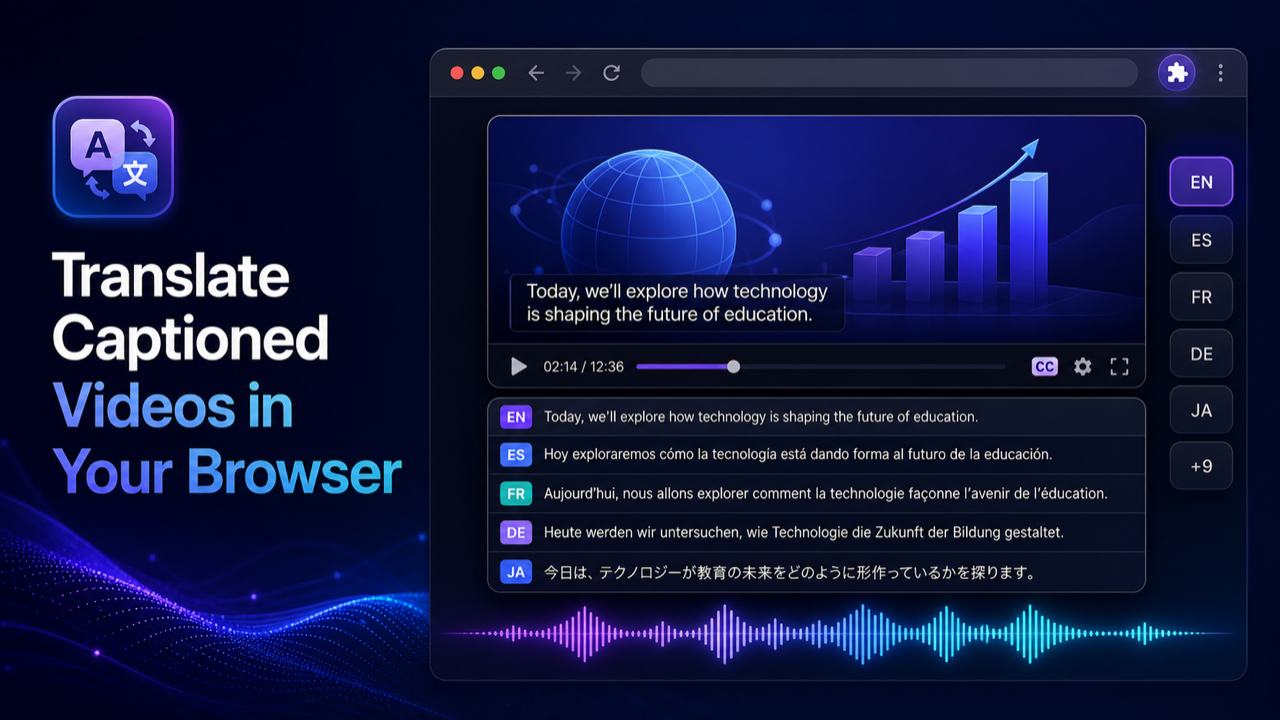
If the video has Korean captions you can switch on, you can translate Korean video to English inside Chrome without downloading or re-uploading anything. The extension reads the caption track, translates it, and plays an English voice in sync with the player, with the Korean audio lowered underneath. You can also show English subtitles. If the video has no captions at all, this method has nothing to work from, so check that first.
What you need first
- A caption track the player can show. The extension works from text the player already exposes. It does not listen to the audio, so it cannot produce a transcript of a video that has none. On YouTube, look for the CC button or check Settings (the gear) > Subtitles/CC. Many Korean uploads have auto-generated Korean captions even when the creator did not add any.
- Chrome on a desktop or laptop. It is a Chrome extension and does not run in mobile browsers.
- A player the extension can read. Unlimited Universal Video Translator has been tested on YouTube, YouTube Shorts, TikTok, Udemy, Coursera, edX, TED, Vimeo, Khan Academy, gamedev.tv, Zenva, and Domestika. Many other HTML5 players with caption tracks work as well. If your site is not in that tested list, try one video before you count on it.
Step by step: how to translate Korean video to English
- Install the extension from the Chrome Web Store.
- Open the Korean video and turn on its Korean captions in the player. Do this before anything else, because the extension picks up the track the player is showing.
- Click the Dub button that appears on the video.
- In the on-video controls, set the target language to English, then pick the mode, the translation engine, and the voice.
- For the free setup, choose Standard mode, Google Translate, and a local Piper voice.
- Press play and watch the first minute. The English line should start when the Korean speaker starts, not a beat later. If you also want to read along, turn on translated subtitles.
You translate video from Korean to English on the page you are already watching, so there is no file to export and nothing to render.
Can you translate Korean video to English free?
Yes, on the free path. Standard mode uses Google Translate for the text and an on-device Piper voice for the speech, and it needs no account. The speech is generated inside the extension rather than sent to a remote text-to-speech service. The caption text itself does go to Google Translate, since that is the translation engine. English voices are available on the free path, so a Korean to English translation video setup costs nothing.
There is also an optional "Free Online" voice. It is a separate choice you make in the voice list, and it needs an internet connection.
PRO adds real-time mode, premium local voices, cloud voices, browser and OS voices, LLM translation, and bring-your-own-key AI providers. An LLM engine can help with the Korean problems described below, because it reads more context than a line-by-line machine translation, but the free setup is a reasonable way to judge whether a given video works at all.
Subtitles or dubbing
Both options come from the same Korean caption text.
English subtitles keep the Korean audio at normal volume. They make sense when tone matters, as in interviews, variety shows, and drama clips, or when you want to compare a name or a term against the original Hangul.
English dubbing plays a generated English voice timed to the caption segments while the Korean audio ducks underneath. It does not change the video file or move anyone's lips. It is an extra audio layer on the page. For a long lecture or a tutorial where you want to look at the screen instead of reading, this is usually easier.
What goes wrong in Korean to English video translation
Korean and English differ in ways that produce the same kinds of errors again and again. Knowing them makes it easier to spot a bad line.
Speech levels and honorifics
Korean marks the relationship between speaker and listener in the verb ending. The formal 합니다 style, the polite 해요 style, and casual 반말 all turn into the same neutral English sentence. When a junior employee speaks to a manager, or when two characters switch from polite to casual speech because they have grown closer, the English line loses that shift.
Address terms have the same problem. 선배 (a senior at school or work), the suffix 님, and 씨 after a name carry social weight that English titles do not match. Machine translation often drops them or turns them into "Mr." or a bare first name. If a scene depends on someone pointedly using, or not using, an honorific, keep the Korean audio audible or read the subtitles alongside it.
Dropped subjects
Korean often leaves out the subject and object when context makes them clear, so a conversation can go on for several lines without anyone saying "I" or "he." Caption tracks cut speech into short segments, and each segment gives the translator little context. The result is pronouns that flip from line to line: "I" in one line, "you" in the next, about the same person. When the English stops making sense, a guessed pronoun is often the cause.
Sentence endings and split lines
Korean puts the verb at the end of the sentence, and negation and tense come with it. If the caption track breaks one sentence across two segments, the first English line can read as a complete statement that the second line then reverses. Give it a second before deciding what the speaker meant.
Spacing and homophones in auto-captions
Auto-generated Korean captions sometimes get word spacing wrong, and in Korean spacing can change which word you are reading. Many technical terms are Sino-Korean words written only in Hangul, and several unrelated words can share one spelling. Whatever the caption says is what gets translated, so a small error there becomes a wrong English word. Creator-written Korean captions are usually cleaner than auto-generated ones when both are offered.
Names, slang, and wordplay
Korean names can be read as ordinary words and translated literally. Internet slang, shortened words, and puns in variety shows often get lost, so you will usually get the meaning of a joke but not the joke itself.
Where it will not work
The biggest one for Korean content is burned-in text. Variety shows and many clips put large, colorful captions straight into the picture. That text is part of the image, not a caption track, and the extension does not read on-screen text. If the only Korean you can see is painted onto the video, there is nothing to translate unless the player also offers a real caption track.
K-drama on Netflix, Prime Video, and other DRM-protected services is out of scope. So are videos with no captions (the extension does no speech recognition), live streams, mobile browsers, and local files. It also does not do lip sync or voice cloning, does not import or export SRT or VTT files, and does not save a translated video file.
Only need English text? YouTube can do that
On YouTube, you can also turn a Korean caption track into English text with no extension: Settings > Subtitles/CC > Auto-translate > English. That gives you English subtitles but no English voice. The extension is for when you would rather listen than read, or want both.
Related guides
For the general method with other source languages, see how to translate a video to English. For YouTube-specific details, the YouTube video translator guide covers that platform. If you are working from Mandarin or Japanese, the problems are different: see translating a Chinese video to English and translating a Japanese video to English. Going the other way, from English lectures into Korean, is covered in the English video to Korean translator guide.
FAQ
Can it translate a Korean video that has no captions?
No. It translates an existing caption track and does not transcribe audio. If the player shows no Korean or other captions for the video, there is nothing for it to read. Check the CC button and the Subtitles/CC menu first, because many Korean YouTube videos have auto-generated captions even when the uploader did not add any.
Does the Korean audio stay on?
Yes. With subtitles only, it plays at normal volume. With dubbing, the Korean audio is turned down underneath the English voice rather than removed, so you can still hear tone, laughter, and background music.
Will it work for a K-drama on Netflix?
No. Netflix and other DRM-protected streaming services are out of scope. The extension works on captioned HTML5 players such as YouTube, Vimeo, TED, and course platforms like Udemy and Coursera.
Can I save the translated video?
No. The English audio and subtitles play on the page while you watch. It does not create a new video file or export subtitles.
Other ways people search for this
People looking for a video translator Korean to English often also search for "korean video to english translation" or "video translate korean to english." They usually want the same thing this page describes: the Korean speaker, understood in English, while the video plays.
Other searches are phrased as "translate video korean to english," "translate korean to english video," or "translate a video from korean to english." The method does not change with the wording. Turn on the Korean captions, click Dub, and choose English.