
Video Translator Extension: Dubbing and Subtitles in the Player
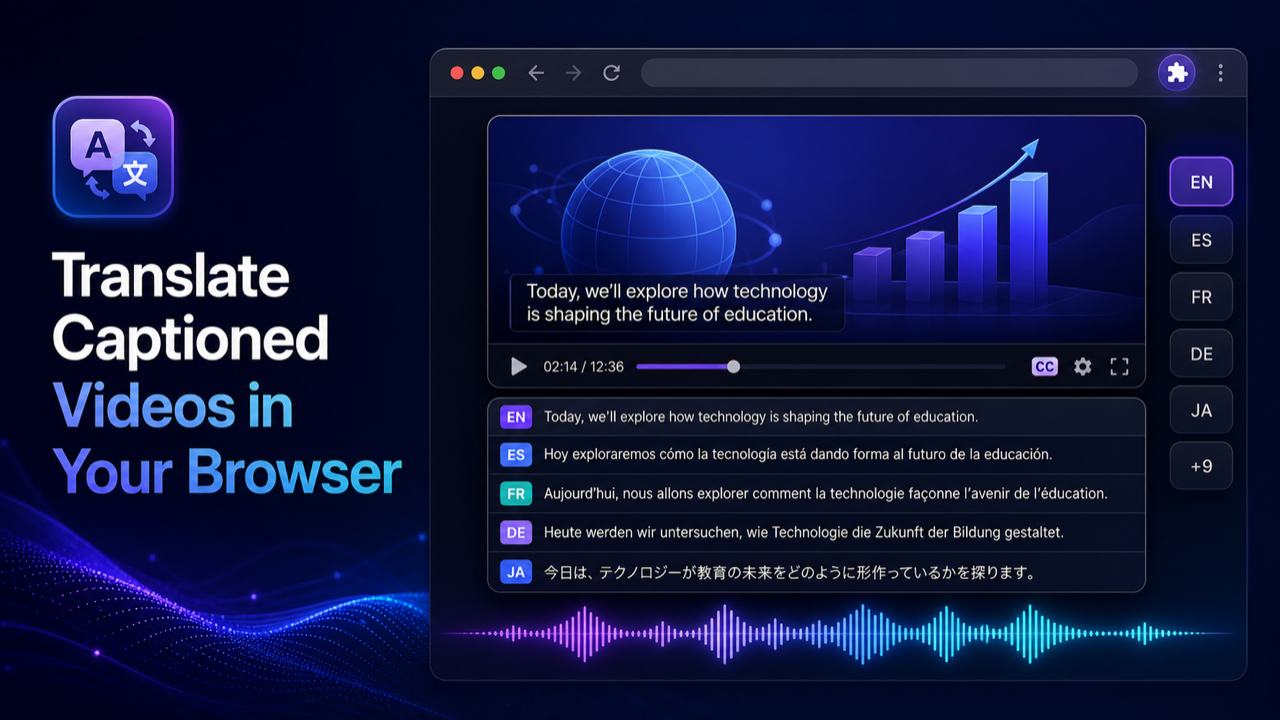
A video translator extension puts the translation controls on the video you already have open. Install once, open a captioned video, click the floating Dub button, and the lecture or tutorial gets spoken in your language while the original audio drops down underneath. Nothing is uploaded, nothing is exported, and there is no second app to switch to.
That is a narrower job than most people expect, and the boundaries are the interesting part. This page covers what a video translation extension actually reads, what it can do while playback is running, and where it stops working. If you want the install path and browser requirements, the Chrome extension guide has those.
What the extension does, step by step
Unlimited Universal Video Translator runs inside the browser tab. Four steps, in this order:
- Detect the caption track the page exposes.
- Translate that text into the language you picked.
- Speak the translated text with a text-to-speech voice.
- Time that speech to the player and duck the original audio.
Every step after the first one depends on the first one. So it is worth being blunt about what an ai video translator extension of this type really is: a caption translator with a synthetic voice on top, running per video, with its own language and voice settings saved for each one.
Captions supply the text
People look for a speech translator chrome extension or an audio translator chrome extension expecting something that listens to the sound and transcribes it. This one does not. The current release has no speech-to-text stage and no automatic transcription step, so nothing here turns a waveform into text.
The generated voice is the output side. Calling it a voice translator extension is half accurate: you hear a synthetic voice, but what feeds that voice is caption text the page already publishes. No captions, nothing to translate. If the Dub button never appears, turn captions on in the player and reload. That single step clears up most failures.
One more distinction worth making, because the searches blur together: a speech translator extension of this kind handles what is being said in the video. It does not translate text burned into the picture, such as slides or code on screen.
Dubbing or translated subtitles
You choose per video, and the two are not interchangeable.
Dubbing generates a spoken track from the translated captions, plays it over the video, and lowers the original audio so the two do not fight. It is the right choice when you need your eyes on a screen recording, a whiteboard, or an IDE.
Translated subtitles show the same translated text as a separate subtitle layer with no generated audio. Faster to start, and better when you want to keep the original speaker's voice, or when you are checking terminology and want to read the exact wording. On dense technical material I usually run both at once.
What live and real time mean here
This is where wording gets oversold across the whole category, so here is the honest version.
Standard mode translates the caption track and builds a synchronized audio track before playing it. The wait before playback depends on video length, how many caption segments there are, which voice you chose, and how fast your machine is. Once the track is prepared, it follows play, pause, and seek.
Realtime mode is a PRO option on supported engines. It generates speech closer to playback instead of preparing the full track up front, which cuts the initial wait. It still has to detect captions, translate upcoming segments, generate the speech, and keep it aligned with the player, so it is lower latency rather than zero latency. Searching for a real time translator extension or a real time translation chrome extension will get you plenty of pages promising instant results; what this one promises is a shorter start-up delay on compatible engines.
The same applies to anything sold as a live translator extension, a live translation extension, or a live audio translation extension. Those are all names for the same caption-driven workflow. A stream broadcasting right now is a different matter, and dubbing one is not a promised use case, because streams frequently expose no caption track the extension can detect. The real-time mode comparison breaks the two modes down further if you are choosing between them.
Translating audio to English
English is the most common target, and the flow is the same as any other language. Pick English in the language selector, choose dubbing or subtitles, and play. Anyone hunting for a translate audio to english extension should know the constraint up front: the source video still needs captions in its own language, whether creator-supplied or automatic. The extension translates that text to English and speaks it; it cannot recover English from a caption-free upload. There is a dedicated walkthrough in translate video to English.
Install and use it
- Add the extension to Chrome from the Chrome Web Store.
- Open a video that has captions: YouTube, a Udemy or Coursera lecture, or a standard HTML5 player.
- Turn captions on in the player if they are off, so the track can be detected.
- Click the floating Dub button on the video and pick a target language, mode, speech engine, and voice.
- Press play. The translated speech is generated, synced, and played with the original audio ducked. Switch to translated subtitles if you would rather read.
No account is needed to start, and settings are kept per video, so two tabs do not overwrite each other's language.
Free versus PRO
The free path covers the whole workflow on its own. Google Translate handles the caption text with no API key, an on-device voice that runs inside the extension speaks it, and you get AI dubbing or translated subtitles with no watermark and no forced upload.
PRO is for people translating video every day. It adds LLM translation for context-aware phrasing, premium local voices, cloud voices for wider language coverage, realtime mode, and bring-your-own-key support for your own provider. If you have been comparing an ai video translator chrome extension against an ai auto translate video extension on features alone, the practical split here is simple: translation quality and voice quality are what PRO buys, and the free path already gets you understanding the video. Free Video Translator lays out exactly where the free line sits.
Where it stops
- Captions are required. No captions, live streams, and DRM-protected videos may not work.
- Captions must be detectable. A player can show subtitles visually without exposing them in a form the extension can read.
- Free voices are limited. The on-device catalog does not cover every language and voice style; premium and cloud voices extend it on PRO.
- There is no export. The dub and the subtitles are part of watching in the browser, not a rendered file you can download.
- Privacy depends on the engine. The video file is never uploaded, and local speech generation stays on your device, but Google Translate, cloud voices, and LLM providers each receive the caption text they need.
If you need a finished translated video to publish, use an upload-and-render tool instead. If you need to understand a course or a tutorial while you watch it, this is the closer fit. How to translate a video walks the caption-first process end to end.
Frequently asked questions
Is there a free video translator extension?
Yes. The free path uses Google Translate plus an on-device voice, with no account and no watermark. PRO adds LLM translation, premium and cloud voices, and realtime mode.
Does it work without subtitles?
No. It translates the caption track the page exposes. There is no speech-to-text in the current release, so a caption-free video cannot be dubbed.
Can it translate a live stream or a video call?
That is not a promised use case. Live streams frequently expose no usable caption track, and the extension needs one.
Which sites does it work on?
YouTube, standard HTML5 players, and course platforms like Udemy and Coursera, wherever the page provides captions the extension can detect. Translating Udemy courses covers the course-platform case in detail.
Is an ai video translator chrome extension slow to run?
It only activates on videos you choose to dub, and it works from caption text rather than the video file, so the overhead is small. On the free path the voice is generated locally in your browser.
Can I download the dubbed video?
No. The translated audio and subtitles exist during playback in the browser and are not exported as a file.
Other ways people search for this
Same tool, different phrasing. People land here looking for a live translation plugin, a live translate extension, a translate videos extension, a video translate extension, and an auto translate video chrome extension. All of those describe the browser-based, caption-driven dubbing and subtitle workflow above, with the same requirement: the video needs captions the extension can detect.