
Translate Video to Spanish: Dubbing and Subtitles in Chrome
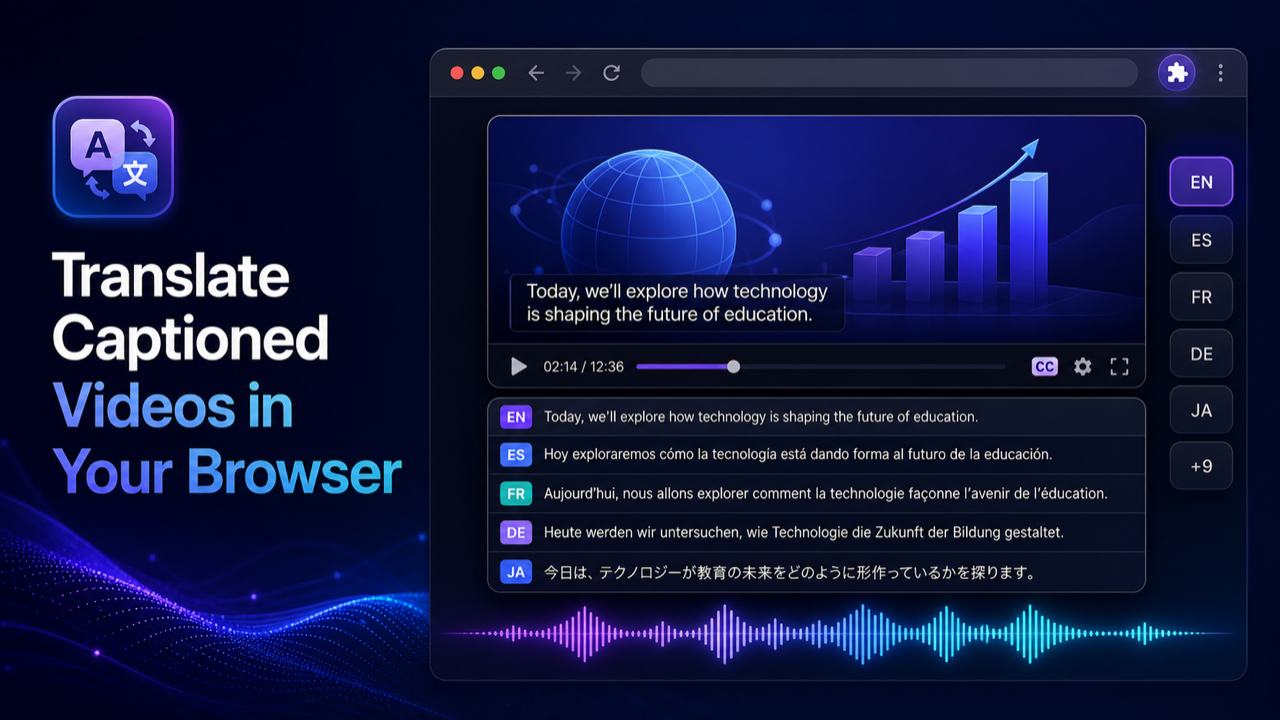
To translate video to Spanish in the browser, you first need a caption track on the video. If the player has captions, a Chrome extension can translate that text, speak it in Spanish over the original audio, and show Spanish subtitles while the video keeps playing on its own site. If the video has no captions at all, this method has nothing to translate.
The usual situation is an English course lecture, a conference talk, or a tutorial open in another tab that you want to follow in Spanish now.
What you need
- Desktop Chrome. Mobile browsers are not supported.
- A video with captions or subtitles the player can show: creator-uploaded, auto-generated, or a caption track built into the page's HTML5 player.
- The Unlimited Universal Video Translator extension.
No account is needed for the free path. That path uses Standard mode, Google Translate for the text, and Piper speech generation that runs on your device inside the extension, so the audio is not produced by a remote speech service.
How to translate a video from English to Spanish, step by step
On a site where the player exposes captions, this is how to translate a video from English to Spanish:
- Open the video and turn captions on in the player. English captions are the usual source, but the source can be another language too.
- Click the Dub button that the extension places on the video.
- In the on-video controls, choose Spanish as the target language.
- Pick the mode (Standard is the free one), the translation engine, and a voice.
- Press play. The extension translates the captions, generates a separate Spanish speech track, syncs it to the player, and plays it with the original audio turned down underneath.
- If you also want to read along, switch on translated subtitles.
The same steps translate english video to spanish on a lesson, a talk, or a short clip. The video stays on its page. Nothing gets rendered, downloaded, or uploaded, so there is also no translated file to keep afterwards.
Picking a Spanish voice
Voice availability for Spanish depends on the engine you select and, for browser and OS voices, on what is installed on your system. The free local voice catalog does not cover every language and voice style, so open the voice list after choosing Spanish and see what it actually offers on your machine. English target voices are available on the free path; for Spanish, check the list rather than assuming.
PRO widens the choice: real-time mode, premium local voices, cloud voices, browser and OS voices, LLM translation, and bring-your-own-key AI providers. There is also an optional Free Online voice. It is something you pick on purpose, and it needs an internet connection.
Where this works
The extension has been tested on Udemy, Coursera, YouTube, YouTube Shorts, edX, TikTok, TED, Vimeo, Khan Academy, gamedev.tv, Zenva, and Domestika. Many other sites with captioned HTML5 players work as well. A site that is not in the tested list may or may not work; the quick check is whether its player shows captions you can switch on.
For course platforms there are separate walkthroughs: how to translate Udemy courses and how to translate Coursera courses.
YouTube
YouTube has its own built-in option for text. With captions on, open Settings (the gear), then Subtitles/CC, then Auto-translate, and choose Spanish. That gives Spanish subtitles but no Spanish audio. The extension adds the spoken track on top of the same caption data. The YouTube-specific details, including what to do when Auto-translate is missing, are in the guide to translating YouTube videos into Spanish.
What English to Spanish video translation gets wrong
In English to Spanish video translation, the machine output is usually grammatical. The trouble comes from choices English never makes you state.
Tú or usted
English "you" has no formality level. Spanish puts it into the verb: haz clic (tú) against haga clic (usted). The translator gets no hint from the English, and because caption lines are translated in short pieces, the register can flip from one line to the next. Watch the first minute before committing to a long lecture.
Which Spanish
Spain and Latin America differ in everyday nouns (ordenador and computadora, móvil and celular, coche and carro) and in the plural "you" (vosotros in Spain, ustedes across Latin America). Machine output often lands on a flattened, fairly neutral register. This is a question of translation register, not a setting in the extension. A neutral Latin American style tends to suit viewers in Latin America, while a viewer in Spain may notice the missing vosotros. An engine with more context, such as the LLM translation in PRO, may keep the wording more consistent, but read the output either way.
Borrowed tech words
Spanish-speaking developers say framework, commit, bug, and plugin in English. A literal pass may turn bug into insecto or framework into marco de trabajo. When a step stops making sense, compare it with the original English caption.
Length
Spanish usually needs more characters than English for the same sentence. Dubbed lines can run a little past the speaker, and subtitles get less screen time per word. Slowing playback on dense sections helps with both.
Names and labels
Product names, people's names, and on-screen commands sometimes get translated when they should stay as they are. If a step refers to a button label, check it against the original caption.
Limits worth knowing before you start
The extension translates caption text and speaks it. It does not transcribe audio, so videos without captions are out of reach. It also does not do lip sync or voice cloning, does not import or export SRT or VTT files, does not render or download a translated video, cannot take a local file upload, and does not read text burned into the picture, such as slide titles or code on screen. DRM-protected streaming services like Netflix and Prime Video, live streams, and mobile browsers are not supported.
Going the other way
If the video is in Spanish and you want English, the same steps apply with the languages swapped. The notes on Spanish auto-captions and regional accents from that side are in translate Spanish video to English.
FAQ
How do I translate video to Spanish free?
Install the extension, turn captions on in the player, click Dub, and choose Spanish with Standard mode and Google Translate. That path is free and needs no account. Whether a free Spanish voice is available depends on the engine and your system, so check the voice list.
Can I translate videos to Spanish if they have no subtitles?
Not with this extension. It works from the caption track, and it does not run speech recognition on the audio. If the player cannot show captions for a video, there is no text to translate.
Is the Spanish voice synced to the video?
The extension generates a separate speech track and keeps it synced to the player, with the original audio lowered underneath. Because Spanish sentences often run longer than English ones, a line may finish slightly after the speaker, especially in fast speech.
Will it produce Latin American or European Spanish?
Neither exactly. Machine translation tends toward a neutral register. For viewers in Latin America or in Spain, read a minute of the output first and judge whether the wording and tú or usted choice suit them.
Other ways people search for this
People who want to translate videos from english to spanish often phrase it as translate video english to spanish or translate english to spanish video, and some simply type video english to spanish. They are all asking for the same thing described above: captions on, Dub, Spanish as the target.
Others search for an english video to spanish translator or a video translator english to spanish, meaning a tool that works on top of the player rather than a service that returns a new file. That is how this extension works. People who ask how to translate a video from english to spanish without paying, or who type translate video from english to spanish free or translate video to spanish free, want the Standard mode path from the steps above.