
Translate French Video to English: Subtitles or a Synced Dub
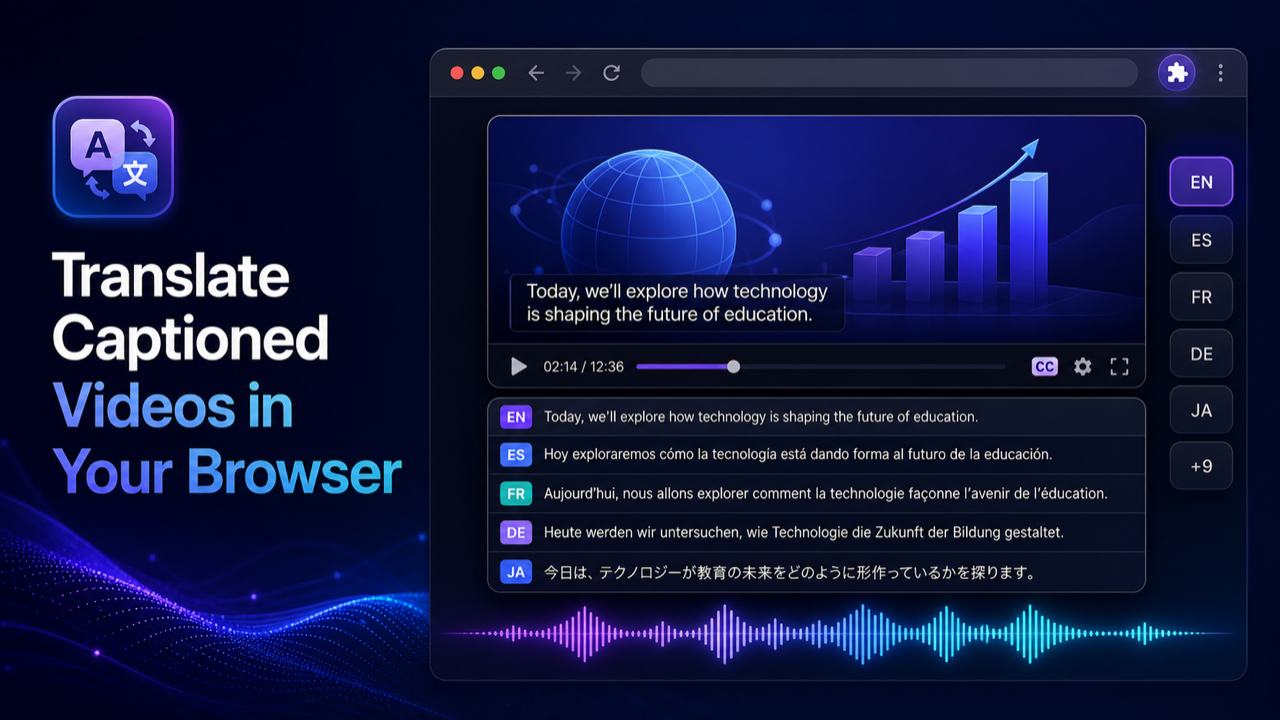
To translate French video to English while you watch it, you need two things: a video that has French captions, and a tool that can read those captions and turn them into English. The Chrome extension Unlimited Universal Video Translator does this on the page where the video already plays. It translates the caption text, generates an English speech track, syncs it to the player, and plays it over the original audio turned down low. You can also show the English subtitles on screen. Nothing gets uploaded and no account is needed for the free path.
The one hard requirement is the captions. The extension does not listen to the French audio and write a transcript. If the video has no caption track, it has nothing to work from.
What you need before you start
- Chrome on a desktop or laptop. Mobile browsers are not supported.
- A French video with captions the player exposes: subtitles uploaded by the creator, or auto-generated captions from the platform.
- The extension installed from the Chrome Web Store.
Platforms where it has been tested and works: YouTube, YouTube Shorts, Udemy, Coursera, edX, TikTok, TED, Vimeo, Khan Academy, gamedev.tv, Zenva and Domestika. Many other HTML5 players with caption tracks work too. A site that is not on that list is untested, so it may or may not work.
On YouTube, French videos often have auto-generated French captions even when the creator didn't upload any. Click the CC button, or open Settings (the gear) > Subtitles/CC and pick French. If the only option is a translated track, pick the French original instead; the extension does the translation itself.
How to translate a video from French to English, step by step
- Open the French video and turn on its French captions in the player.
- Click the Dub button that appears on the video.
- In the on-video controls, set the target language to English.
- Pick Standard mode, Google Translate as the engine, and one of the free local English voices.
- Press play. The English voice follows the captions, and the French audio keeps playing quietly underneath.
- Turn on translated subtitles if you want to read along, or to check a name or a number against what you hear.
Watch the first minute with some care. If names, brand terms or numbers come out wrong, the problem is almost always in the French captions, not in the translation step.
Can you translate video from French to English free?
Yes. To translate video from French to English free, use the Standard mode described above. Google Translate handles the text, and speech is generated on your computer by Piper, which runs inside the extension. That speech generation is not sent to a remote TTS service. Google Translate does receive the caption text when you select it as the engine; the video file itself never leaves the page. There is also an optional "Free Online" voice, which you have to choose explicitly and which needs an internet connection.
English voices are available on the free path, so French to English is one of the easier pairs to run for free. Voice availability still depends on the engine you select and on the voices installed on your system, so check the voice list in the controls.
PRO adds real-time mode, premium local voices, cloud voices, browser and OS voices, LLM translation, and bring-your-own-key AI providers. LLM translation is worth trying when context matters, for example when a speaker switches between tu and vous and you want the English to reflect the change in tone.
Subtitles, dub, or both
English subtitles over the French audio keep the speaker's own voice and timing. That suits lectures, interviews and anything where you want to hear how something was said. The downside is that reading and listening at the same time gets tiring over a long video.
A dubbed English track suits tutorials, cooking videos or documentaries you want to follow without staring at the screen. You lose the delivery: a free local voice reads everything in the same even tone, and wordplay that depends on French sound rarely survives. You can also run both at once, the voice for following along and the subtitles for checking.
What goes wrong in French to English video translation
Most errors in French to English video translation come from the captions, or from French grammar that has no English equivalent.
Liaison and fast speech break auto-captions
Spoken French runs words together. "Les amis" is said roughly as "lezami", and "vous avez" as "vouzavez". In fast conversation, auto-captions sometimes cut a word boundary in the wrong place or merge two words into one that doesn't exist. The translation then gets a garbled French word and produces a strange English one. Verb forms add to this: parler, parle, parlez and parlais can sound alike, so an auto-caption may pick the wrong tense. Creator-uploaded subtitles avoid most of these problems. If a video offers both, use the creator's track.
Tu and vous become one "you"
French marks formality with tu (informal) and vous (formal or plural). English has only "you". The distinction disappears in translation, and sometimes it matters: an interviewer who moves from vous to tu partway through, or a teacher using vous with a whole class. Vous can also mean "you all", which English translation often flattens into a singular reading.
Quebec French and France French
Quebec French differs from the French spoken in France in accent, vocabulary and informal expressions. Auto-captions can be less accurate on strong Quebec accents, and machine translation may miss local words. "Char" for car, "blonde" for girlfriend, "magasiner" for shopping, and "fin de semaine" for weekend are common examples. A European French speaker would use different words for most of these, so a literal translation can come out odd.
Gender, negation and idioms
Every French noun has a grammatical gender, so "il" or "elle" can refer to a table or a decision. Translation has to choose between "he", "she" and "it", and sometimes chooses wrong. Negation wraps the verb in two parts (ne ... pas), and in speech the "ne" is often dropped, leaving only "pas". If a caption line breaks in the middle, the fragment can lose the negation. Idioms such as "avoir le cafard" (to feel down) or "poser un lapin" (to stand someone up) may come out literal.
Limits
The extension works with existing captions only. It does not transcribe videos that have no captions, read French text burned into the image, sync lips, clone the speaker's voice, import or export SRT or VTT files, render or download a translated video, or accept local file uploads. It does not work on DRM-protected streaming services such as Netflix or Prime Video, on live streams, or in mobile browsers.
Related guides
For other source languages, start with the guide to translating any video to English. If you need the opposite direction, see how to translate a video into French. Italian has similar caption issues, covered in the Italian to English guide. For French on YouTube specifically, the YouTube to English guide covers captions and auto-translate there. How the AI video translator works explains the translation and speech steps.
FAQ
Can I translate a French video that has no subtitles?
No. The extension reads a caption track and does not recognize speech from audio. If the player shows no French captions, auto-generated or uploaded, there is nothing to translate. On YouTube, check the CC menu first, because many French videos have auto-generated captions even when the creator added none.
Is the English dub free?
Yes. Standard mode with Google Translate and a free local English voice costs nothing and needs no account. Speech is generated on your computer. Real-time mode, premium local voices, cloud voices, LLM translation and your own AI provider keys are part of PRO.
Does it handle Quebec French?
It translates whatever French is in the captions, regardless of accent. The weak point is the captions: auto-captions can be less accurate on strong Quebec accents, and regional words may translate literally. Creator-uploaded subtitles usually give better results.
Can I save the translated video or subtitles?
No. The translation plays in the browser while you watch. It does not export SRT or VTT files, and it does not render or download a new video.
Why does the English sound wrong on some lines?
Usually because the French caption line was already wrong, often from liaison in fast speech, or because a line break split a phrase. Turn on the English subtitles and compare with the French captions to see which step caused it.
Other ways people search for this
Some readers find this page by searching for french to english translation video, usually because they want to watch a French clip with an English voice. Others type french video to english translation or translate video french to english. The task is the same in each case, getting English out of a French video that already has captions, and the steps above cover it.