Why Is YouTube Translating Video Audio? How to Get the Original Back
If you are asking why is youtube translating video audio, the short answer is auto-dubbing: the channel allowed YouTube to generate AI-dubbed audio tracks, and YouTube picked the one that matches your language preference instead of the original. It also remembers that choice, which is why the next video from a dubbed channel may start in the same wrong language.
Your account is fine. Getting the original voice back takes three clicks per video. The harder part is that it keeps coming back, and that audio is only one of four things YouTube can show in a language you didn't pick.
Where the dubbed voice comes from
Creators can let YouTube produce AI-dubbed audio tracks for their videos in other languages. YouTube opened this up to creators broadly across 2025 and 2026, so a channel you have watched for years may now carry voice tracks in languages the creator doesn't speak.
When you open one of those videos, YouTube doesn't necessarily play the audio the creator recorded. It checks your language preference and, if a dubbed track matches it, plays that one. So the question "why is youtube translating videos" has a boring answer: the channel opted in, and YouTube guessed you would rather hear your own language, without asking.
YouTube labels the tracks. Auto-dubbed tracks are marked as such, tracks the creator uploaded are listed separately, and the original carries "(original)" after the language name. Look for that label.
How to switch back to the original audio
On a desktop browser:
- Click the gear icon in the player.
- Open Audio track.
- Pick the entry marked "(original)", for example "English (original)".
If the gear menu has no Audio track entry, the video has only one audio track and YouTube isn't dubbing it. Whatever you're hearing is what the creator uploaded.
How to stop YouTube from automatically translating videos
Viewers get no global switch. You can't tell YouTube "never auto-dub anything for me." The only control you have is the Audio track menu, one video at a time.
So how to stop youtube from automatically translating videos, in practice, comes down to two habits. Switch to the original track whenever a dub starts, because YouTube remembers the preference you show it and applies it to later videos. And make sure your language settings list the languages you actually understand, since that preference is what YouTube matches dubbed tracks against. If your settings say Spanish, YouTube will keep choosing Spanish dubs, and you'll be switching back by hand on every dubbed channel.
Creators do get a channel-wide switch. It's in the creators section below.
Why are my YouTube videos in Spanish?
Three causes cover most cases. From the viewer's seat they look identical, so check them in this order.
The dubbed track was picked from your language preference. Open the gear menu on an affected video. If there is an Audio track entry and the active track is Spanish and not marked "(original)", this is auto-dubbing. Switching the track fixes that video. If only some channels do it, this is almost certainly the cause, because only channels with dubbing enabled have a Spanish track to pick.
Your Google Account or YouTube language is set to Spanish. Look at the YouTube interface itself. If the menus, buttons and sidebar are in Spanish, your language setting is Spanish, and YouTube will keep choosing Spanish tracks and Spanish captions wherever they exist. Fix the setting and the dubbed tracks stop being chosen for you. The step-by-step for this is in change YouTube language to English.
Your location looks Spanish-speaking, often because of a VPN. If the interface is in English but YouTube still behaves as if you live in Spain or Mexico, check whether a VPN is on. YouTube infers a region from your connection, and a VPN exit in a Spanish-speaking country can nudge it toward Spanish content and tracks. Turn the VPN off, reload, and see whether the behaviour changes.
Why are my YouTube videos playing in a different language?
The same three causes apply to any language, not just Spanish: an auto-dubbed track matched to your preference, a language setting you forgot about (or that someone else changed on a shared computer), or a region guessed from your connection. If you ask why are my youtube videos playing in a different language and the answer is "only on some channels," start with the Audio track menu. If it's every video and every menu, start with your account language.
Four things that can be in the wrong language
A lot of the confusion comes from treating "YouTube is in the wrong language" as one problem. It's four separate settings, and fixing one does nothing to the others.
- Interface. The menus, buttons and sidebar. Controlled by your YouTube and Google Account language. See change YouTube language to English.
- Titles. YouTube machine-translates some video titles too, which is a different feature from audio dubbing, with no single toggle. That one has its own page: why does YouTube translate video titles.
- Captions. Chosen with the CC icon and the gear menu under Subtitles/CC. Auto-translate there only appears when a caption track exists.
- Audio track. The subject of this page. Chosen per video under the gear icon, Audio track.
So youtube translating videos can mean translated titles on the home page, translated captions, a dubbed voice, or all three at once. Work out which one you're looking at before changing settings.
For creators: turning automatic dubbing off for your channel
If you run the channel and don't want YouTube dubbing your uploads, you can switch it off in YouTube Studio:
- Open YouTube Studio and go to Settings.
- Choose Channel, then Advanced settings.
- Untick Allow automatic dubbing.
- Click Save.
That checkbox is the only place where auto-dubbing can be turned off for a whole channel.
Why the dubbed track sounds off
A dubbed track is a synthetic voice reading a machine translation of what the creator said, and each half loses something. The translation gets names wrong, flattens jokes that depend on wordplay, and picks the everyday meaning of a technical term when the video meant the specialist one. The voice then reads the result at an even pace, without the creator's timing or sarcasm. You'll notice it first on a tutorial where "branch" means a Git branch, or on a comedy channel built on puns.
For a viewer who doesn't understand the original language at all, a rough dub is still better than nothing. If you understood the original fine, you're getting a worse copy of the same video.
The opposite case: you want a translation and there isn't one
Some people land here from the other direction. They found a video they can't follow, and it has no dubbed track at all because the channel never enabled dubbing.
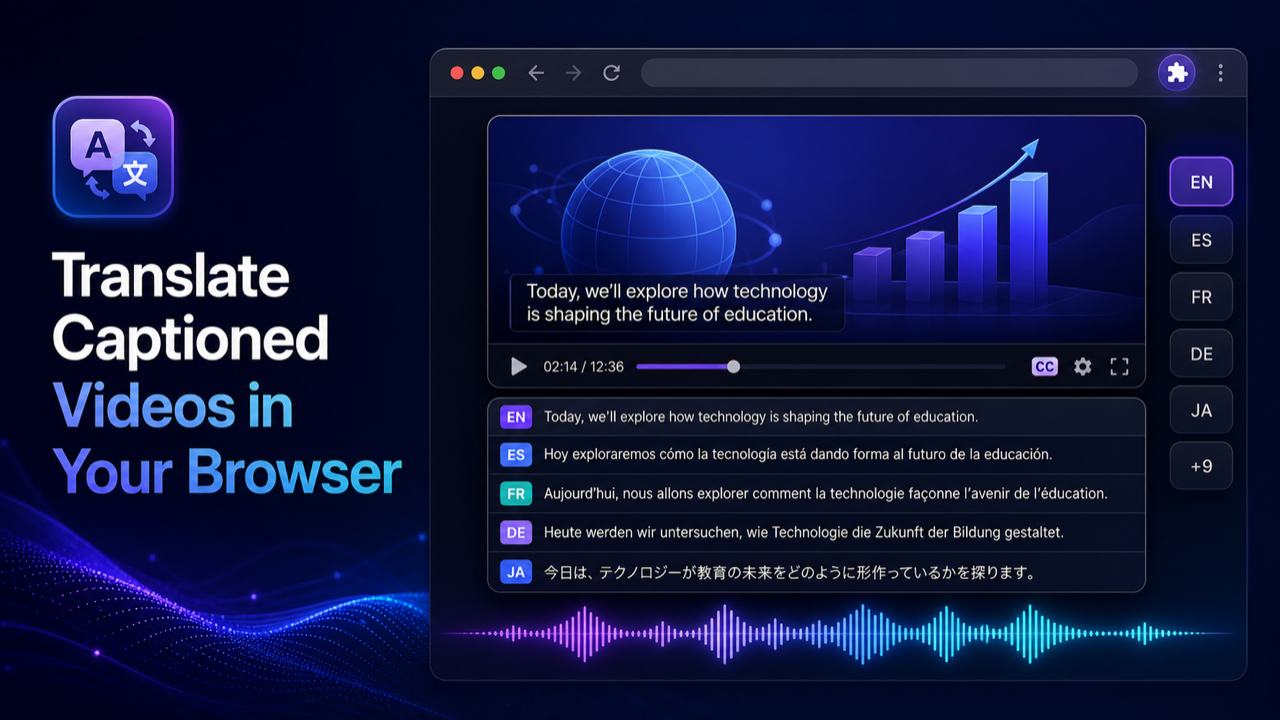
That's the case I build for. Unlimited YouTube AI Video Translator is a desktop Chrome extension that reads the video's existing caption track, translates it, and plays AI speech over the original audio or shows translated subtitles. It needs a caption track to work, so check that the CC icon offers one first. It is not a way to remove YouTube's own auto-dubbing. For that, use the Audio track menu above. The broader overview of viewer-side options is in the YouTube video translator guide.
Related guides
- Why does YouTube translate video titles covers machine-translated titles, a separate feature from audio dubbing.
- Change YouTube language to English walks through the interface and account language settings.
- YouTube subtitle translator explains captions and YouTube's Auto-translate.
- Translate YouTube video to English is for when you want a translation on purpose.
Frequently asked questions
Can I turn off YouTube auto-dubbing for every video?
No. Viewers can't switch auto-dubbing off globally. You change it per video with the gear icon, then Audio track, then the track marked "(original)". Only the creator can turn it off for a whole channel.
Why does the next video start dubbed again after I switched it back?
YouTube remembers your language preference and applies it to future videos that have a matching dubbed track. Setting your account language to the language you actually want reduces how often it happens. Switching to the original track when it does happen tells YouTube what you prefer.
How do I know if a track is auto-dubbed or recorded by the creator?
Open the Audio track menu. YouTube labels auto-dubbed tracks and shows creator-uploaded tracks separately, and the original audio carries "(original)" after the language name.
Does turning off captions stop the dubbing?
No. Captions and audio tracks are separate settings. Turning captions off changes only the on-screen text, and the dubbed voice keeps playing until you pick the original audio track.
Will a VPN change which language I hear?
It can. YouTube infers your region from your connection, and a VPN exit in another country can push it toward that country's language. If the problem started when you turned a VPN on, turn it off and reload the video.