
YouTube Video Translator: Every Method for Watching in Your Language
You found the lecture, the repair walkthrough or the interview you needed, and it is in a language you do not read. Search for a youtube video translator and you get tool listings that all claim the same thing, which is unhelpful, because the methods behind them behave very differently and they do not work on the same videos.
This page is the map. Every way a viewer can translate a youtube video gets a short, honest description here, plus a link to the page that goes deep on it. I build a Chrome extension in this category, so I will say up front which parts of the job it does and which parts it does not touch.
One fact decides most of what follows: whether the video carries a caption track. YouTube's own translation reads caption text. So does every browser extension that works inside the tab, including mine. When there is no caption track there is no text to translate, and a method that worked perfectly on the last video does nothing on this one. That is the single most common reason people conclude that youtube translation is broken.
The methods, in one place
There are five things a viewer can actually do, plus one that only the channel owner controls.
- Turn on YouTube's Auto-translate and read translated subtitles.
- Switch to an alternative audio language the channel uploaded, when one exists.
- Install a browser extension that reads the caption track and speaks a translated voice over the original audio.
- Pull the captions out as text and translate that instead of watching.
- Give up on automatic methods for that specific video, because it has no captions at all.
Everything below expands one of those. Nothing here needs you to download the video, upload a file anywhere, or open a separate site.
Method 1: YouTube's built-in Auto-translate
Check this before you install anything, because it is free and it is already in the player.
On desktop, the CC icon turns captions on. The gear icon opens settings, where Subtitles/CC leads to Auto-translate and then a language list. Pick your language and YouTube machine translates the caption text as the video plays. In the YouTube mobile app the path is the CC icon, then Captions, then Auto-translate, then the language. That is how to translate on youtube without adding anything, and it is the same menu whether the captions were written by the creator or generated automatically from the audio.
Two limits matter. The first is that Auto-translate gives you translated subtitles only. It never produces spoken audio, so you are reading the bottom of the screen for the whole video. The second is that the Auto-translate entry appears only when the video has a caption track at all. If the uploader disabled captions, or automatic speech recognition never ran on the video, there is no Auto-translate row in the menu and YouTube shows no explanation for why. People assume they are looking in the wrong place. They are not; the option genuinely is not there.
So, does youtube auto translate videos? It auto translates the captions of videos that have captions, which is a narrower promise than it sounds. YouTube will auto translate youtube videos into most of the languages in that list the moment a caption track exists, and the automatic translation of youtube videos costs nothing and takes no setup. When the track does not exist, no menu item appears.
Quality is the other half of the story. Auto-translate usually runs on top of an automatic transcript, so any word the speech recognition misheard gets translated confidently into the wrong word. Technical vocabulary, product names and accented speech are where this shows. YouTube subtitle translator covers the subtitle path in detail: the exact menus, what to do when Auto-translate is missing, and how to judge whether the caption track you are reading is trustworthy.
Method 2: audio tracks the channel uploaded
YouTube also supports multi-language audio. A channel can upload additional spoken tracks for a video, and when they exist they appear in the gear menu under the audio track option. Big educational and entertainment channels use this for their main markets.
This is worth separating from everything else on the page, because it is not machine translation. It is the uploader's own dub, usually recorded or reviewed by people, and it is the best-sounding option you will ever get on YouTube. You also cannot do anything to create it. If the channel did not upload an audio track in your language, the menu simply has one audio option and you move on to the next method.
Method 3: a browser extension that dubs and subtitles in the tab
This is the category most people mean when they look for a video translator for youtube: something that makes the video speak your language rather than making you read.
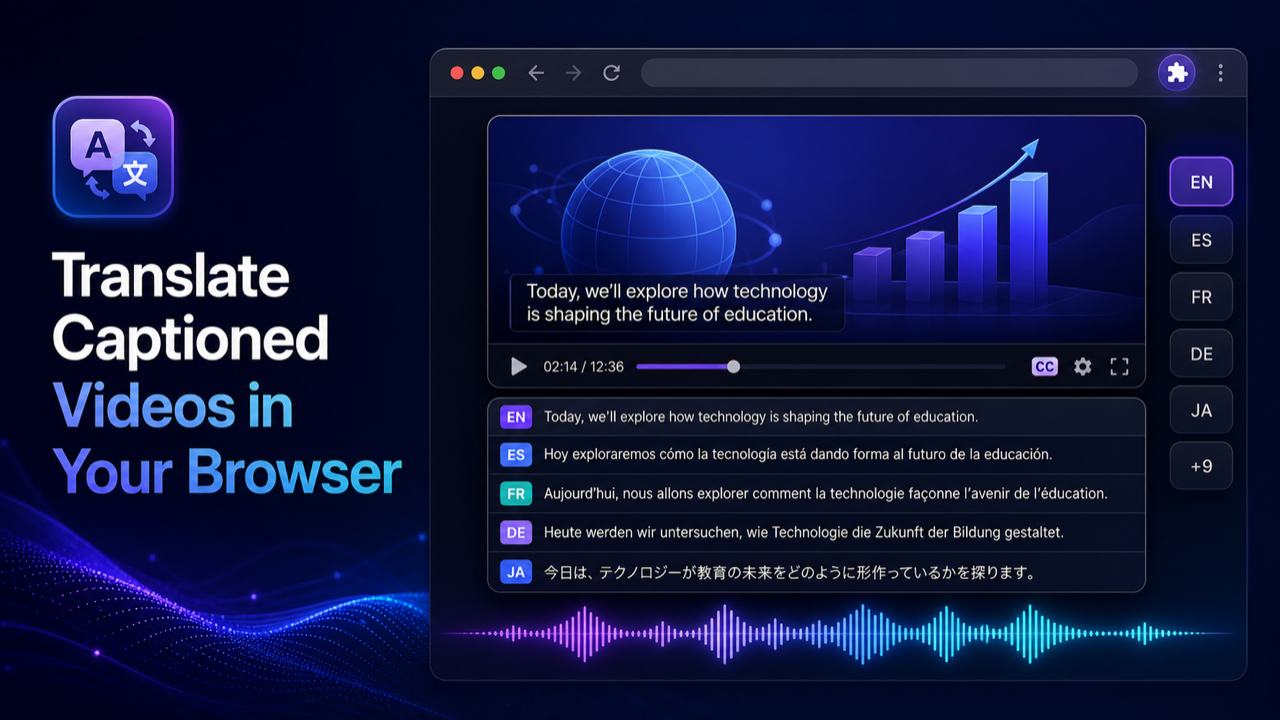
Unlimited YouTube AI Video Translator is the one I build. It runs in desktop Chrome, reads the caption track the video already has, translates that text, and then plays AI text-to-speech over the original audio, shows translated subtitles, or both at once. The video keeps playing where it already was. There is no upload of the video file, no separate player and no export step. Free to start, with a paid tier for unlimited use.
An ai youtube video translator built this way inherits one constraint and gains one capability. The constraint is the caption track again: the extension reads text, it does not transcribe audio, so a video with no captions produces nothing. The capability is voice. YouTube can give you translated text; an extension can read that text aloud while you watch the screen, which is the difference between following a soldering tutorial and pausing every ten seconds to read.
Whether ai translation of youtube videos beats YouTube's own subtitles depends on the source. Both start from the same caption track, so both inherit its transcription errors. What changes is the translation pass and the delivery: a dedicated translator can use a stronger translation model and give you the spoken layer, and you can keep the original captions visible underneath when the speaker is spelling out a command or a proper noun.
Chrome extension to translate YouTube videos is the installation and first-run guide, including permissions, what the first video looks like, and what to check when nothing happens. The broader video translator Chrome extension page covers the same category beyond YouTube, and AI video translator explains what the underlying models do and do not do.
Method 4: get the text out instead of watching
Sometimes you do not want to watch at all. You want the content of the video as text you can read at your own pace, search, quote in notes, or paste into a document.
That is a different output from either subtitles or dubbing, and it is worth naming as its own method because the source is the same caption track. When a video has captions, you can read them as a transcript and translate that transcript. When it does not, you are back to the no-captions problem below. Translate YouTube video to text covers the transcript route, what YouTube's own transcript panel gives you, and where the limits sit. Worth knowing before you start: my extension shows translated subtitles in the player and speaks them, but it does not export a subtitle file or hand you a downloadable transcript.
Method 5: videos with no caption track
This is the case that ruins the most evenings. Music-heavy videos, phone recordings with bad audio, very long uploads, videos in languages YouTube's speech recognition does not cover, and uploads where the channel turned captions off all end up with no caption track. No caption track means no Auto-translate entry and no in-tab dubbing, because both read text that is not there.
There are still things you can do, and they are honest but limited. Translate YouTube video to English without CC is the page for this case, and it spends its length on how to confirm the track is really missing, what else in the page can carry meaning, and which approaches are realistic rather than wishful.
Method 6: live streams
A live stream behaves differently from a finished upload. Captions, when they exist, arrive as the stream runs, which changes what any translator can do with them and how far behind the speaker you end up. YouTube live translation is the page for streams, premieres and the delay you should expect.
Picking a target language
The method is the same for every language; what changes is how good the result sounds and how often the caption track exists in the first place. Three targets have enough people searching for them to deserve their own walkthroughs:
- Translate YouTube video to English is the most common case and the one with the most reliable voices.
- Translate YouTube video to Spanish covers the regional variant question, which affects how natural a dub sounds more than most people expect.
- Translate YouTube video to Hindi covers a target where source caption availability is the real bottleneck.
If your target is not in that list, the process is identical. Pick the language in the menu, and expect the voice quality to track how much text-to-speech work exists for that language. Outside YouTube the same target-language question comes up on every platform, which is what translate a video to English covers.
Translating the audio, and what that phrase actually means
A lot of people search for a youtube audio translator, and the phrase hides an assumption worth pulling apart.
To translate audio of youtube video content the way most people imagine it, software would listen to the speech, transcribe it, translate the transcript, and speak the result. Every browser tool I know of, mine included, skips the first two steps and starts from the caption track. So when you translate youtube audio in the tab, what you are hearing is the caption text, translated and spoken by a text-to-speech voice, played over the original. The original audio is still there underneath at lower volume.
The practical consequence: youtube audio translation is only as good as the captions. When a channel writes its own captions, the result is clean. When the captions came from automatic speech recognition on a noisy recording, the dub repeats those errors out loud. An audio translator for youtube videos that promises to work on any video regardless of captions is describing transcription, which is a different and much heavier job than anything running inside a browser tab. If you want the audio side explained across platforms rather than just YouTube, video audio translator goes into it.
How to translate a YouTube video, step by step
Here is the full sequence for the dubbing route, since that is the method with actual setup. The question how can i translate a youtube video has a two-minute answer the first time and a one-click answer after that.
- Check the caption track first. Open the video, click the CC icon, and confirm captions appear. If nothing turns on, skip to the no-captions page above.
- Install the extension from the Chrome Web Store in desktop Chrome. There is no account step and nothing to configure before the first video.
- Open the video you want. Normal YouTube URL, normal player, normal account.
- Pick your language in the extension panel. This is the language you will hear and read.
- Choose dubbing, subtitles or both. Both together is the best setting for anything technical, because hearing and seeing a term at the same time is how it sticks.
- Start the voice track and press play. Browser speech can begin almost immediately; other voices need the track generated first, which takes a moment on a long video.
Your settings carry to the next video, so the sequence above is a one-time cost. That is the honest answer to how to translate a video on youtube with dubbing rather than subtitles.
For the subtitles-only route there is no step 2 through 6. Gear icon, Subtitles/CC, Auto-translate, language. Done.
Limits worth knowing before you install
I would rather you read this than discover it after installing something.
- A caption track is required. No captions, no translation, on every in-tab method including mine.
- There is no transcription. The extension does not listen to the audio and write down what it hears.
- No lip sync. The speaker's mouth keeps moving to the original language.
- No voice cloning. The dub uses a synthetic voice, not the speaker's own.
- No file import or export. Nothing reads or writes .srt or .vtt, and nothing renders a translated copy of the video you could download.
- No burned-in text. Subtitles that are part of the picture, and on-screen slides, are pixels to an extension. Translate text in video explains that boundary.
- Desktop Chrome only. Chrome for Android has never supported extensions, and Chrome on iOS runs on WebKit with no extension support at all, so there is no mobile install.
That last one disappoints people daily. On a phone, the YouTube app's Auto-translate captions are the realistic option.
Tips that actually change the result
Keep the original captions visible alongside the translated ones when the speaker is dictating code, library names or part numbers. Machine translation mangles proper nouns, and seeing the source string saves you a second search.
Slow the video slightly on dense sections. YouTube's speed control keeps working underneath any of these methods, and a dub at 0.9x is much easier to follow than a dub at normal speed in an unfamiliar subject.
Prefer a specific regional variant of your language when the menu offers one. The difference between a generic voice and a regional one is larger than the difference between two translation engines.
And check whether the channel published its own subtitles before reaching for anything automatic. Creator-written captions beat automatic ones by a wide margin, and everything downstream inherits that quality.
Related guides
Chrome extension to translate YouTube videos is the install guide, and YouTube subtitle translator covers the subtitle layer. Course platforms behave differently from YouTube, which is what how to translate Udemy courses and how to translate Coursera courses are for. Free video translator covers what the free tiers across this category really include, and how to translate a video is the general starting point for video outside YouTube.
Frequently asked questions
How do I translate a YouTube video to English?
For subtitles, open the gear icon, then Subtitles/CC, then Auto-translate, then English. For spoken English over the original audio, install a translator extension in desktop Chrome, set English as the target, and turn dubbing on. Both routes need the video to have a caption track.
Is there a free YouTube video translator?
YouTube's Auto-translate is free and built in, and my extension is free to start with a paid tier for unlimited use. So yes, you can translate youtube video online free for subtitles with no software at all, and try the dubbing route without paying first.
Can I hear the video in my language instead of reading?
Yes, but only through an extension. YouTube's Auto-translate produces text on screen and never speech. An in-tab translator reads the translated caption text aloud with a text-to-speech voice while the original audio plays quietly underneath.
Why does Auto-translate disappear on some videos?
Because that video has no caption track. Either the uploader turned captions off, or automatic speech recognition never produced one, which happens with music-heavy audio, unsupported source languages and poor recording quality. YouTube does not explain the absence; the menu row is simply missing.
Does any of this work on my phone?
Extensions do not, because mobile Chrome does not support them. The YouTube mobile app's own Auto-translate does: tap CC, then Captions, then Auto-translate, then your language. That gives you translated subtitles, not audio.
Will a translator slow the video or change its quality?
No. Everything described here runs alongside normal playback in the browser, so YouTube's quality, speed and playback controls keep working exactly as before. You are adding a layer on top of the player, not replacing it.
Other ways people search for this
The same job gets typed dozens of ways, and the variations are worth explaining because they reveal what people expect before they arrive. Some searches name the tool, some name the action, and some name the outcome.
Tool-shaped searches assume a product exists and go looking for a list of them: youtube translators, a translator youtube result, a video translator youtube page, or a translator for youtube videos. Add the model to the front and the same request becomes youtube ai translator, ai youtube translator, an ai translator youtube query, an ai translator for youtube videos, an ai video translator youtube search, ai translator youtube video, or the plain ai youtube video translator free version of it. Put the model at the end instead and you get youtube video translator ai and youtube video translate ai, which are the same search with the words in a different order. People also write it as youtube ai translate, youtube ai translation, or ai translate video youtube, and occasionally skip the space entirely and type youtubetranslate or translateyoutube into the address bar.
Action-shaped searches describe what you want done: translate youtube videos, youtube translate video, translate video youtube, youtube video translate, or just translate from youtube. The question forms are the honest ones, and they are usually typed by someone who has already tried the menu and failed: how to translate youtube videos, how to translate youtube video, how to translate a youtube video, how to translate videos on youtube, how to translate in youtube, how can i translate youtube videos, can ai translate youtube videos, and the flatly practical ai to translate youtube videos. Some people go looking for capability rather than instructions and search for ai that translates youtube videos or an ai tool to translate youtube video, which is really the same question with more hope in it.
Automation words show up when someone wants the translation to happen without them doing anything: auto translate for youtube video, auto translate video youtube, automatically translate youtube video, ai auto translate youtube video, and the fully spelled-out auto translate youtube video into your language. Those searches map onto the built-in Auto-translate menu more often than people realise, and the answer is usually the gear icon rather than a download.
Outcome-shaped searches name the result: youtube video translation, video translation youtube, translation for youtube videos, youtube to translation, or ai translate youtube video free when budget is the real question. On the audio side the phrasing shifts again, to audio translate youtube video and audio translation youtube video, which describe the dubbing method rather than the subtitle one. A smaller group searches for ai youtube video language translator, which is the most literal description of the whole category anyone has typed.
They all land on the same two questions. Does the video have a caption track, and do you want to read the translation or hear it? Answer those two and the right method on this page is obvious.