
YouTube Subtitle Translator: Auto-translate, In-Tab Subtitles, Your Own Files
Two completely different people type "youtube subtitle translator" into Google. One is watching a video right now in a language they do not read and wants the text on screen to change. The other owns a channel and wants their own video to carry subtitles in five languages so it travels further. Both are reasonable, and neither answer helps the other person at all, so this page keeps them apart.
If you are the viewer, start at the next section. If you run the channel, skip down to the part about uploading your own subtitle files.
Viewer: turn on YouTube's own translated captions
YouTube can translate the caption track for you, inside the player, for free. The desktop steps, in order:
- Click the CC icon in the player bar. Captions appear in the original language.
- Click the gear icon next to it.
- Choose Subtitles/CC.
- Choose Auto-translate.
- Pick your language from the list.
The captions stay on and the text switches to the language you picked. In the YouTube mobile app the path is shorter: the CC icon, then Captions, then Auto-translate, then the language.
Three things about this are worth knowing before you go hunting for a menu that is not there.
Auto-translate appears only when the video has a caption track. That includes YouTube's own automatic speech-recognition track, so plenty of videos qualify without the uploader doing anything. But if the uploader turned captions off, or recognition never ran because the audio is music only, the spoken language is unsupported, or the recording is very long or very noisy, there is no Auto-translate entry. YouTube does not explain why. The menu item is simply absent, which is why so many people conclude the feature is broken.
The language list is long. That length comes from machine translation, not from anyone reviewing the output, so a language being present says nothing about how good the result will be.
It changes text only. Auto-translate never touches the audio. The speaker keeps speaking the original language and you read along underneath. Separately, a channel can upload alternate audio tracks, and when those exist they show up in the gear menu under the audio track control. That is the uploader's own dub, recorded or commissioned by them, not YouTube translating anything.
Why youtube auto translate captions read the way they do
People try youtube auto translate captions, find the result oddly clipped, and assume the translation engine is weak. Usually the engine is fine and the input is the problem.
A caption track is not a document. It is a list of short timed segments, each one sized to sit on screen for a second or two. When that track gets translated, the segments go through more or less as they are, so the translator often works on a fragment that ends mid-clause. Word order that a human would rearrange across a sentence boundary has nowhere to go. Paste the same speech into a translation box as flowing text and you get a noticeably smoother result, because the engine can see where the sentence ends.
The second problem stacks on top when the source is an automatic track. Speech recognition guesses; translation then treats those guesses as fact. A misheard library name becomes a confidently wrong word in your language, and nothing in the output marks it as suspect. Technical vocabulary, proper nouns, acronyms, and numbers with units are where this bites, and they tend to be the exact words you were watching for. Treat translated automatic captions as a good hint, not as a quote you can cite.
A creator-written caption track behaves much better under the same machine translation, because the punctuation is real and the segment boundaries fall where a person put them.
Viewer: translating subtitles in the tab instead
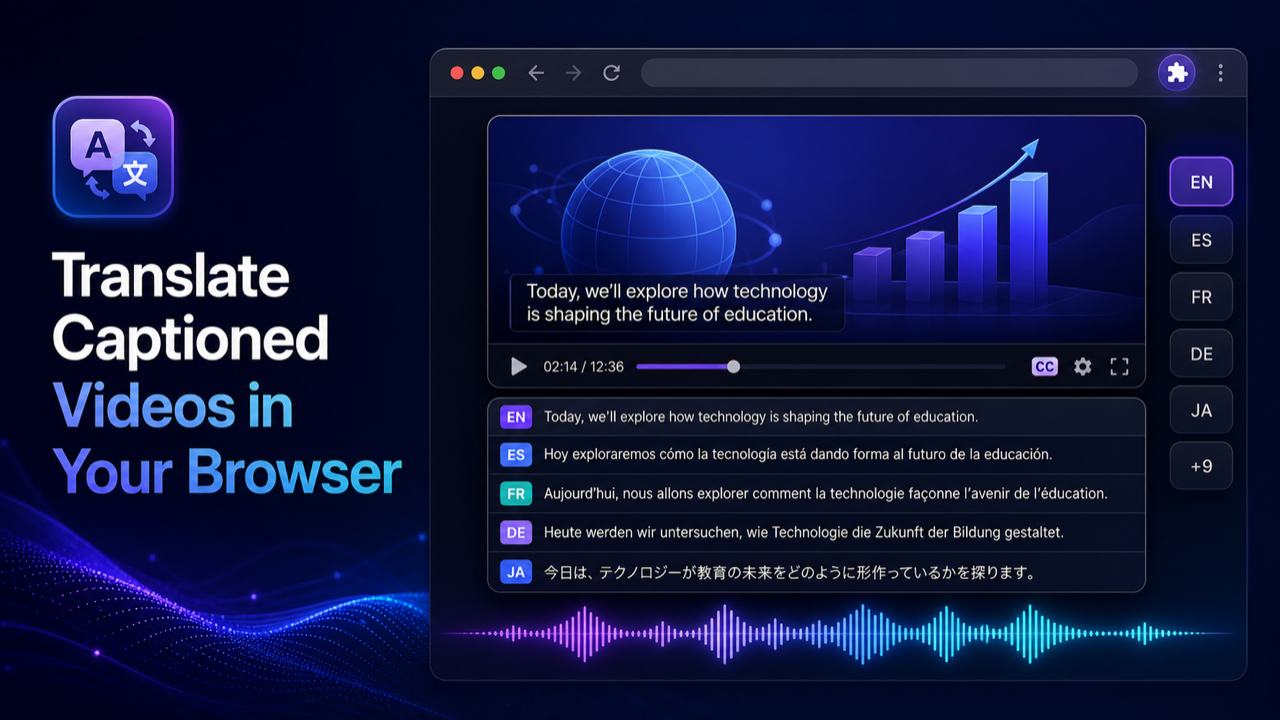
The other way to translate youtube subtitles is to let an extension do it in the tab while the video plays. Unlimited YouTube AI Video Translator is a desktop Chrome extension that reads the caption track the page already serves, translates it, and puts the translated lines on screen. If you want to listen rather than read, it can also speak the translated text with an AI voice over the original audio, though dubbing is a separate topic from this page.
What you get over the built-in menu:
- Line handling that reads better, because segments are joined and punctuated instead of being translated one clipped fragment at a time.
- The option of spoken output when watching hands-free beats reading.
- Settings that stick per video, so the next lecture does not need reconfiguring.
What you do not get, stated plainly: the same hard requirement of an existing caption track. No captions on the video means nothing to read and nothing to translate, exactly as with Auto-translate. There is no speech recognition inside the extension. It also does not import a subtitle file you have on disk and does not export one. Nothing is downloaded, nothing is rendered, nothing is saved as .srt or .vtt. The translated lines exist while you watch, and that is the whole product.
It runs on desktop Chrome only. Chrome for Android does not support extensions, and Chrome on iOS is a WebKit browser with no extension support, so on a phone your only route is YouTube's own Auto-translate.
Translate youtube video to english subtitles
English is the most requested target by a wide margin, so it gets asked as its own question. To translate youtube video to english subtitles, either pick English in the Auto-translate list, or set English as the target language in an in-tab translator and switch translated subtitles on. The mechanics do not change with the target language; what changes is how much material the engine has seen in that language pair, and English pairs are the best served ones you will meet.
The awkward cases (no caption track at all, a source language recognition never handled, long lectures) are covered on the dedicated page: translate a YouTube video to English.
Creator: add translation to youtube video the right way
Now the other half of the search. If you own the channel, you are not translating someone else's captions. You are producing localized text and attaching it to your upload, and YouTube supports that directly.
A channel owner can upload their own subtitle file per language, alongside the original one. You write or commission the translation, save it in a standard subtitle format with the timings, and attach it to the video as that language's track. Viewers then see a real subtitle option in the CC menu instead of a machine guess. A channel can also upload alternate audio tracks, which is how a video ends up with a Spanish or Hindi dub the uploader actually approved.
Uploader-supplied subtitles beat Auto-translate for one dull reason: a person wrote them. The person knew that the product in the video is called by its English name in every market, knew which joke to replace, knew that the on-screen text at 4:12 needs a line explaining it. No machine translation of a caption track recovers that, because none of it is in the caption track to begin with.
So when you plan adding translation to youtube video content you own, the order is: fix the original captions first, then translate from that clean source, then upload the result per language. Translating a sloppy original just multiplies the sloppiness by the number of languages you ship. YouTube changes the Studio interface often enough that step-by-step menu paths go stale, so check the current help page for the exact screens rather than trusting a screenshot from a blog post, this one included.
Subtitle craft: what separates a good translated line from a bad one
This is the part that decides whether your subtitles get watched or switched off, and it has almost nothing to do with which translation engine you used.
Reading speed comes first. A subtitle has to be read, understood, and left behind before the next one arrives. Subtitling guides converge on roughly 17 characters per second as the comfortable ceiling for adults, with around 42 characters per line and no more than two lines on screen. Those numbers are not arbitrary. Go faster and viewers stop watching the picture because they are busy reading.
Translation expands text. English to Spanish, German, or Russian typically runs longer than the source. A line that fit at 40 characters in English arrives at 55 and now sits on screen for the same 1.8 seconds. This is where most machine-translated subtitle tracks fail: the words are right and the line is unreadable.
Condense instead of transcribing. A translated subtitle that mirrors every word of the speech is worse than one that fits. Drop filler, false starts, repeated names, and discourse markers. Keep the content words, the numbers, and the terms. If a speaker says "so, um, what we're going to do here is, we're basically going to take this value and pass it into the function", the subtitle is "we pass this value into the function". Nothing was lost, and the viewer got the line with time to spare.
Break lines where the grammar breaks. Split between clauses or before a preposition, never between an article and its noun. A badly broken line forces the reader to re-parse, which costs more time than the line has.
Never split a punchline across two subtitles. If the timing forces it, retime the pair.
None of this applies to the viewer half of this page, since nobody can fix a machine-translated line they are reading in real time. It applies entirely to the creator half, and it is the reason a hand-made subtitle track is worth the afternoon it costs.
Which route fits which situation
| Your situation | What to use |
|---|---|
| Watching, video has captions, reading is fine | YouTube Auto-translate |
| Watching, want smoother lines or spoken audio | In-tab extension on desktop Chrome |
| Watching on a phone | YouTube Auto-translate, no extension route exists |
| Video has no caption track at all | Neither works; nothing to translate |
| You own the video and want quality | Write the subtitles and upload them per language |
Related guides
Every method of translating a YouTube video for a viewer, including dubbing, is compared on the YouTube video translator hub page. If what you want is the words as a block of text you can search or paste, read translate a YouTube video to text. For the case where the video has no caption track and no Auto-translate entry, see translating a YouTube video without CC. Installation and permissions for the extension are covered in the Chrome extension for translating YouTube videos guide. Subtitle translation on players other than YouTube is handled in translate video subtitles, and the file-based workflow lives in the SRT translator guide.
Frequently asked questions
Does YouTube have a built-in subtitle translator?
Yes. In the desktop player it lives behind the gear icon, under Subtitles/CC and then Auto-translate. It translates the existing caption track into the language you pick and shows the result as subtitles. It does not generate speech.
Why is Auto-translate missing on this video?
Because the video has no caption track. The uploader either disabled captions or automatic speech recognition never produced one, which happens with music-only audio, unsupported source languages, and very long or poor-quality recordings. YouTube shows no message explaining the absence.
Can I translate YouTube subtitles on my phone?
Only with YouTube's own Auto-translate, through the CC icon, then Captions, then Auto-translate. Chrome for Android does not support extensions and Chrome on iOS runs on WebKit without extension support, so no browser extension route exists on mobile.
Will translated subtitles also translate the audio?
No. Auto-translate changes on-screen text and leaves the original speech untouched. Spoken output requires either an alternate audio track the channel uploaded itself, or a dubbing tool that speaks the translated text over the original.
Can I download the translated subtitles as a file?
Not from the extension. It renders translated lines for watching and has no .srt or .vtt export, and no import either. A file you can edit and ship comes from a subtitle editor, not from a browser overlay.
As a creator, are my own subtitle files better than Auto-translate?
Almost always. A human translator handles names, jokes, on-screen text, and terminology that a caption track never carried in the first place. Uploaded subtitles also stay stable, while machine output changes whenever the engine behind it changes.