
Translate YouTube Video to English: 3 Ways That Actually Exist
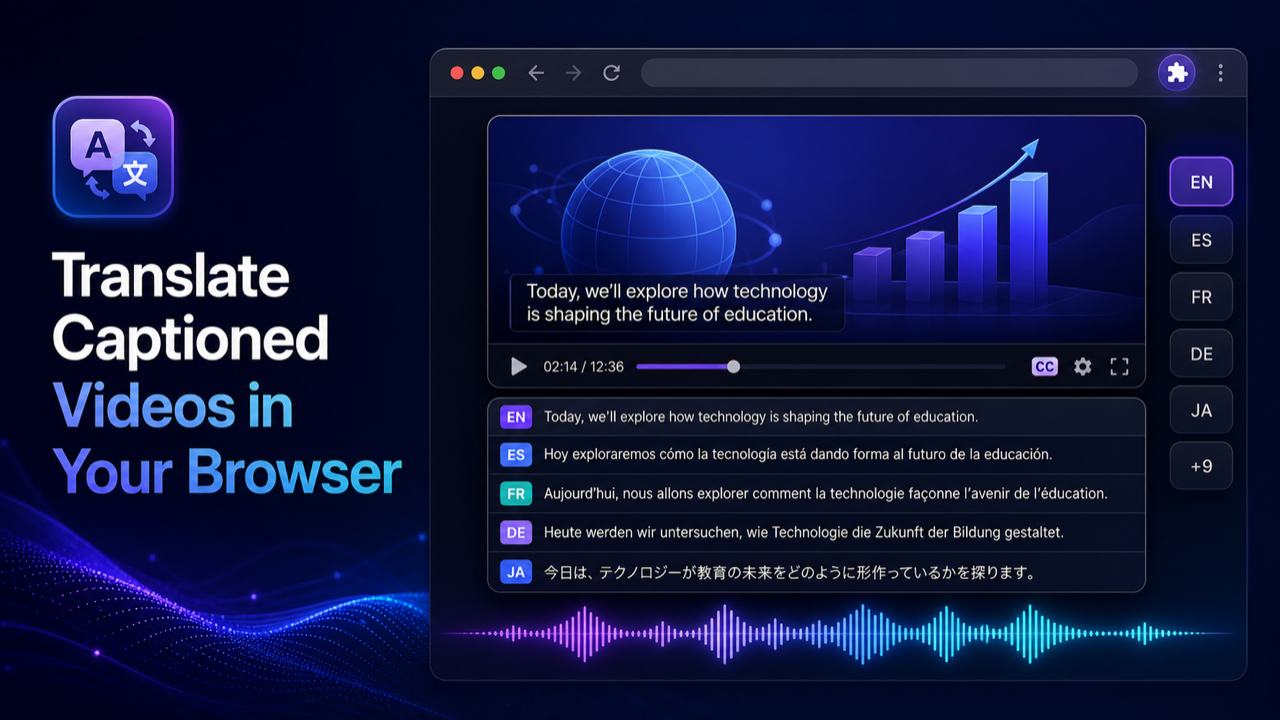
Short answer, then the proof. If the video has a caption track you can translate YouTube video to English subtitles in roughly fifteen seconds without leaving the page: captions on, gear icon, Subtitles/CC, Auto-translate, English. Spoken English is the harder half, and it comes from one of two places only, an English audio track the channel uploaded itself or a dubbing layer that reads those same captions and speaks them over the original sound.
The caption track decides everything below. YouTube's translation feature translates text that already exists, and so does the extension I build. Neither one listens to the audio and writes a fresh transcript. So before you compare methods, click CC on the player and see whether a caption language is offered at all. If one is, all three methods are open to you. If none is, skip to the section near the bottom.
Method 1: YouTube Auto-translate, the fastest route
This is the auto translate youtube video to english path, and it costs nothing. Here is how to translate a YouTube video to English in the player, desktop first.
- Start the video and click the CC icon so the original captions appear.
- Click the gear icon in the player controls.
- Open Subtitles/CC.
- Click Auto-translate.
- Pick English from the language list.
In the YouTube mobile app the same thing lives one level shallower. Tap the video once so the controls show, tap the CC icon, tap Captions, tap Auto-translate, then tap English.
Two limits worth knowing before you go hunting for the menu item. Auto-translate appears only when the video already carries a caption track, which includes YouTube's own automatic speech recognition track. When the uploader switched captions off, or when recognition never ran on that upload, the Auto-translate entry simply is not in the menu and the player tells you nothing about why. The second limit is the output: you get translated subtitles. There is no spoken English anywhere in this feature, at any point, on any platform.
That is how to translate youtube video to english when reading is fine, and for a slide-heavy lecture it usually is. It is also the whole of how to translate youtube videos to english for free, one video at a time, with nothing installed.
Method 2: the English audio track the channel uploaded
A channel can publish several audio tracks on one video. When that has been done, the gear menu carries an audio track entry, and English may be one of the options. Switch to it and the video speaks English from the start.
This is the best sounding English you will ever get out of a foreign-language upload, because a person decided how each line should read and a voice was recorded or approved against that decision. It is the uploader's own dub rather than machine output. It is also the one case where the player's own tools translate YouTube to English as speech instead of text, and you cannot make it happen from your side. Either the channel did the work or it did not. Big education and news channels do it more often than anyone else, so check the gear menu before assuming you need software.
Method 3: dub the captions into spoken English in your tab
When there is a caption track but no English audio track, dubbing closes the gap. To dub youtube video to english while the video keeps playing where it is, I use my own Chrome extension, Unlimited YouTube AI Video Translator. It reads the caption track the page already exposes, translates that text, and plays synthetic English speech over the original audio while the original is lowered underneath. Nothing is uploaded and nothing is downloaded. The same panel will translate YouTube video into English text instead if you would rather read, and running speech and subtitles together works well on dense material.
Honest version of the requirement, because it is the same requirement as Method 1: no caption track, no dubbing. The extension has nothing to read. This is a desktop Chrome extension, so it needs a laptop or a desktop, and it is free to start with a paid unlimited tier for people who watch translated video most days.
It is the ai translate youtube video to english option in the sense that matters to you: the translation and the voice are both machine generated, on top of a caption track that was often machine generated as well. Which brings us to quality.
What the English actually reads like
Machine translation into English is good at exactly the kind of speech that fills tutorials and lectures. Plain declarative sentences, a narrow technical vocabulary, a presenter who talks slowly because they are also typing. On that material I can follow a Korean Kubernetes walkthrough or a Spanish statistics lecture without much friction.
It breaks in predictable places. Idiom goes flat or comes out literally. Jokes die. Proper nouns and product names get replaced by ordinary words that sound similar. Anything with two people talking over each other loses the thread, because the caption track itself has no idea who is speaking.
The failure mode people underestimate is compounding. Translating youtube videos to english from an automatic caption track means you are translating a guess: recognition already decided what it thought it heard, and translation then works on that decision with full confidence. A misheard name does not arrive in English flagged as doubtful, it arrives as a normal English word in a normal English sentence. Creator-uploaded captions do not have this problem, which is why the same method can feel excellent on one channel and useless on the next.
So people asking how to translate youtube videos into english accurately are really asking about the source track. Check the Subtitles menu: if the language is listed with "auto-generated" next to it, lower your expectations for names and numbers and keep an eye on the original when something reads oddly.
When there is no caption track at all
Sometimes the player exposes nothing. Captions disabled by the uploader, music-only audio, a source language recognition does not cover, a very long or very noisy recording. In that case Auto-translate is missing, dubbing has no input, and no amount of reinstalling anything changes it.
That case has its own page, because the answers there are different from the answers here: translate a YouTube video to English without CC covers what is left to try when the track does not exist.
Doing this on a phone
The short answer on an app to translate youtube videos to english is that the YouTube app itself is the app, and only for subtitles. Its Auto-translate path is the four taps above and it works the same as on desktop.
There is no Chrome extension route on a phone. Chrome for Android does not support extensions, and Chrome on iOS runs on WebKit with no extension support either. So anyone looking for an app that can translate youtube videos to english with spoken English audio, installed from a phone, is looking for something that does not exist in the form they imagine. I would rather say that plainly than sell a workaround. If you want the wider picture of what phone software can and cannot do here, video translator app goes through it.
Practical compromise: use the phone app for subtitles when you are on a train, and save the long tutorial for the laptop where dubbing is available.
Related guides
YouTube video translator is the overview of every translation route on the platform, with links down to each one. If subtitles are your only interest, YouTube subtitle translator stays on that. For a written copy you can search and quote, read translate YouTube video to text. Other target languages have their own pages, for example Spanish and Hindi. Installation details for the extension live in Chrome extension to translate YouTube videos.
Frequently asked questions
Can I translate YouTube videos to English on any video?
No. Both YouTube's Auto-translate and any caption-based dubbing tool need a caption track, creator-uploaded or automatic. When the uploader disabled captions or recognition never produced a track, there is nothing to translate and the Auto-translate menu entry does not appear.
How can I translate a YouTube video into English for free?
Turn captions on, open the gear icon, go to Subtitles/CC, click Auto-translate, pick English. That costs nothing and needs no software. For spoken English, the free tier of a dubbing extension covers occasional videos on desktop Chrome.
How to translate a YouTube video into English with audio instead of subtitles?
Check the gear menu for an audio track option first, since an uploader-provided English track beats anything automatic. If there is none, a dubbing extension reads the caption track and speaks the translation over the original audio in the same tab.
Does YouTube's Auto-translate produce English speech?
No. It produces translated subtitles only. English speech comes either from an audio track the channel uploaded or from a dubbing tool running in your browser.
Why is Auto-translate missing from my menu?
Because that video has no caption track the player can offer. YouTube does not explain this in the interface, which is why the option looks broken rather than absent. Open the Subtitles/CC menu: if no source language is listed, the track genuinely is not there.
Is the translation accurate enough for study?
For technical and lecture speech, usually yes, with names and numbers as the weak spots. For interviews, comedy and anything idiomatic, treat it as a rough guide and keep the original audio audible so you can hear when the English has drifted.
Other ways people search for this
The same request reaches this page in a dozen shapes. Some readers type translate to english youtube, some type youtube video translate to english, and some just type youtube translate to english, which are all the same question with the words shuffled. Others search for the how-to form, whether that is translate youtube videos into english for a playlist of lectures or a single clip. Whichever phrasing brought you here, the answer splits the same way: subtitles come from the player in under a minute, spoken English needs an uploader track or a dubbing layer, and both need captions to exist first.