How to Translate Udemy Courses Into Your Language
You found the perfect course. Great reviews, exactly the topic you need, and the instructor clearly knows their stuff. Then you hit play and it's in a language you only half understand. So you go looking for how to translate Udemy courses, and the answer is more complicated than it should be.
Here's the short version: Udemy has some built-in translation, but it's patchy, and the quality swings from decent to unreadable. If your language isn't in the caption dropdown, or the auto-generated captions read like a bad phrasebook, you need something better. This guide walks through what Udemy gives you, where it falls short, and how a browser extension fills the gap with proper AI dubbing and cleaner subtitles.
What Udemy already offers
Udemy isn't ignoring translation. Depending on the course, you get a few things for free.
- Instructor-provided captions. Some instructors upload subtitles in several languages. When they do, you'll see those languages in the CC menu on the player.
- Auto-generated captions. Udemy machine-transcribes many courses in the original language, then offers machine-translated captions on top of that transcript.
- A caption language dropdown. Click CC, and you'll see whatever languages exist for that specific course.
The catch is the phrase "for that specific course." Caption availability is decided course by course, so two courses from the same instructor can have completely different language coverage.
Why the built-in translation falls short
If you've tried Udemy's own captions and walked away frustrated, you're not imagining it. A few reasons:
- Your language may not be listed at all. Popular courses get more caption languages. Niche or older courses often have the original language and nothing else.
- Machine translation on top of machine transcription compounds errors. If the auto-transcript mishears a technical term, the translation faithfully translates the wrong word, so two layers of guessing stack up.
- Subtitles still make you read. Even good captions mean your eyes are pinned to the bottom of the screen instead of the code editor, the diagram, or the slides. For a two-hour course, that's exhausting.
- No audio option. Udemy translates text, not speech. You can't listen to the lecture in your language while you follow along with the on-screen material.
That last point is the big one. When you're learning something hands-on, like programming, design, or spreadsheets, you want to watch the screen and hear the explanation, not split your attention reading.
The better approach: AI dubbing in your browser
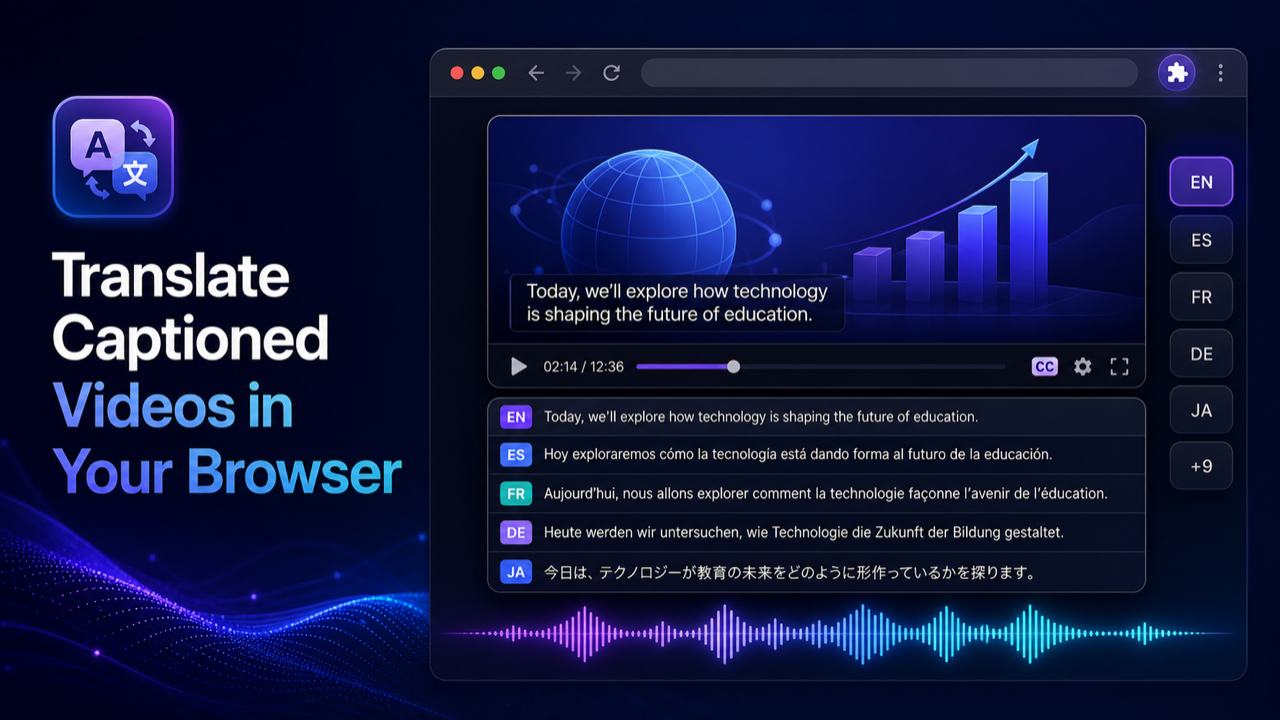
When a Udemy lecture exposes a source caption track, the extension can translate that text and generate a spoken track in your chosen language. The lecture video itself is not uploaded, but the text required by the translation or voice engine may be sent to the selected online provider. A lecture with no detectable source captions cannot be translated by the extension.
Because it works while you watch, there's no file to upload and no waiting for a whole course to process. You press play, and the translation happens as you go.
How to translate a Udemy course, step by step
Here's the full setup. It takes about two minutes the first time, then it's one click per lecture after that.
- Install the extension. Add Video Translator for Udemy - Unlimited AI Voice Dubbing to Chrome from the Web Store. It's free to start, so you don't need to commit anything to try it.
- Open your Udemy course and go to any lecture. Log in as normal. The extension works inside your own Udemy session and doesn't touch your account.
- Pick your target language. Open the extension and choose the language you want to hear and read. This is where you get languages Udemy never offered for that course.
- Choose dubbing, subtitles, or both. Want to listen? Turn on AI dubbing. Prefer to read? Turn on subtitles. Doing both is fine and often the best way to learn: hear it and see it.
- Generate the selected voice track, or use browser speech where available, then press play with translated captions enabled.
That's it. Move to the next lecture and your settings carry over, so you're not reconfiguring anything.
Tips for the best results
- Use both dub and subtitles for technical courses. Hearing the concept and seeing the translated term together helps the vocabulary stick, especially for jargon.
- Keep the original captions handy for names and code. Proper nouns, library names, and command-line snippets are best read in the original. Toggle back when the instructor is spelling something out.
- Slow the playback slightly if the dub feels rushed on dense sections. Udemy's speed control still works underneath the extension.
- Pick the closest regional variant of your language if it's offered. It usually sounds more natural than a generic version.
Related guides
Read why Google Translate alone cannot dub a Udemy lecture, or compare the Coursera translation workflow. For free video outside a course platform, see the YouTube video translator guide.
Frequently asked questions
Can I translate Udemy courses for free?
Yes. Udemy's own captions are free where they exist, and the extension is free to start, so you can translate lectures without paying upfront. Heavier use may move you to a paid tier, but you can try it at no cost.
Does Udemy have every language in its subtitles?
No. Caption languages are set per course, so your language may be missing entirely. That's the main reason people add a translation extension: it covers languages the course never shipped.
Will translating a course get my account in trouble?
The extension runs in your own browser on top of your normal Udemy session, the way any accessibility or reading tool does. It doesn't download the course or share your login. You're just changing how the lecture is presented to you.
Can I get the lecture as spoken audio, not just subtitles?
Yes, and that's the main advantage over Udemy's built-in captions. AI dubbing plays the lecture aloud in your language, so you can watch the screen instead of reading the bottom of it.
What if the auto-translation gets a technical term wrong?
It can happen with any machine translation. Keeping the original captions available lets you glance at the source term when something sounds off, which is handy for code, product names, and acronyms.
Does it work on mobile?
The extension is a desktop Chrome tool, so it works where Chrome extensions run. For learning a hands-on course, a laptop is usually the better setup anyway.