
How to Translate Coursera Courses Into Your Language
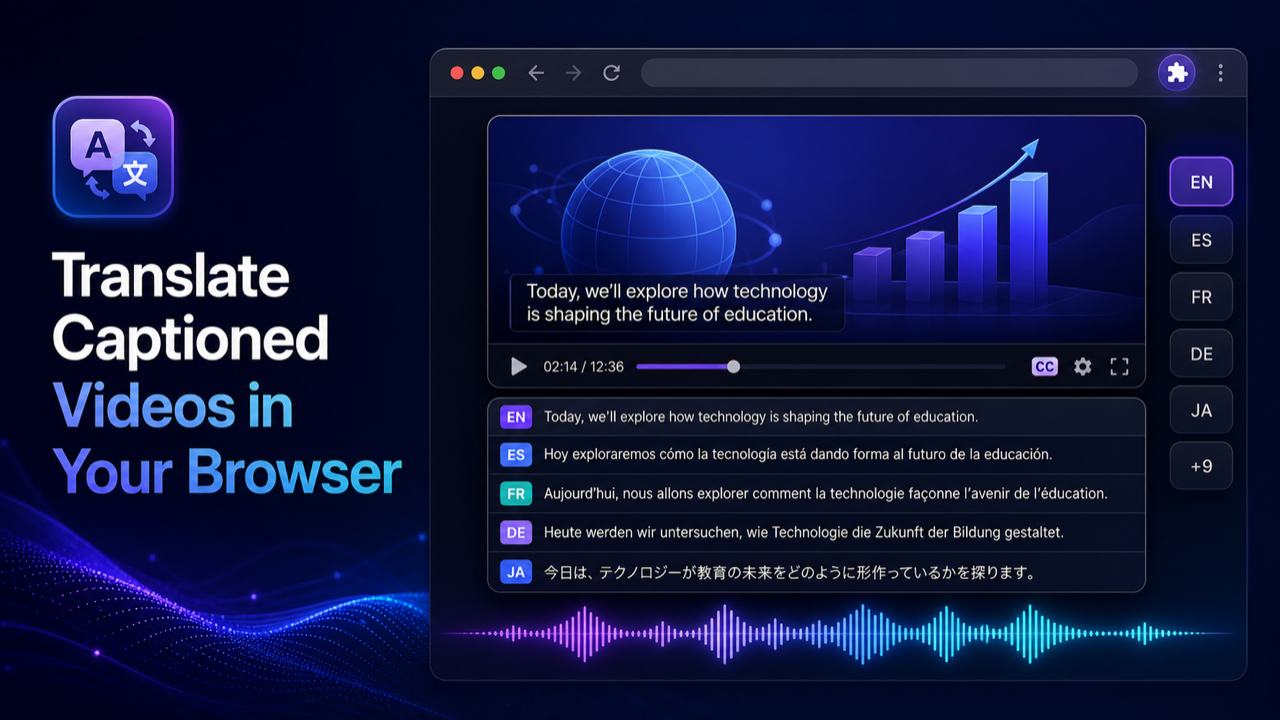
Coursera has some of the best university and industry courses online. It also has a language problem: a lot of that content is in English, and the subtitle languages you're offered depend entirely on which course you opened. If you're trying to figure out how to translate Coursera courses into a language that isn't in the list, you've probably already discovered how uneven the coverage is.
This guide covers what Coursera translates for you, why the built-in subtitles come up short, and how a browser extension adds proper AI dubbing and cleaner subtitles so you can actually follow the lecture in your language.
What Coursera already translates
Coursera does more localization than most platforms, so start with what you have.
- Instructor and community subtitles. Many courses include subtitles in several languages, some professionally produced, some community-contributed.
- Interface localization. Coursera's own menus and pages appear in a number of languages regardless of the course.
- A subtitle language selector on the video player, showing whatever languages exist for that specific course.
The limitation is familiar: subtitle languages are decided per course. A flagship specialization might have a dozen languages, while a smaller course might have English only.
Why the built-in subtitles fall short
If Coursera's own captions aren't cutting it, here's what's usually going on:
- Your language isn't in the list. Popular courses attract more translations. Niche, newer, or smaller courses often ship with the original language and little else.
- Quality varies by source. Professionally translated subtitles are excellent. Machine-translated or partial community subtitles can be rough and inconsistent.
- You're reading, not watching. Coursera lectures lean heavily on slides, formulas, and screen demos. Pinning your eyes to the subtitle line means missing the very thing being explained.
- There's no dubbed audio option. Coursera translates text, not speech. You can't listen to a lecture in your language while you follow the on-screen material.
For dense academic material like statistics, engineering, or programming, splitting your attention between reading captions and understanding a diagram is a real handicap.
The better approach: AI dubbing in your browser
When a Coursera lecture exposes a source caption track, the extension can translate that text and generate a spoken track in your chosen language. The lecture video itself is not uploaded, but the text required by the translation or voice engine may be sent to the selected online provider. A lecture with no detectable source captions cannot be translated by the extension.
Because it works while you watch inside your own Coursera session, you keep your enrollment, progress, and account exactly as they are. You're only changing the language you hear and read.
How to translate a Coursera course, step by step
The first setup takes a couple of minutes. After that it's one click per lecture.
- Install the extension. Add Unlimited Video Translator for Coursera to Chrome from the Web Store. It's free to start.
- Open your Coursera course and go to any lecture video. Stay logged in. The extension works inside your normal session and doesn't touch your account or your grades.
- Choose your target language. Open the extension and select the language you want to hear and read. This is where you get languages the course never offered.
- Pick dubbing, subtitles, or both. Turn on AI dubbing to listen, subtitles to read, or both, which is usually the best combination for academic material.
- Generate the selected voice track, or use browser speech where available, then press play with translated captions enabled.
Your settings carry over to the next lecture, so there's nothing to redo as you move through the course.
Tips for the best results
- Use both dub and subtitles for technical courses. Hearing the concept and reading the translated term together helps the vocabulary stick.
- Keep original captions for formulas and code. Toggle to the source when the instructor is writing an equation or spelling out a command.
- Adjust playback speed if the dub feels rushed on dense sections. Coursera's speed control still works underneath.
- Choose the closest regional variant of your language when offered for a more natural-sounding dub.
Related guides
Compare this workflow with translating Udemy courses or the YouTube video translator guide. For another free lecture platform, see Khan Academy.
Frequently asked questions
Can I translate Coursera courses for free?
Yes. Coursera's own subtitles are free where they exist, and the extension is free to start, so you can translate lectures without paying upfront. Heavier use may move you to a paid tier.
Does Coursera have subtitles in every language?
No. Subtitle languages are set per course, so your language may not be available at all. That's the main reason to add a translation extension: it covers languages the course never included.
Will using a translator affect my grades or certificate?
No. The extension changes how the lecture is presented in your browser. It doesn't submit anything, alter your progress, or touch quizzes and assignments.
Can I listen to a lecture in my language instead of reading subtitles?
Yes, and that's the main advantage over Coursera's built-in captions. AI dubbing plays the lecture aloud in your language so you can focus on the slides and demos.
What if the translation gets a technical term wrong?
Any machine translation can slip on jargon. Keeping the original captions available lets you glance at the source term when something sounds off, which is useful for formulas, code, and proper nouns.
Does it work for specializations and multi-course programs?
It works on standard Coursera lecture videos in your browser, so it applies across the individual courses that make up a specialization or program.