
Udemy Subtitle Translator: Translate and Dub Lectures
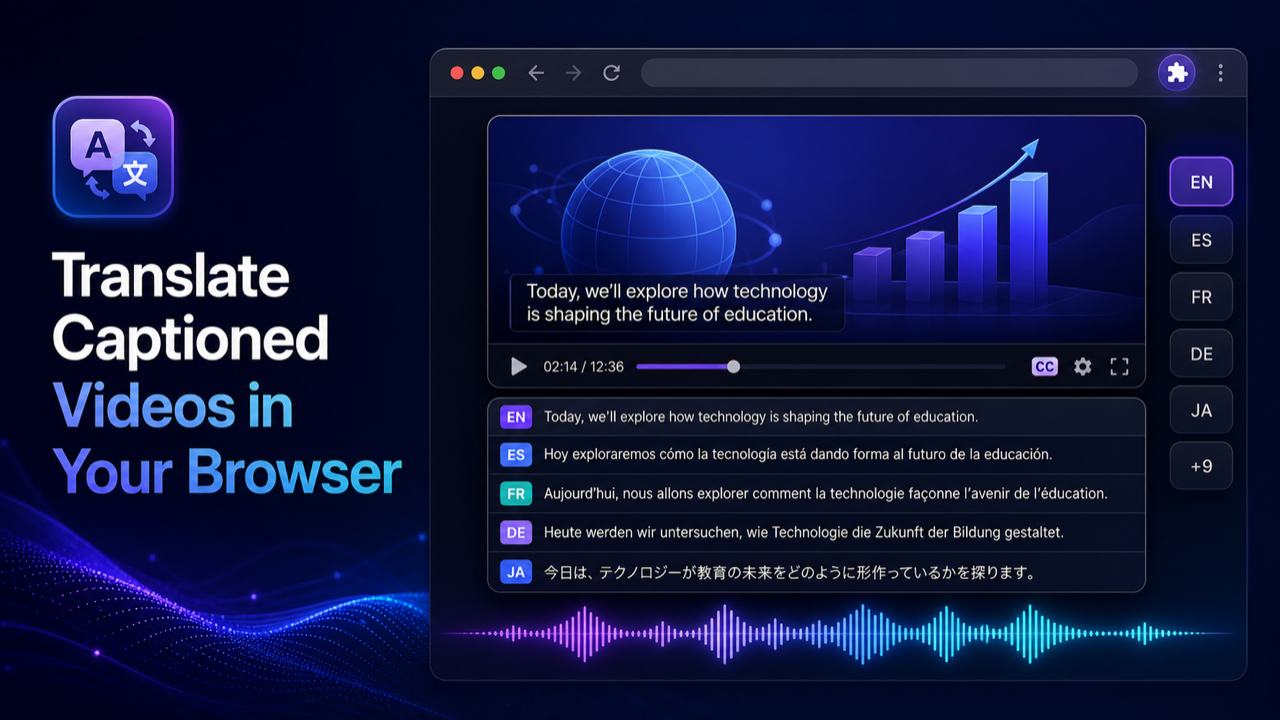
A Udemy subtitle translator does all of its work on text. The spoken words of a lecture already exist as a caption track inside the player, and every practical route to understanding the course in another language starts from that track. Once you see it that way, the topic gets simpler. If the lecture has captions, you have something to translate, and you can get readable subtitles and a spoken voice out of it. If it does not, no tool running in a browser can invent them for you.
This post is about the subtitle layer specifically. What Udemy's own caption languages cover, why people still go looking for a Udemy translate option after trying them, and how a Chrome extension reads the caption track to produce subtitles and AI dubbing in a language the course never shipped. For the course-level walkthrough, including tips per lecture, read the full guide on how to translate Udemy courses.
What Udemy's own subtitles give you
Udemy does ship translation, and for some courses it is enough. Click CC on the player and you get whatever exists for that specific course:
- Captions the instructor uploaded, sometimes in several languages.
- Machine-generated captions in the original language, produced by Udemy's own transcription.
- Machine-translated captions layered on top of that transcript.
That third item is where most Udemy translation actually comes from. It is free, it is already there, and it costs you nothing to check. The problem is coverage. Caption languages are decided course by course, so two courses from the same instructor can have completely different dropdowns, and the older or more niche the course, the shorter that list gets.
Where Udemy language translation stops
Four limits come up again and again.
Your language may simply not be listed. Popular courses collect more caption languages over time; a 2019 course on a narrow tool often has the original language and nothing else.
Errors stack. A machine translation sitting on top of a machine transcript inherits every mishearing. If the transcript turns a library name into a similar-sounding English word, the translation faithfully translates the wrong word, and you get a sentence that parses but means nothing.
Subtitles keep your eyes at the bottom of the screen. For a course where the instructor is typing code or pointing at a diagram, that split attention is the real cost. Two hours of it is tiring in a way that a five-minute clip never shows.
And Udemy language translation is text only. There is no option to hear the lecture in your language. That is the gap people are usually trying to close when they go looking for a udemy translator in the first place.
Udemy Google Translate, and why it is only half a fix
The usual first attempt is copy and paste. Open the transcript panel, take a chunk, drop it into Udemy Google Translate in another tab, read it, switch back, rewind because you lost your place. It works, in the sense that you end up with translated text. It also destroys the rhythm of watching a lecture, and it still gives you nothing to listen to.
The other attempt is Chrome's "translate this page" on a course page. That rewrites the menus, the title, the description, and leaves the lecture untouched, because the video is an embedded object and its captions live inside the player rather than in page text. The separate post on Udemy and Google Translate goes through both dead ends in detail.
Worth knowing: Google Translate is still the engine doing the text work on the extension's free path. The difference is that the copy, paste and rewind loop disappears, and a voice gets generated on top.
How a caption-based Udemy translator works
The Video Translator for Udemy - Unlimited AI Voice Dubbing extension runs inside your own browser tab, on the page you were already on. The pipeline is short:
- Detect. It finds the lecture's caption track, the text of what the instructor is saying.
- Translate. That text goes to the selected translation route and comes back in your target language.
- Speak. For dubbing, text-to-speech turns the translated lines into audio.
- Sync and play. That generated speech is timed against the video and played while the original audio is ducked down underneath.
Nothing about the lecture video gets uploaded. Text that the translation or voice engine needs may be sent to the selected online provider, and the extension states that when a mode uses one. A lecture with no detectable source captions cannot be translated this way, so the caption requirement is not a detail you can work around.
Because it works while the video plays, there is no processing queue and no dubbed copy to download. You press play and the translation happens as you watch.
How to translate Udemy course lectures, step by step
- Install the extension. Add Video Translator for Udemy - Unlimited AI Voice Dubbing to Chrome from the Web Store.
- Open your course and go to any lecture. You stay logged in as normal; the extension works inside your own Udemy session.
- Turn captions on in the player. This is the step people skip. The extension reads the caption track the page exposes, so if captions are off or hidden, nothing starts.
- Pick your target language, then choose subtitles, dubbing, or both.
- Generate the selected voice track, or use browser speech where available, then press play with translated captions enabled.
Settings carry over to the next lecture, so the setup cost is roughly two minutes for the whole course.
Udemy translate free versus PRO
The free path is a complete workflow rather than a trial. It uses Google Translate for the caption text with no API key, and an on-device voice that runs inside the browser extension to speak the result. No watermark, and no account needed to start. For most people who want to follow a course in their own language, a udemy translate free setup ends there.
PRO exists for heavier use and adds LLM translation for context-aware phrasing, premium local voices and cloud voices for quality and wider language coverage, a real-time mode that starts speaking sooner instead of waiting for the full track, and bring-your-own-key support if you would rather use your own provider. LLM translation is the upgrade that matters most on technical courses, where a word-by-word route mangles terminology. Free Video Translator sets out the boundary in more detail.
The limits, stated plainly
- Source captions are required. No captions means no translation, and that is a hard stop, not a quality issue.
- Captions must be enabled in the player so the extension can detect them.
- Live sessions, DRM-protected video, and caption-free uploads may not work.
- The free on-device voice catalog does not cover every language or voice style. Premium and cloud voices extend that on PRO.
- Translation quality inherits the transcript. If Udemy's auto-transcript misheard a term, the translated subtitle carries the same mistake, so keep the original captions available for code, product names and acronyms.
Related guides
To translate Udemy courses alongside other platforms, the Coursera walkthrough covers the same pipeline on a different player, and the YouTube video translator guide covers free video outside a course platform. AI Video Translator explains what happens to a caption track once the extension is installed.
Frequently asked questions
Can Udemy translate subtitles into any language?
No. Each course has its own caption language list, set by the instructor plus whatever Udemy auto-generated. If your language is missing from the CC menu, the platform has nothing to offer for that course, which is where an extension that translates the existing caption track comes in.
Is there a free Udemy subtitle translator?
Yes. Udemy's own captions are free where they exist, and the extension is free to start, using Google Translate for the text and an on-device voice for the audio. Premium voices, cloud voices and LLM translation are optional paid upgrades.
Can I hear the lecture instead of reading subtitles?
Yes. AI dubbing speaks the translated caption text over the video, synced, with the original audio lowered. That lets you watch the code editor or the slides instead of the bottom of the screen.
Does it work if the course has no captions at all?
No. The extension translates the caption track the page exposes. A lecture with no detectable captions cannot be dubbed or subtitled by it.
Will using a translator affect my Udemy account?
It runs in your own browser on top of your normal session, like a reading or accessibility tool. The course is not downloaded and your login is not shared. Only the presentation of the lecture changes.
Why did the dubbing not start?
Almost always because captions are off or the player is hiding them. Enable CC first. On live sessions, DRM-protected video or lectures with no caption track, the extension has no text to work from.
Other ways people search for this
People land on this page from a lot of near-identical queries. For the record, they all mean the same thing here: udemy translate, udemy translation, udemy translator, udemy translate subtitles, udemy translate free, udemy language translation, udemy google translate, how to translate udemy course, translate udemy courses, udemy subtitle translator.