
How to Translate an Arabic Video to English
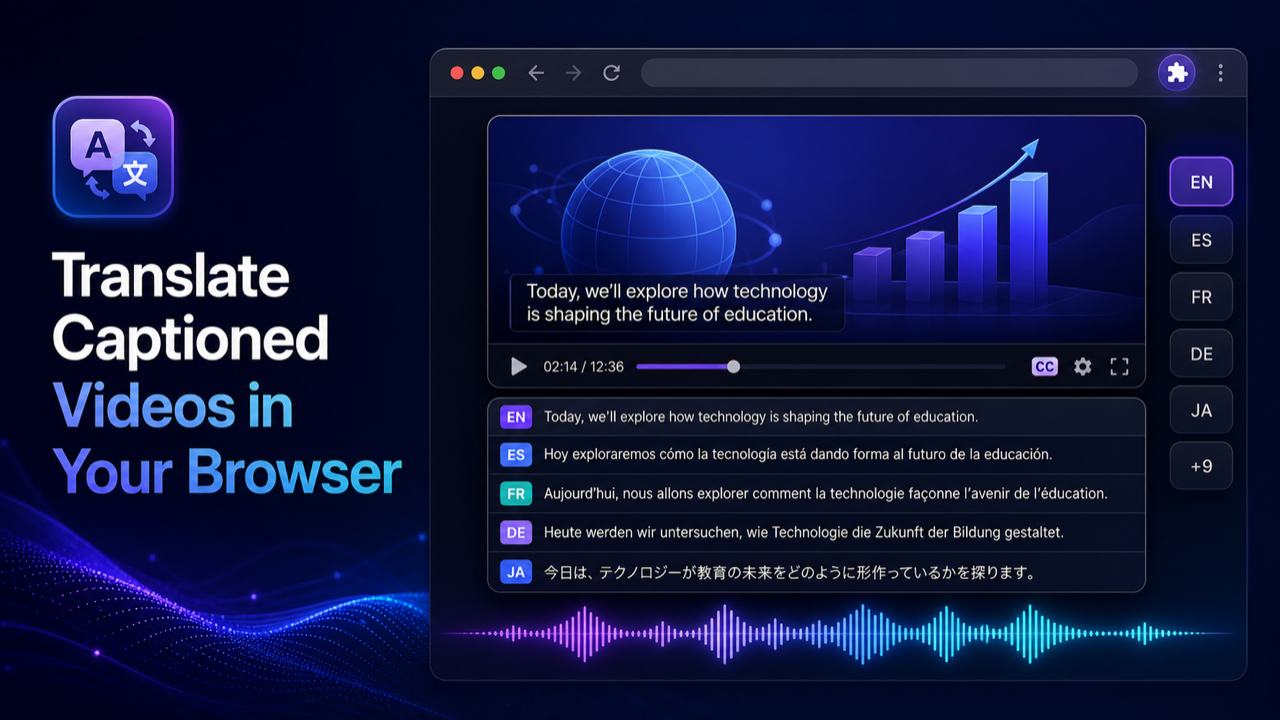
Before anything else, answer two questions about the clip you want to understand: is the speaker using Modern Standard Arabic (العربية الفصحى, the register used in news broadcasts, lectures, and documentaries) or a regional dialect (Egyptian, Levantine, Gulf, Maghrebi) and does the video actually have a caption track you can turn on? Those two facts decide the outcome more than any setting inside a translator extension. If you can turn on Arabic captions and the speech is close to MSA, a browser extension like Unlimited Universal Video Translator can give you readable English subtitles or a synced English voiceover in a couple of minutes. If the speech is heavy dialect and the platform never generated captions for it, no extension, this one included, has anything to work with, because it translates the caption track a video player exposes, not the raw audio. There is no built-in speech-to-text engine here, so a video with the CC button greyed out is a dead end regardless of how good the translation model behind it is.
What you actually get
Once captions exist, the extension gives you one of two outputs. Standard mode overlays English subtitle text on top of the video while the original Arabic audio keeps playing, which is useful when you want to check names, technical terms, or tone against what's actually being said. Dub mode goes further: it lowers the Arabic audio and plays a generated English voice timed to the caption segments, which suits long-form content like a lecture or interview where you'd rather listen than read. Neither mode edits the underlying video file. It doesn't touch lip movement, strip DRM, or produce a downloadable file. Everything happens live in the browser tab, on top of the player the site already gives you.
The free tier covers Standard mode with Google Translate and an on-device Piper voice, and nothing in that path uploads the video itself. It does send the caption text to Google when Google Translate is the selected engine. That's worth knowing before you run it on anything you'd rather keep private. Real-time translation, LLM-based translation, and the higher-quality cloud voices are Pro features, and each of those sends the relevant caption text to whichever provider you pick for that feature.
Setting it up in Chrome
- Install Unlimited Universal Video Translator from the Chrome Web Store.
- Open the Arabic video on a supported site: YouTube, Udemy, Coursera, TED, Vimeo, and Khan Academy are the platforms this has actually been tested against.
- Turn on the video's own Arabic captions first. If there's no CC option in the player, stop here: the extension has nothing to translate.
- Click the extension's Dub button on the player and set English as the target language.
- Pick Standard mode with Google Translate to start on the free path, or switch to Pro if you want an LLM engine or a cloud voice for better handling of dialect and idiom.
- Play the video and check the first minute or two against the source audio, paying attention to names and any specialized vocabulary before you trust the rest.
Where Arabic to English translation actually breaks
Dialect is the single biggest failure point. MSA content (news segments, formal lectures, documentary narration) is written and spoken close to how it's transcribed, so both the caption generation and the subsequent English translation tend to hold up reasonably well. Egyptian, Levantine, Gulf, and Maghrebi dialect speech departs from MSA in vocabulary, verb forms, and pronunciation, and platforms are noticeably worse at auto-captioning it in the first place. A lot of dialect-heavy content simply never gets a caption track, which means the extension can't touch it at all.
A second issue sits underneath the writing system itself: short vowels (harakat) are normally omitted in written Arabic, so the same consonant skeleton can represent several different words. A human reader resolves the ambiguity from context and, often, from hearing the word spoken. A text-based translator working only from the caption string doesn't have the audio to lean on and will sometimes pick the wrong reading. You'll notice this as an English sentence that's grammatically fine but clearly about the wrong thing.
Arabic also marks grammatical gender on verbs and adjectives in a way English doesn't mark at all, so information about who is being addressed or described can get lost or muddled once it's flattened into English. Related to that, Arabic has a dual number (a specific form for exactly two of something) alongside singular and plural. English has no equivalent, so a sentence about "two colleagues" and one about "several colleagues" can end up reading almost the same in translation, even though the original was precise.
Sentence structure is its own problem. Arabic speech, especially in unscripted or formal registers, often strings long clauses together with و ("and"), producing sentences that would need real restructuring to read naturally in English. Caption segmentation (which breaks lines by timing, not by grammar) tends to chop these long sentences at arbitrary points, and the translator then works on fragments instead of complete thoughts. Religious or classical phrasing, including Qur'anic quotation, formulaic expressions, and proverbs, gets translated literally far more often than idiomatically, so if a video includes that kind of language and precision matters to you, keep the Arabic subtitles visible so you can catch a mistranslation rather than take the English at face value. Names are a smaller but constant annoyance too: Arabic-to-English transliteration isn't standardized, so the same person can appear spelled two or three different ways across a single video.
When this won't work
Skip it, or expect a rough result, for live streams (no caption track exists yet to translate), DRM-protected video, players that hide or block their caption data from the page, and any dialect-heavy content that was never captioned to begin with. If the video only has auto-generated Arabic captions and the speech is fast, informal, or overlapping, expect a noticeably rougher translation than a scripted MSA source would give you.
Related guides
For the general workflow across languages, see How to Translate a Video. If you're working from Turkish instead, the Turkish-to-English guide covers a different but comparably tricky set of grammar issues. And if you want to know exactly where the free tier stops before you hit a paywall, read the free video translator guide.
FAQ
Does this work on an Arabic video with no captions at all?
No. The extension translates an existing caption track; it has no speech-to-text engine, so a video without captions can't be processed no matter which mode you choose.
Is Egyptian or Gulf dialect translated as well as Modern Standard Arabic?
Generally not. Dialect speech is both harder for platforms to auto-caption and harder for the translation engine to render accurately, so expect more errors than you'd see on MSA news or lecture content.
Does anything leave my browser during translation?
The video file never gets uploaded. But the caption text does get sent to whichever engine is doing the translating: Google Translate on the free tier, or an LLM or cloud voice provider on Pro. Treat that text as shared with a third party.
Can I download the English version afterward?
No. This is a browser-side viewing layer, not a video export tool: there's no synced lip movement, no rendered file, and no SRT to save.