
How to Translate a Turkish Video to English
Turkish packs into one word what English needs a whole clause to say. Evlerimizden breaks down as "from our houses": house, our, plural, and "from" all riding on a single root as stacked suffixes. That single-word-to-multi-word ratio is why caption timing matters more here than in most language pairs: when you translate turkish video to english, a caption line that gets cut mid-word, or right before the last suffix, can hand the translator a completely different sentence than the one the speaker said. The fix isn't a smarter dictionary. It's making sure the tool respects where Turkish actually breaks its ideas.
Before any of that works, though, the video needs a Turkish caption or subtitle track that Chrome can read. Unlimited Universal Video Translator translates existing captions. It does not listen to the audio and does not transcribe speech. No caption track means no translation, full stop.
The caption track has to already be there
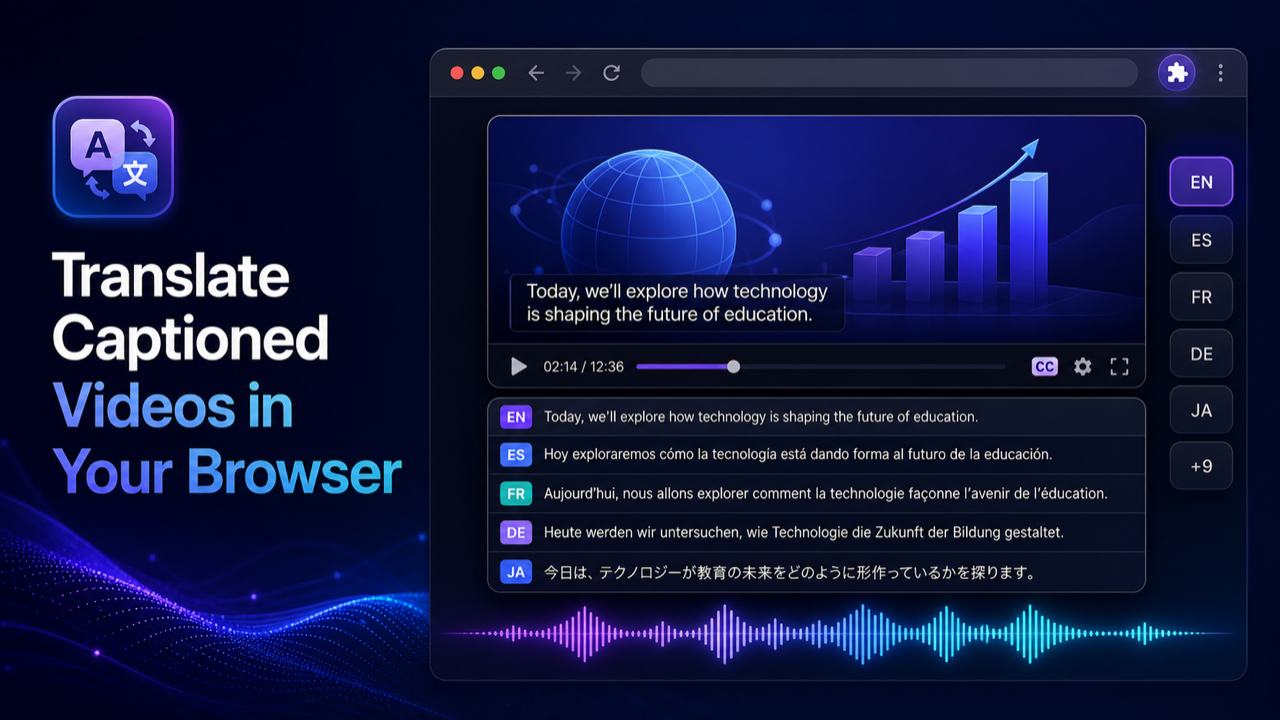
The extension reads whatever caption or subtitle data the video player exposes, translates that text, and displays it as English captions or speaks it as English audio. It does not touch the video file itself: nothing is uploaded or re-encoded. But when you pick an online engine (Google Translate) or a cloud voice or LLM translation, the caption text needed for that step is sent to that provider. On-device options exist too: Standard mode with Google Translate and a local Piper voice is free and doesn't require an LLM. Real-time mode, LLM-based translation, and premium cloud voices are Pro features. None of that is free, and none of it should be advertised as such.
Tested and working on YouTube, Udemy, Coursera, TED, Vimeo, and Khan Academy. Live streams, DRM-protected video, and players that hide their caption data from the page are likely dead ends.
Turning on English captions or dubbing in Chrome
- Install Unlimited Universal Video Translator from the Chrome Web Store.
- Open the Turkish video and turn on its captions in the player itself, since the extension needs that track active to find it.
- Click the extension's Dub button and set the target language to English.
- Start with Standard mode, Google Translate, and the built-in local voice before spending Pro credits on anything else.
- Watch a minute or two and compare a few captions against the spoken Turkish, especially around names and numbers.
- If the caption timing looks reasonable, switch to dubbed audio; if you just want to read along, leave it as captions.
Why word order and suffixes trip up the English translation
Turkish grammar creates a specific set of failure patterns going into English, separate from generic "auto-captions are sometimes wrong":
- Suffix stacking changes meaning, not just spelling: because a single root plus suffixes carries person, number, tense, and case, a speech-recognition engine mishearing one suffix can flip the English output from "in our house" to "from your houses." The error looks small in Turkish and large in English.
- Turkish is verb-final, so the verb and the negation both sit at the end of the sentence: "I did not go" keeps its "not" and its "go" for last. If a caption line is cut before that final word lands, the fragment can read as an affirmative statement until the next line arrives and reverses it.
- The reportative past suffix (-miş) has no English equivalent. It tells the listener the speaker didn't witness the event directly, only heard about it, and English has no grammatical marker for that distinction, so a translated caption can present secondhand information as plain fact.
- Turkish has one pronoun for all genders: o covers "he," "she," and "it." When a Turkish sentence uses o for a person, the English translation has to guess a gender it was never given, and it sometimes guesses wrong.
- Turkish frequently drops the subject entirely, since the verb ending already encodes who's doing the action. The sentence itself often has no separate subject word for the caption engine to translate, so the English side has to invent a pronoun that isn't in the source text at all.
- Vowel harmony means a mis-heard vowel produces a real word, not gibberish, because Turkish suffixes shift vowels to match the root. A transcription slip doesn't fail loudly; it quietly substitutes one valid Turkish word for another, and the mistranslation looks fluent.
- Sen and siz both become "you" in English. Turkish marks formality and plurality in its second-person pronoun, while English collapses both into one word, so a formal address to an elder can read exactly like a casual one to a friend.
When this will not work
Anyone trying to translate a Turkish video to English runs into the same wall first: if the Turkish video has no caption track (many recorded lectures, phone footage, and informal interviews don't), there is nothing for the extension to translate, and turning on auto-captions in the player first (where the platform offers them) is the only way around that. Live broadcasts, DRM-locked streams, and embedded players that don't expose their caption data to the page will also fail, regardless of settings.
Related guides
For the general workflow that applies to any source language, see the guide to translating video to English. If you're translating from Russian instead, the Russian-to-English video guide covers a different set of caption pitfalls. And since most publicly available Turkish video with captions turns up on YouTube, the YouTube video translator guide is worth reading alongside this one.
Frequently asked questions
Does this work on a Turkish video with no captions at all?
No. The extension translates existing caption text; it does not do speech-to-text, so a video without a caption track can't be translated.
Is my caption data ever sent anywhere?
The video file stays local. But when you choose Google Translate, an LLM, or a cloud voice, the caption text needed for that feature is sent to that provider, so it isn't fully offline unless you stick to the local voice option.
Can I download the English version afterward?
No. The extension changes what you see and hear while watching in the browser; it doesn't generate a new video file or an SRT export.
Will it work on Facebook or LinkedIn Learning videos?
Those platforms haven't been tested, so don't count on it. YouTube, Udemy, Coursera, TED, Vimeo, and Khan Academy are the platforms this has actually been verified against.