
How to Translate Video to English: Subtitles, Dubbing or Transcript
You have a lecture in Portuguese, a product demo in Korean, or a cooking clip in Turkish, and you want to follow it in English. Before you pick a tool, answer two questions. Do you want English subtitles or English speech? And does the video already have a caption track, meaning a text version of the speech that the player can switch on?
Those two answers decide how to translate video to English. A captioned video can be translated in minutes, as text or as a dubbed voice. A video with no captions needs a transcription step first, which is a different kind of tool and usually costs money per minute. If the English version will be published, sold or used in a legal or medical setting, have a person translate it.
Further down you will also find what "over the video" means in practice and where the English output tends to go wrong.
Two questions that pick the method
Start with subtitles versus speech. English subtitles keep the original voice and put English text in the player, so you hear the speaker's tone and read the meaning. English speech takes over the listening: a generated voice reads the translation while the original audio plays quietly underneath. Subtitles suit short clips and anything where tone matters. Speech suits long material. Reading every line of a three-hour course wears you out.
Then check for captions. Look for a CC icon or a subtitles menu in the player. If it lists at least one language, the video has a caption track, written either by the creator or generated automatically by the platform. No CC control at all, or an empty menu, means there is nothing to translate from yet.
| Captions present? | You want English text | You want English speech |
|---|---|---|
| Yes | Player's own caption translation, or an in-tab extension | In-tab extension with AI dubbing |
| No | Transcription tool, then translate the transcript | Transcription tool, then dubbing, or a human service |
| Publishing it | Human translator | Human translator and voice talent |
Method 1: the player's own caption translation
Some platforms translate captions themselves. YouTube is the best known: when a video has a caption track, the player can machine-translate it into English on the fly. The exact menu clicks for YouTube, and what to do when no captions exist, are in how to translate a YouTube video to English, so they are not repeated here.
Nothing needs installing, which is the main advantage. You only get text, though, not speech, and only on platforms that built the feature. The result also depends on the source captions: if the automatic captions misheard a word, the English translation of that word will be wrong too.
Course platforms vary. Some courses on Udemy and Coursera ship with subtitles in several languages, English included, because the instructor or the platform added them. If English is already in the subtitle menu, just use it. Our guides on how to translate Udemy courses and how to translate Coursera courses cover the cases where it is missing.
Method 2: in-tab translation for captioned web video
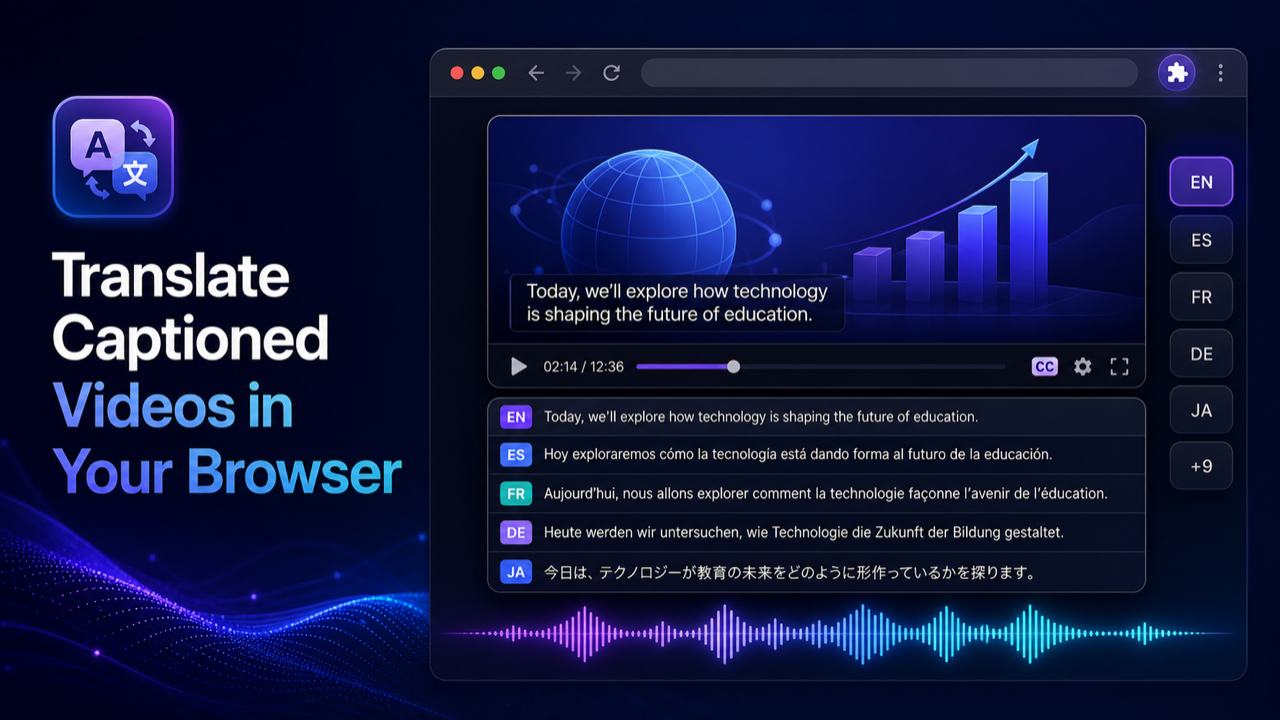
When the player offers no English option, or you want to hear English instead of reading it, a browser extension can do the work in the tab where the video already plays. The Unlimited Universal Video Translator is a Chrome extension for desktop Chrome that reads the video's existing caption track, translates it, and then shows English subtitles, plays AI text-to-speech dubbing in English over the original audio, or both.
It has been tested and works on Udemy, Coursera, YouTube, YouTube Shorts, edX, TikTok, TED, Vimeo, Khan Academy, gamedev.tv, Zenva and Domestika. Many other captioned HTML5 players may also work, but sites outside that list are not promised. For TikTok specifics, see how to translate a TikTok video.
How to translate a video to English this way:
- Install the extension in desktop Chrome and open the video in its usual page.
- Turn captions on in the player. The extension translates from the caption track, so the player has to expose one.
- Pick English as the target language, then choose subtitles, dubbing, or both.
- Press play. English text appears in the player, or the English voice reads along while the original audio is turned down.
There is no file to download, nothing to upload, and no account needed to start. The free path uses Google Translate for the text and an on-device English voice that runs inside the browser extension, so speech generation is not sent to a remote service. If you translate video often, the paid unlimited tier adds a real-time mode, premium and cloud voices, and LLM-based translation.
Some limits are worth knowing before you try it. It does not transcribe audio, so a video without a caption track will not work. It has no lip sync and no voice cloning; the English voice is a generated text-to-speech voice, not the speaker's. It does not import or export .srt or .vtt files, does not render a translated video file, cannot read text burned into the picture, and does not accept uploaded local files. It does not run on phones, and DRM-protected streaming video is out of scope.
What "english translator over video" means in practice
People often search for an english translator over video, meaning something that sits on top of the video they are already watching. In a browser that can mean two things.
The first is subtitles overlaid in the player. The English lines are drawn over the picture, usually near the bottom, timed to the original captions. The video itself is not changed; close the tab and it is exactly as before.
The second is a dubbed voice over the original audio. A text-to-speech voice reads each translated caption line at the moment it would be spoken, and the original soundtrack keeps playing at a lower volume. Captions carry the words but not the music, sound effects or the speaker's pauses, so muting the original would strip out everything around the speech. Keeping it audible also lets you notice when the speaker changes tone or points at something on screen.
Neither version moves the speaker's lips or copies their voice. If you need those, you are looking at a production tool, and our pages on AI video translation with lip sync and voice cloning explain what that involves.
Method 3: no captions, so transcribe first
If the video has no caption track, every translation method above has nothing to read. You need speech recognition first: software that listens to the audio and writes a transcript with timestamps. Only then can the text be translated into English.
This is a separate category of tool. Transcription services usually take an uploaded file or a link, process the audio on their servers, and charge by the minute of audio, often with a small free allowance. Prices change often, so check the current per-minute rate before uploading a two-hour recording.
A typical workflow looks like this:
- Get the audio or video file you are allowed to use.
- Run it through a transcription tool in the original language, not straight to English, so you can check the transcript.
- Fix names, numbers and technical terms in the transcript. Errors here multiply after translation.
- Translate the corrected transcript into English, and export it as a subtitle file if you want timed captions.
The transcript is also useful on its own if you only need to read the content in English rather than watch it.
Method 4: a human translator for anything that matters
Machine translation is fine for understanding a video you are watching. It is not fine for a video you will publish with your name on it, a contract walkthrough, a medical explanation or evidence in a dispute. In those cases a professional translator, ideally a native English speaker who knows the subject, should produce or review the English text.
If you need to translate my video to English, as creators often phrase it, for a public release, plan for human review at least on the parts people will quote. Our overview of video translation services explains what agencies and freelancers typically deliver and what to ask for.
How good is the English? It depends on the source language
AI can translate video to English quickly, but quality varies with the language you start from. How close the source grammar is to English matters, and so does the quality of the source captions.
Closely related European languages such as Spanish, French, German, Italian and Portuguese usually translate into English cleanly. Word order and sentence structure line up well enough that the meaning survives, and machine translation for these pairs has had a lot of training material.
Languages with very different grammar need more care. Japanese and Korean often drop the subject of a sentence and use honorifics that have no direct English equivalent, so the English can come out stiff or guess the wrong "he" or "she". Chinese does not mark tense on verbs the way English does, so it can be unclear whether something happened or will happen. Turkish packs a lot of meaning into a single long word, and spoken Arabic dialects differ a lot from the written standard that translation engines know best.
Names and technical terms fail in every language. Automatic captions mishear product names, people's names and jargon, and translation then turns a misheard word into a confident wrong one. When a term in the English sounds odd, switch the player back to the original captions for a moment and compare.
We have separate notes on the pitfalls of each pair: Spanish, French, German, Italian, Portuguese, Russian, Turkish, Arabic, Chinese, Japanese and Korean.
South Asian source languages: Telugu, Bengali and others
Videos in Telugu, Bengali, Tamil and other South Asian languages are harder for a simple reason: fewer of them have a caption track in the first place, and where platforms generate automatic captions for these languages, they are less accurate than for English or Spanish. Code-switching, where a speaker moves between Telugu or Bengali and English in the same sentence, confuses speech recognition further.
Anyone looking for a telugu video to english text converter should know that no converter can produce text from nothing: it still needs either an existing caption track or a transcript made from the audio. If the video has captions, translating them works like any other language. If not, you are in Method 3, and it is worth checking the transcript before translating.
The same applies to bangla to english video translation. With good Bengali captions, the English is usually understandable, though idioms and forms of address may read flatly. With auto-generated Bengali captions, expect errors in names and some mistimed lines, and treat the English as a guide rather than a record of what was said. For the text side of this, translate video to text goes into more detail.
Which method to use
For a captioned video you are watching in the browser, the player's own translation or the in-tab extension is enough. If you would rather listen than read through a long course, use in-tab AI dubbing on a supported platform. With no captions, transcribe first and translate second. And when the English will be published or relied on, pay a human translator.
If you want to translate this video to English right now, and it sits on a tested platform with captions switched on, the in-tab route takes the fewest steps. Otherwise, start by checking whether a caption track exists.
Related guides
- AI video translator: what AI translation of video does and does not do
- Video translator Chrome extension: how the in-tab approach works
- YouTube video translator: YouTube-specific options
- How to translate a video: the general guide for any target language
- Video translation services: hiring people for publishable work
Frequently asked questions
How do I translate a video to English for free?
If the video has captions, turn them on and use the player's own translation where it exists, or a browser extension that translates the caption track in the tab. The Unlimited Universal Video Translator is free to start and works on the tested platforms listed above. Videos without captions need transcription first, which is usually paid per minute.
Can I translate a video to English without captions?
Not with caption-based tools, including our extension, because they have nothing to read. You need a transcription tool that listens to the audio and writes a transcript, which you then translate. Check the transcript before translating, since mistakes carry into the English.
Can AI translate video to English with the original voice?
Caption-based in-tab dubbing uses a generated text-to-speech voice, not the speaker's own voice, and does not change lip movement. Voice cloning and lip sync exist in separate production tools that work on uploaded files. For watching, a clear generated voice over the lowered original audio is usually enough.
Why does the original audio stay on when English dubbing plays?
The captions only contain the spoken words. Music, sound effects and pauses are not in them, so the original track is kept at a lower volume to preserve them. It also lets you hear the speaker's tone while the English voice carries the meaning.
Does this work on my phone?
The extension runs in desktop Chrome only and does not install on phones. On mobile, use the app's own caption translation where it is offered, such as the auto-translate option in the YouTube app. Our iPhone guide covers other mobile options.
Other ways people search for this
People type this question in many forms, and they all lead to the same two decisions described above. Some search for how to translate video to English or how to translate videos to English, others for how to translate a video into English or how to translate videos into English. Some just type "video to english", "video translate to english" or "translation video to english" into the search box, and at least one common search is written exactly as "translate. a video to english." with the stray periods included. Shorter phrasings such as "video translator english" and "video translator to english" are usually looking for a tool, while "translate videos to english", "translate videos into english", "translate video into english" and "translate a video into english" tend to come from people with a batch of clips to get through. A search for video translation to English on a course site usually means a lecture. People who ask to auto translate video to English, or type "auto translate to english video", mostly want the automatic caption translation a player offers, and "ai to translate video to english" usually means in-tab AI dubbing or a transcription tool. Whatever the wording, check for a caption track first.