
How to Translate a Portuguese Video to English in Chrome
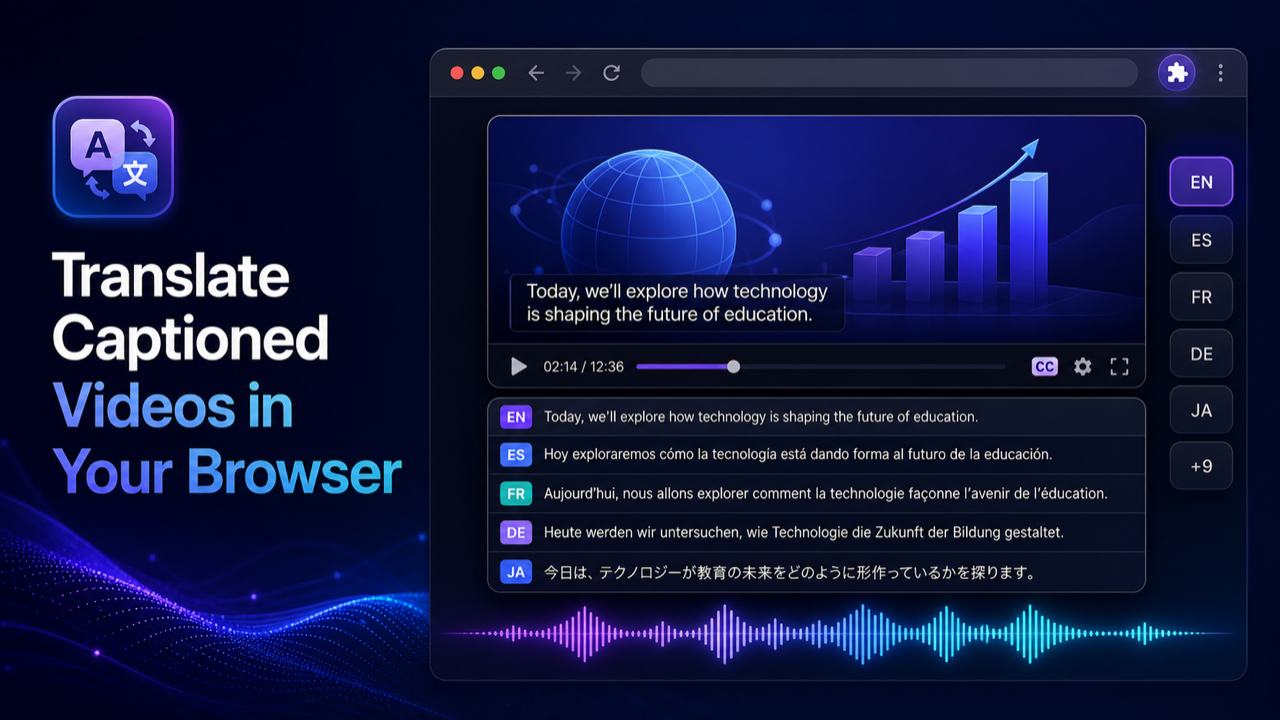
If you want to translate a Portuguese video to English, the first thing worth figuring out is which Portuguese you're dealing with. Brazilian and European Portuguese are close enough that speakers understand each other, but different enough (in vocabulary, rhythm, and especially pronunciation) that they behave like two separate inputs for a translation tool. Unlimited Universal Video Translator, a Chrome extension, turns the caption track a video already has into English captions or a synced English voiceover. It cannot listen to raw audio and invent captions from nothing: no captions on the video, no translation, no matter which Portuguese is being spoken.
Brazilian or European Portuguese: it changes what to expect
The two varieties don't just sound different, they sometimes use different words for the same thing: a Brazilian speaker takes a trem, a Portuguese speaker takes a comboio; a Brazilian rides an ônibus, a Portuguese rider takes an autocarro. Pronoun placement shifts too. European Portuguese tends to put object pronouns before the verb in cases where Brazilian usage puts them after. None of that breaks translation on its own; auto-captioning and machine translation handle vocabulary variation reasonably well.
Pronunciation is the bigger problem. European Portuguese reduces unstressed vowels heavily, to the point that syllables Brazilian speech pronounces fully almost disappear in Portugal's spoken rhythm. Most auto-captioning models are trained predominantly on Brazilian speech, and their accuracy drops noticeably on European Portuguese audio as a result. If the video you're working from is from Portugal rather than Brazil, check the caption quality before you trust the English output: a mangled Portuguese caption produces a mangled English one, and the extension has no way to know the caption was wrong to begin with.
The caption requirement, restated plainly
The extension reads whatever caption track the video player exposes. It does not do speech-to-text. That means it only works where captions exist and where the player doesn't hide them from the page. It's been tested on YouTube, Udemy, Coursera, TED, Vimeo, and Khan Academy. It hasn't been tested on Facebook, Skillshare, or LinkedIn Learning, so don't assume it behaves the same there.
Setting it up in Chrome
- Install Unlimited Universal Video Translator from the Chrome Web Store.
- Open a Portuguese video on a supported site and turn on its Portuguese captions in the player itself first.
- Click the extension icon, choose Dub, and set the target language to English.
- Start with Standard mode, Google Translate, and the built-in local voice, which is the free combination.
- Play the video and check names, numbers, and any technical terms against the original caption text.
The video file itself is never uploaded. The caption text is sent to Google Translate when that engine is selected, because the translation has to happen somewhere outside your device. The local voice runs on-device. Real-time mode, LLM-based translation, and premium cloud voices are part of the paid tier. They aren't part of the free path.
Where Portuguese-to-English translation actually trips up
A few things about this specific language pair are worth knowing before you rely on the English output:
- Portuguese has a personal infinitive: an infinitive form that still marks its subject (para eles saírem, "for them to leave"). English has no equivalent construction, so that subject marking disappears in translation and has to be reconstructed from context, which a machine translator doesn't always get right.
- Você, tu, and o senhor mark different levels of formality toward "you." English collapses all three into a single word, so tone that a Portuguese viewer would pick up instantly can flatten out in the English captions.
- Nasal vowels (ã, õ) are a common source of auto-caption errors. A mis-heard nasal can swap one Portuguese word for an unrelated one, and that wrong word carries straight through into the English translation.
- Portuguese frequently drops the subject pronoun entirely, since the verb ending already implies it. Short segments translated in isolation sometimes end up with an English pronoun that's a guess rather than a certainty.
- Contracted prepositions plus articles (do, na, pelo, and similar forms) can get split in the wrong place by automatic captioning, which changes which noun a phrase is actually attached to.
When it won't work
Live streams generally don't expose a stable caption track for the extension to read. DRM-protected video and players that deliberately hide their captions from the page are also out of reach. If the source video simply has no captions (common on older or informal Portuguese-language uploads), there's nothing to translate, and no setting changes that.
Related guides
For the mechanics that apply across any source language, see the general guide to translating a video to English. Arabic is another case where a standard-versus-dialect split shapes what to expect: that's covered in the Arabic video translation guide. And if you're deciding whether the free tier covers your use case, what the free video translator actually includes lays that out.
FAQ
Does it work on videos without captions?
No. The extension reads existing captions; it doesn't transcribe audio, so a video with no Portuguese captions can't be translated.
Is European Portuguese handled as well as Brazilian Portuguese?
Auto-captioning tends to be less accurate on European Portuguese audio, since most caption models lean on Brazilian speech data. Check the source captions before trusting the English translation.
Can I get an English audio track instead of captions?
Yes, with Dub mode and a local voice on the free tier, or a premium cloud voice on PRO. Either way it plays back synced in the browser. It isn't exported as a file.
Will this download the video with English subtitles?
No. It translates what plays in the browser tab; it doesn't produce a downloadable file or an SRT.