AI Video Translators for E-Learning Content: A Learner Guide
AI video translators for e-learning content have a narrower job than the dubbing tools built for films. A lecture is not entertainment you can half-follow. You are supposed to come out of it able to do something you couldn't do before, and that falls apart fast when the audio is in a language you only partly hold onto.
This guide is about the learner side of that problem: what AI dubbing and translated subtitles actually change while you study, what the tool needs from the course platform before it can do anything, and where the translation gets shaky on technical material.
Why course video is the hardest thing to watch in a second language
A film gives you faces, context, and a plot that carries you over the words you miss. A lecture gives you none of that. The information lives entirely in the speech, and it arrives at a fixed pace set by someone who assumed the room already spoke their language.
Three things make it worse than ordinary video.
- The density. An instructor packs definitions, exceptions, and caveats into a single sentence. Miss the caveat and you learn the rule wrong.
- The split attention. Course video almost always has something on screen that matters: a code editor, a spreadsheet, a diagram, an equation being written out. Reading subtitles at the bottom means not watching the thing being explained.
- The length. A two-hour section is not a four-minute clip. Whatever effort the translation costs you per minute, multiply it by the length of the whole track.
That second point is the one most people underrate. You can survive subtitles for a short video. Over six hours of a course you start skipping back, and the course takes twice as long as it should.
What AI dubbing and translated subtitles change
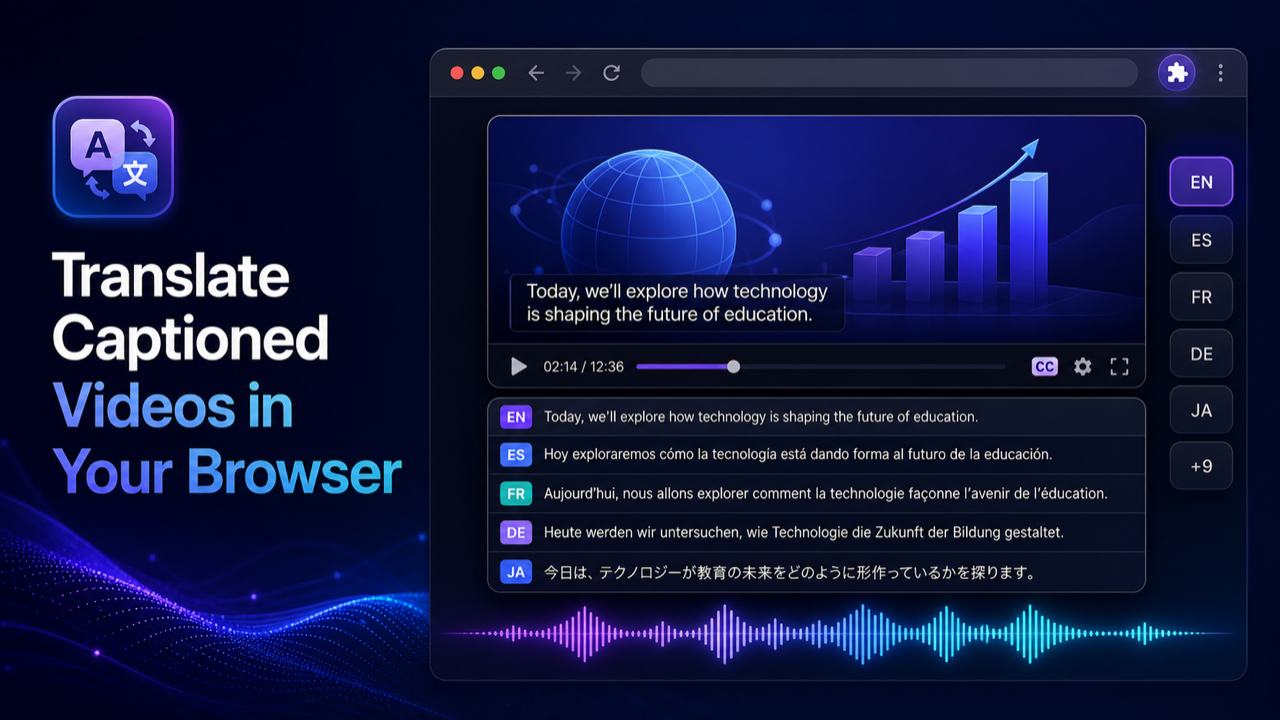
An AI video translator works from the text of what's being said. The one I build, Unlimited Universal Video Translator, is a Chrome extension that does this in the page you are already watching. It finds the caption track the page exposes, translates that text into your language, and then either shows it as subtitles or hands it to a text-to-speech voice that plays over the video with the original audio lowered underneath. The AI video translator guide walks through the same pipeline in detail.
For a learner the dubbed audio is the part that matters. Your eyes stay on the screen where the demo is happening, and the explanation arrives through your ears in a language you don't have to decode. Subtitles are still useful, just for a different reason: when the instructor says a library name or an acronym, seeing the source text beats hearing a voice approximate it.
Running both at once is the setup most people land on for technical courses. Hear the concept, read the term.
The caption requirement on course platforms
Here is the limit to understand before installing anything. A browser-based translator needs a source caption track to read. It doesn't transcribe audio, so if the lecture has no captions the page exposes, there is nothing to translate.
On Udemy and Coursera that usually works out, because both platforms machine-transcribe a lot of their catalogue, and instructors upload subtitles too. Caption availability is decided per course though, so two courses from the same instructor can behave differently. Turn captions on in the player first; the extension detects the track, not the sound. Live sessions, DRM-protected video, and caption-free uploads may not work at all.
Platform-specific walkthroughs live in the Udemy course translation guide and the Coursera course translation guide, including where each platform's own subtitle menu stops being enough.
What voice over translation software for online learning actually does
The phrase voice over translation software for online learning covers a few different products, and they are not interchangeable. Studio tools record a human voice actor over a finished course, which is what a publisher pays for when it localizes a catalogue. Browser tools like this extension generate a synthetic voice on the fly for whoever is watching.
The synthetic route gives up some things. There's no performance, no script editing, no re-recording a line that landed badly. The timing follows the caption cues, so a long translated sentence can feel slightly rushed against a short original one.
What it gives you instead is coverage. Any captioned lecture, any of the languages the voice engine supports, immediately, without asking the course author to fund a localization. For a learner that trade is usually worth making. Nobody is going to fund a human-dubbed version of that course for your benefit, so the realistic comparison is six hours of reading subtitles.
Free path versus PRO on a long course playlist
The free path is a working setup on its own: Google Translate for the caption text, plus an on-device voice that runs inside your browser to speak it. No account, no watermark. For a single course in a language with decent voice support, that's often the end of the story.
Volume is where the free path starts to chafe. Course playlists are long, and two things get noticeable over hours of listening:
- Translation quality on jargon. Standard machine translation handles plain speech well and slips on domain vocabulary. PRO can use LLM translation, which reads context better and tends to keep technical phrasing intact.
- Voice coverage and quality. The on-device catalogue doesn't include every language or voice style. PRO adds premium local voices and cloud voices, which matters more when you're listening for an hour than for four minutes.
PRO also has a real-time mode that starts speaking sooner instead of generating the whole track first, and bring-your-own-key support if you'd rather use your own AI provider. Start on the free path, and only move up if the free voice or the free translation is the thing slowing you down.
Accuracy caveats on technical terminology
Machine translation is weakest exactly where course content is strongest: named things. Library names, function names, product names, statistical terms, anatomical terms. A translator will sometimes render a term literally when the field actually uses the English word, and sometimes translate a proper noun that should have been left alone.
Two habits fix most of it. Keep the original captions available so you can glance at the source term when the dub says something that doesn't sound like a real word in your field. And slow the playback slightly on dense passages, since the platform's speed control still works underneath the extension.
If a course is heavily notation-based, expect to read as much as you listen. No dubbing tool reads an equation aloud correctly in your language.
What this does not do
Worth being blunt about the boundaries, because the category name invites the wrong assumption.
This is a viewer tool. It helps you watch a course in your language. It does not localize a course you publish: there's no export, no dubbed file to ship to students, nothing you can attach to your own upload. If you're an instructor who wants a translated version of your course for your audience, that's a production job, not a viewing job, a browser extension.
It also doesn't create captions where none exist, doesn't download the video, and doesn't upload it anywhere. The video file stays where it is. The caption text may go to the translation or voice provider you selected, and on the free path the voice is generated on your own device.
Frequently asked questions
Do AI video translators for e-learning content work on any course platform?
They work wherever the page exposes a caption track the extension can detect, which covers YouTube, standard HTML5 players, and course sites like Udemy and Coursera. A lecture with no detectable captions can't be translated.
Can I listen to a lecture in my language instead of reading subtitles?
Yes. AI dubbing speaks the translated captions over the video while the original audio is lowered, so you can keep watching the slides or the code instead of the subtitle line.
Is there a free option for translating course video?
Yes. The free path uses Google Translate for the caption text and an on-device browser voice to speak it, with no account and no watermark. PRO adds LLM translation, premium and cloud voices, and real-time mode.
Will the translation get technical terms right?
Not always. Standard machine translation slips on library names, jargon, and proper nouns. Keeping the original captions visible lets you check the source term, and PRO's LLM translation handles context better than a plain machine-translation route.
Can I use this to publish a translated version of my own course?
No. It translates playback for the person watching. There's no file export and no dubbed copy to distribute, so instructor-side localization is outside what it does.
Does it work on live classes?
Live streams may not work, since the tool depends on a caption track the page exposes. Recorded lectures with captions are the reliable case.