
AI Video Translator: Dubbing for Supported Captioned Videos
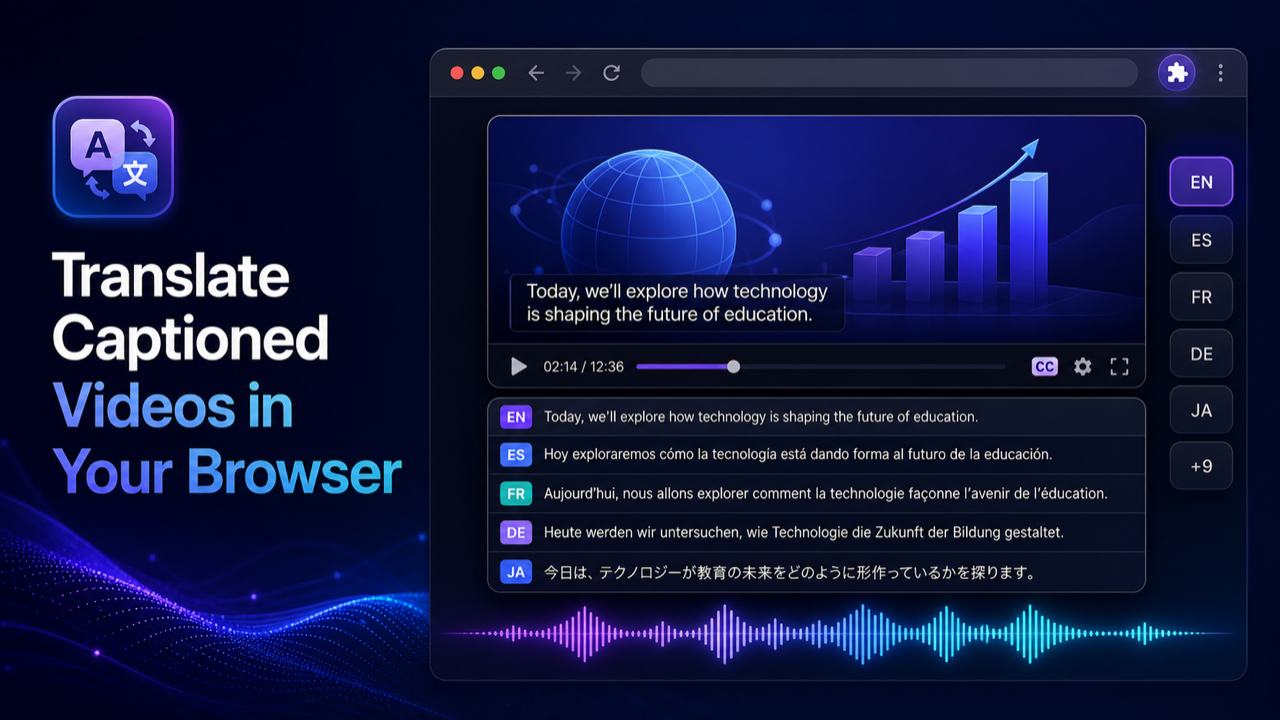
An AI video translator takes a video in one language and hands you a version you can follow, either as translated text on screen or a generated voice speaking over the original. Ten years ago that was a studio job with a script, a booth and an editor. Now a browser extension does it while the video plays, without the file leaving your computer.
This page is about the machinery rather than the shopping: which parts are genuinely AI, where the output holds up, and what the free engines do compared with the paid ones. For the shortest route to a dubbed video, the how to translate a video guide is the hub.
The four stages of AI video translation
Behind "translate this video" sits a short pipeline. Knowing the stages tells you why some videos work on the first click and others never start at all.
- Detect. The tool finds the caption track, which is the text of what is being said.
- Translate. That text is converted into your target language. Machine translation or an LLM does this part.
- Speak. For dubbing, a text-to-speech voice turns the translated text into audio.
- Sync and play. The generated speech is timed to the video and played while the original audio is lowered underneath.
Every AI video translator that runs in a browser does some version of these four steps. The Unlimited Universal Video Translator extension runs the whole pipeline inside your browser tab, on captioned videos, so the video file itself never gets uploaded.
Stage one, caption detection, is not AI
The first stage disappoints people who expect magic. Finding the words is plumbing, not intelligence. The extension looks for the subtitle or caption track the page already exposes, reads the cues out of it, and stops there. It does not listen to the audio and it does not transcribe speech.
That single design choice explains most of what follows. It is why the extension starts in a second instead of a queue, why nothing has to be exported, and why a video with no captions gives you nothing. Live streams, DRM-protected video and caption-free uploads may not work, because there is no text to read.
Caption tracks carry more than words. Each cue comes with a start time and an end time, and that timing is what makes stage four possible. Any AI translation of video that starts from a caption file inherits the source timing for free.
Stage two, translation, where the first AI sits
Once the text exists, it has to change language. The free path sends caption text through Google Translate. The PRO path can use LLM translation, which handles context and phrasing better than a straight machine-translation route, and that matters more than it sounds.
Classic machine translation works close to the line. It sees a cue, produces a cue, and moves on, so a pronoun whose referent sat two sentences earlier is a coin flip. An LLM route has more context, so it picks the phrasing that fits the passage rather than the fragment. On a cooking video nobody notices. On a forty-minute lecture about distributed systems you notice within a minute.
This stage also decides whether an ai powered video translator feels smart or clumsy, because the voice in stage three can only read what stage two wrote.
Stage three, voice generation, where the second AI sits
Text-to-speech turns the translated lines into audio. The free path uses an on-device voice that runs in your browser, which is why there is no meter running and no server bill to pass on to you. PRO adds premium local voices and cloud voices for wider coverage and better quality.
The gap between those options is mostly prosody. An on-device voice is clear and easy to follow, and after ten minutes you stop noticing it. Premium and cloud voices put the stress in more believable places, which makes a long session less tiring. Neither one is acting, though. If you want a voice performance you want a human, and no AI video translators on the market change that.
Stage four, timing and ducking
The generated speech is synced to the video and played while the original audio is turned down underneath. Ducking the original rather than muting it is deliberate. You keep the music, the room and the laughter while the translated line carries the meaning.
Timing comes from the caption track, which is why the dub lands roughly where the original speech lands. Browser speech can start quickly. Other standard voices may need the track generated before playback, and the PRO real-time mode starts speaking sooner instead of waiting for a full track to finish.
Where AI helps and where it stops
Two of the four stages run on AI models. The other two are ordinary code, and being clear about which is which saves disappointment, because most complaints about ai translating videos expect intelligence in the wrong place.
| Stage | Is it AI? | What that means for you |
|---|---|---|
| Caption detection | No | Captions must exist and be turned on |
| Translation | Yes | Free uses Google Translate, PRO can use LLM translation |
| Voice generation | Yes | Free on-device voice, PRO premium and cloud voices |
| Timing and ducking | No | Timing is inherited from the caption cues |
So AI does not rescue a video with no caption track, and using AI for video translation does not repair a source transcript that was wrong to begin with. If YouTube mishears a library name, the translation step will confidently translate the wrong word. Errors stack when stages feed each other.
What to expect on technical terminology
Terminology is where ai video translation earns or loses your trust, and the pattern is predictable enough to plan around.
Ordinary speech translates well. Numbers, names, commands, library names and product names are the weak spot, and they are exactly the words you needed. Two habits fix most of it. Run dubbing and translated subtitles together on technical content, so you hear the explanation and read the term. Then toggle back to the original captions when the speaker starts spelling something out, because the source text sits closer to the truth than a translation of it.
If you work in a specific field, try the LLM route on PRO before concluding that ai for video translation cannot handle jargon. Context is what it adds.
Free engines versus PRO engines
The free path is a complete AI video translator on its own. Google Translate for the text, an on-device AI voice for the speech, no account, no watermark, no forced upload. For most people who want to understand one video tonight that is the end of the story, and the free video translator guide covers the edges.
PRO exists for people who translate video constantly and want more from each stage:
- LLM translation for context-aware phrasing instead of line-by-line machine translation.
- Premium local voices and cloud voices for higher quality and wider language coverage.
- Real-time mode that starts speaking faster instead of waiting for the full track to generate.
- Bring-your-own-key support if you would rather use your own AI provider.
Start free. Move up only when you can name what the free path would not do.
Language and voice coverage
Any ai video language translator runs into the same asymmetry. Text coverage is wide. Voice coverage is narrower.
The translation route handles a long list of languages, so the subtitle half of the job usually works wherever you point it. Speech is the constraint. The on-device catalog that speaks the translation does not include every language or every style, which is why PRO adds premium local voices and cloud voices that reach further. So when you ask AI to translate video to another language that is less commonly served, turn captions on, confirm the source language, then pick the target. If subtitles appear but nothing speaks, the target has no on-device voice, and a premium or cloud voice fills that gap.
People also search for this as a video language changer, and an ai video language changer describes what the dub does to your listening experience. The original file does not change. Your playback does.
The one requirement to know
An AI video translator that works in the browser needs something to translate from. This one works from the captions the page exposes, so the video needs captions and they need to be on in the player. There is no audio transcription step to fall back on.
For the vast majority of educational and informational video, captions are present. YouTube auto-generates them for most uploads, and course platforms add them for accessibility. The exceptions stay the same everywhere: live streams, DRM-protected video and uploads with no caption track.
How to use it
- Install the extension and open a captioned video, whether that is YouTube, a course on Udemy or Coursera, or a standard HTML5 player.
- Turn on captions in the player so the extension can detect them.
- Click the floating Dub button, then choose your language, mode, speech engine and voice.
- Play the video and listen to the dubbed track, synced automatically, with the original audio ducked down. Prefer reading? Use translated subtitles instead.
Settings are kept per video, so a Spanish lecture and a Japanese interview need not share one configuration. No account is required to start, and there is no watermark.
What "automatic" actually covers
When people look for an ai auto translate video workflow, they mean they do not want to touch a transcript. Caption text gets translated and spoken without you editing a line, so you can auto translate video ai style across a playlist without opening an editor.
The setup is not automatic. You still choose the target language, the mode, the speech engine and the voice. After that, pressing play is the entire interaction.
Software, online tools and browser extensions
Searches for ai video translation software and ai video translator software usually land on upload-based web apps, which are built around a file. You export the video, upload it, wait for processing, then download a dubbed copy. If you own the video and need a finished localized master, that shape is right.
An ai video translator online in that sense is a different job. A browser extension never receives the file. It reads the caption text the page already serves, translates it, and plays speech over the video in place. Calling it an online ai video translator is half accurate: the file stays put, while caption text does reach the translation route and, if you pick them, cloud voices.
What the Reddit question is really asking
Queries like ai video translator reddit come from people who want someone without a product to sell to say whether this works. Based on the mechanics above, the honest version is short. AI translation of the words and AI generation of the voice both work well enough to learn from on captioned content today. The usual failure is caption detection, so keep the original captions one click away.
Related guides
How to translate a video is the general hub covering all three routes. The Chrome extension guide covers installation and browser requirements, Free Video Translator sets out where the free path stops, and the real-time mode comparison covers the wait before playback. Most people try this on YouTube first, which the YouTube video translator guide handles, and for on-screen text rather than a voice read translate video subtitles.
Frequently asked questions
What is an AI video translator?
It is a tool that reads a video's caption text, translates it with AI, and either shows the result as subtitles or speaks it as a generated voice synced to the video. The original audio is lowered underneath while the dub plays.
Can AI translate a video?
Yes, for the language part. AI handles the translation and the spoken voice. It does not create the caption track, so a video with no captions gives an in-browser tool nothing to work from.
Can AI translate videos in real time?
The PRO real-time mode starts speaking sooner instead of waiting for the whole track to generate. Browser speech can also begin quickly. Other standard voices may need the track generated before playback.
Is there a free AI video translator?
Yes. The free path uses Google Translate and an on-device AI voice, with no account and no watermark. PRO adds LLM translation, premium and cloud voices, and real-time mode.
Does the AI dubbing sound natural?
The free on-device voice is clear and understandable. For better prosody and wider language coverage, PRO adds premium local voices and cloud voices.
Can the AI translate context rather than single lines?
The free path uses standard machine translation, which works close to the individual cue. The PRO LLM route has more context available, which helps on technical or specialist material.
Is there an AI that translates videos without uploading them?
A browser extension does exactly that. The video file is never uploaded, although caption text reaches the translation route and any cloud voice you select.
Which sites does the AI video translator work on?
YouTube, standard HTML5 players and course sites such as Udemy and Coursera, anywhere the page provides captions the extension can detect.
Can I use AI to translate video language into something uncommon?
Text coverage is broad, so subtitles usually work. Voices are the narrow half, and the free on-device catalog does not cover every language. Premium and cloud voices on PRO extend it.
Do I need to upload my video to the AI?
No. The extension reads the captions the page already exposes and plays the dubbed audio over the video in place. On the free path the voice is generated on your device.
Other ways people search for this
This job arrives in dozens of shapes, most of them the same three words in a different order. None is a different product, so here they are as people search:
- Word order variants: translate video ai, ai translate video, ai video translate, ai translator video, video translator ai, video translation ai, video translate ai, video ai translator, ai translation video, translate ai video, video ai translate, ai video translate language, translate videos ai, video ai translation, ai translate videos, ai translate a video, ai video translators
- Phrasings with "with" and "for": translate videos with ai, translate video with ai, video translation with ai, ai for translating videos, ai for translate video, ai for translation video, ai to translate video, ai to translate videos, ai to translate a video, ai translator for videos, ai translate from video
- Language-focused phrasings: ai video language translator, ai language video translator, ai language translator video, ai language translator for video, ai language translation video, video language translator ai, translate video language ai, ai translate language video, ai translate video language, ai to translate video language, change video language ai, ai to translate video to another language, ai translate video to another language, ai translate video to different language
- Online and automated phrasings: ai video translator online, online ai video translator, ai translate video online, ai auto translate video, auto translate video ai
- Questions typed as queries: ai that can translate videos, ai that translates videos, can ai translate a video, can ai translate videos, ai video translator reddit
- Software phrasings: ai video translation software, ai video translator software, ai powered video translator, ai translation of video, ai translating videos, ai for video translation
- Misspellings and other languages, left as typed: ai video translater, ia video translator, ia video translate