
Khan Academy Video Translator In Your Language
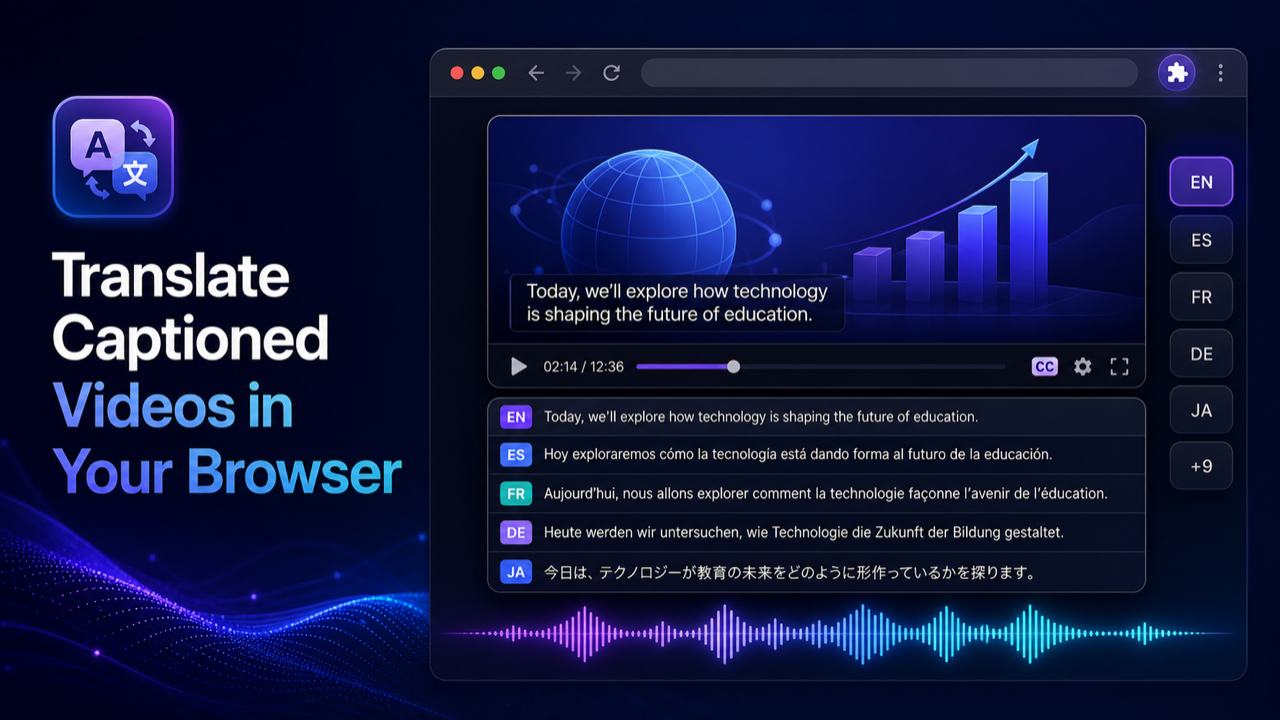
Khan Academy is one of the best free places to learn math and science, as long as you speak the language the lesson happens to be in. You go looking for a Khan Academy video translator because the exact video you need, on exactly the topic you're stuck on, is in English and moving faster than you can follow.
Here's the short version: Khan Academy has localized versions in several languages, but not every lesson is available in every language. On a supported lesson that exposes a caption track, Unlimited Universal Video Translator, a browser extension can translate those captions and generate spoken audio in another language. It cannot translate a lesson with no detectable source captions.
Khan Academy's localization
Khan Academy has invested real effort in reaching learners worldwide. Depending on the subject, you get:
- Localized versions. Some courses are fully translated or re-recorded into major languages through Khan Academy's international partners.
- English captions. Most core videos have English captions, and popular ones have captions in additional languages.
- Separate localized sites. For a few languages there are dedicated versions of the platform with translated content.
The catch is coverage. The deepest localization is concentrated on foundational courses and a handful of languages. Advanced or newer material, and most languages, is English-first, with captions at best.
Why the built-in options fall short
If Khan Academy's own translations haven't solved it for you, here's why:
- Your language may not have that course. Localized courses cover a limited set of subjects and languages. The exact lesson you need often isn't translated.
- Coverage thins on advanced topics. Foundational math might exist in your language while the higher-level or specialized video doesn't.
- Captions keep you reading. For STEM, your eyes need to be on the worked example, the graph, or the equation, not the subtitle line at the bottom.
- No spoken lesson in your language. Where only captions exist, you can't simply listen to the explanation in your language while you follow the math on screen.
For learning math and science, splitting attention between a subtitle and a worked problem is exactly the wrong tax to pay.
The better approach: AI dubbing in your browser
Instead of depending on whether a course was localized into your language, you add your own translation layer with a Chrome extension that runs on khanacademy.org. It reads the lesson captions, translates them, and gives you two things Khan Academy doesn't offer for every course. The first is AI-dubbed audio: the lesson spoken aloud in your language, synced to the video. The second is clean subtitles in any language you pick, even when the course wasn't localized.
The video file stays on its original page. Free Standard mode prepares a synchronized track; PRO offers realtime-capable engines.
How to translate a Khan Academy lesson, step by step
The first setup takes about two minutes. After that it's one click per video.
- Install the extension. Add the Universal Video Translator to Chrome from the Web Store. It's free to start.
- Open the lesson on Khan Academy and press play. Sign in if you track progress. The extension works inside your own session and doesn't touch your account.
- Pick your target language. Open the extension and choose the language you want to hear and read. This is where you get languages the course was never localized into.
- Choose dubbing, subtitles, or both. Want to keep your eyes on the math? Turn on AI dubbing. Prefer to read? Turn on subtitles. Both together is often best for STEM.
- Generate the translated track in Standard mode, or use a supported realtime engine in PRO, then press play.
Move to the next lesson and your settings carry over.
Tips for STEM learners
- Lead with dubbing on worked examples. Hearing the steps in your language lets your eyes stay on the equation or graph as the instructor writes it out.
- Turn on subtitles for definitions and terms so key vocabulary lands correctly.
- Keep original captions handy for notation. Symbols, formulas, and English math terms are often clearest in the original, so toggle back when the instructor names a specific term.
- Slow the playback slightly on dense derivations. Khan Academy's speed control still works underneath the extension.
Related guides
For another educational player, see the TED Talk translator guide. For paid course platforms, see Coursera and Udemy. The general video translation tutorial explains the shared caption requirement.
Frequently asked questions
Can I translate Khan Academy videos for free?
Yes. Khan Academy is free, and the Universal Video Translator is free to start, so you can dub and subtitle lessons without paying upfront. Heavier use may move you to a paid tier.
Does Khan Academy have my language for every course?
No. Localized courses cover a limited set of subjects and languages, and advanced topics are often English-only. That's the gap the extension fills.
Will using a translator affect my Khan Academy account?
The extension runs in your own browser on top of your normal session, like any reading or accessibility tool. It doesn't download the lesson or share your login. It only changes how the video is presented to you.
Can I hear a lesson in my language instead of reading?
Yes, and that's the main advantage for STEM. AI dubbing plays the lesson aloud in your language so you can watch the worked problem instead of the subtitle line.
What if the translation gets a math term wrong?
Any machine translation can slip on notation and jargon. Keeping the original captions available lets you glance at the source term when something sounds off.
Does it work on mobile?
It's a desktop Chrome extension, so it runs where Chrome extensions run. For working through math with a video, a laptop is usually the better setup anyway.