TED Talk Video Translator: Watch In Your Language
There's a TED Talk everyone keeps quoting, and when you finally sit down to watch it, the speaker is talking fast in a language you only partly follow. So you look for a TED Talk video translator, open the subtitle menu on ted.com, and find plenty of languages, just not yours, or not for that particular talk.
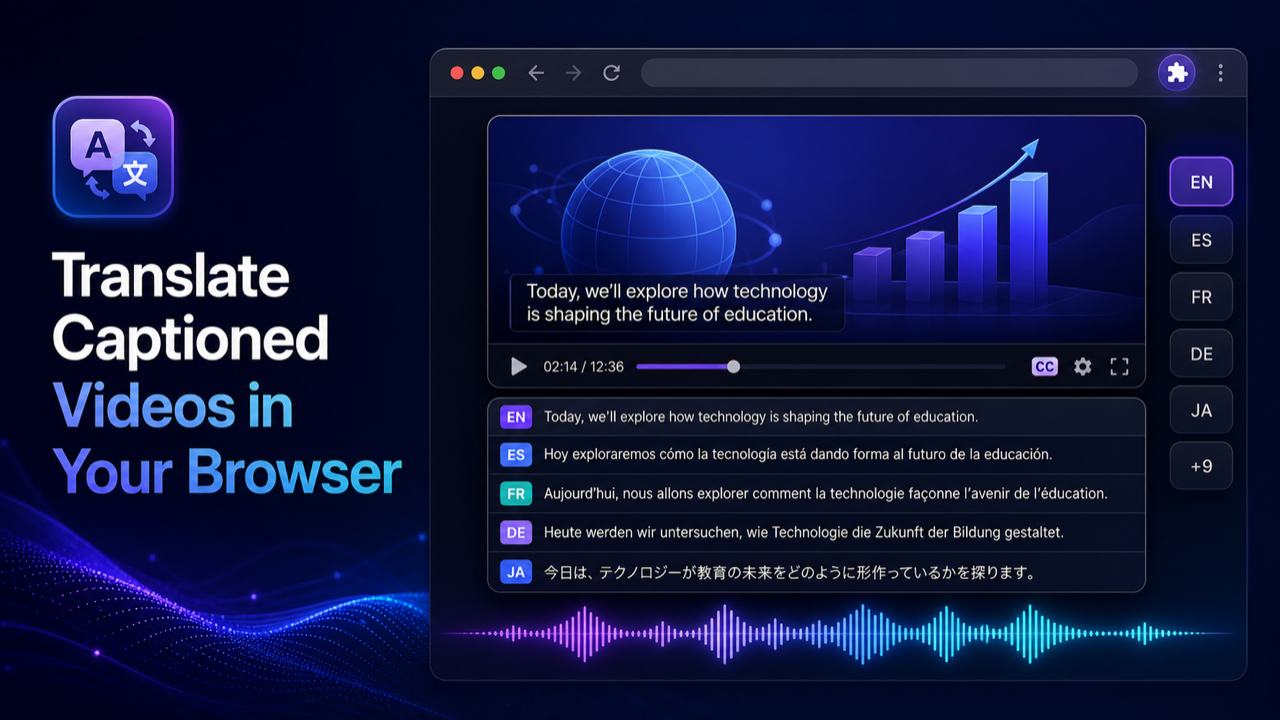
Here's the short version: TED has a substantial community subtitle program, but coverage differs by talk and language. When a talk on ted.com exposes a source caption track, Unlimited Universal Video Translator, a browser extension can translate that track and generate spoken audio in another language. It cannot translate a talk with no detectable source captions.
TED's subtitle situation
TED is unusually good at translation, thanks to a long-running volunteer program. Depending on the talk, you get:
- Community-translated subtitles. Volunteers have subtitled many talks into dozens of languages, shown in the subtitle menu on ted.com.
- Transcripts. Popular talks often have full text transcripts you can read alongside the video.
- Wide but uneven coverage. A famous talk from years ago might have 40+ languages, while a newer or niche talk might have only a few, or just English.
There's also a wrinkle: the TED channel on YouTube is a different surface with its own auto-translate, separate from ted.com's curated subtitles. Which one you're watching changes what's available.
Why the built-in subtitles fall short
TED's program is impressive, but it still leaves people stuck:
- Your language may not be translated for that talk. Volunteer coverage is deepest on the most-viewed talks. Step outside them and your language often isn't there.
- Newer talks lag. Translation takes time, so recent talks may have few languages or none beyond the original.
- Subtitles keep you reading. TED talks are about the speaker: their delivery, the slides, the pauses. Reading the bottom of the screen pulls you away from all of it.
- No spoken translation. ted.com gives you translated text, not translated speech. You can't simply listen to the talk in your language.
For a format built around a compelling speaker, being stuck reading subtitles undercuts the whole experience.
The better approach: AI dubbing in your browser
Instead of relying on whether volunteers reached your language, you add your own translation layer with a Chrome extension that runs on ted.com. It reads the talk's captions, translates them, and gives you two things TED doesn't always offer. The first is AI-dubbed audio: the talk spoken aloud in your language, synced to the video. The second is clean subtitles in any language you pick, when the talk exposes a source caption track.
The video file stays on its original page. Free Standard mode prepares a synchronized track; PRO offers realtime-capable engines.
How to translate a TED Talk, step by step
The first setup takes about two minutes. After that it's one click per talk.
- Install the extension. Add the Universal Video Translator to Chrome from the Web Store. It's free to start.
- Open the talk on ted.com and press play. There's nothing to log into, since the extension attaches to the player on the page.
- Pick your target language. Open the extension and choose the language you want to hear and read. This is where you get languages the talk never had.
- Choose dubbing, subtitles, or both. Want to focus on the speaker? Turn on AI dubbing. Prefer to read? Turn on subtitles. Both together works well for talks with slides.
- Generate the translated track in Standard mode, or use a supported realtime engine in PRO, then press play.
Tips for the best results
- Lead with dubbing for talks. TED is about delivery. Hearing the talk in your language keeps you watching the speaker instead of reading.
- Turn on subtitles for data-heavy talks. Talks with statistics, quotes, or named studies are easier to follow with translated captions on screen.
- Keep original captions handy for names. People, places, and study titles read best in the original. Toggle back when the speaker cites something specific.
- Pick the closest regional variant of your language when offered. It usually sounds more natural.
Related guides
The same caption-based workflow covers Khan Academy lessons and YouTube videos. For the caption requirement itself, review the video subtitle translation limits.
Frequently asked questions
Can I translate TED Talks for free?
Yes. TED's community subtitles are free where they exist, and the Universal Video Translator is free to start, so you can dub and subtitle talks without paying upfront. Heavier use may move you to a paid tier.
Does TED have subtitles in every language?
No. TED's volunteer subtitles cover many languages on popular talks, but coverage is uneven and newer or niche talks may have few languages or only the original. That's the gap the extension fills.
Does it work on ted.com and the TED YouTube channel?
It attaches to the video player on the page, so it works on ted.com and on the TED channel's videos alike, anywhere the player exposes audio and captions.
Can I hear a talk in my language instead of reading?
Yes, and that's the main advantage over ted.com's subtitles. AI dubbing plays the talk aloud in your language so you can watch the speaker instead of the subtitle line.
What if the translation gets a name or term wrong?
Any machine translation can slip on proper nouns. Keeping the original captions available lets you glance at the source when a name or study title sounds off.
Does it work on mobile?
It's a desktop Chrome extension, so it runs where Chrome extensions run. For watching talks with slides and data, a laptop is usually the better setup anyway.