
Video Subtitle Translator for Captioned Videos
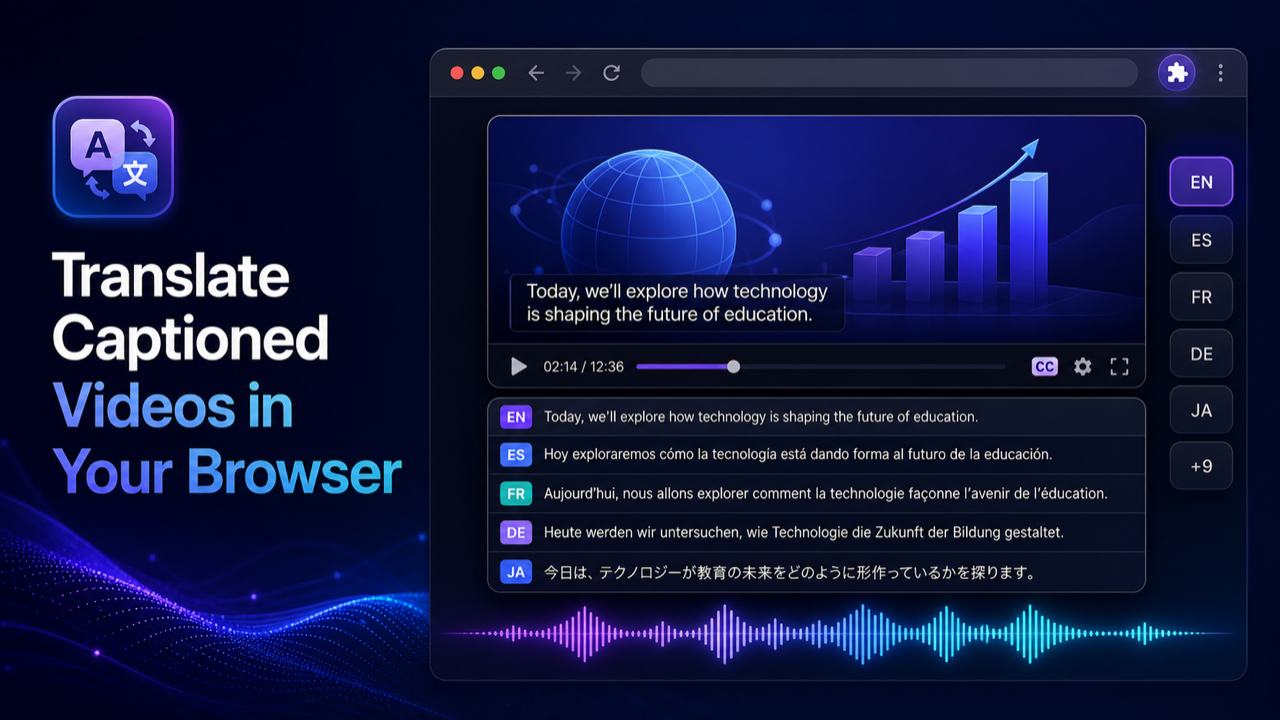
A video subtitle translator takes the caption track a player already serves and gives you the same lines in a language you read. That is the entire job. Nothing is downloaded, nothing is uploaded, nothing is rendered. If the video in front of you has captions you can switch on, you can translate video subtitles in the same tab while it plays.
Unlimited Universal Video Translator is caption-first. The page has to expose an existing subtitle track, and the viewer has to enable captions in the player. The extension then translates each segment, can display the translated text on screen, and can generate synchronized speech if you would rather listen than read. It does not transcribe audio, and it does not hand you a subtitle file at the end.
What happens to an existing caption track
Video subtitle translation in a browser is four steps, and knowing them tells you where the quality comes from.
- Detect. The extension finds the caption track the page is serving and reads its segments and their timings.
- Translate. Each segment of text goes through a translation route. The free path uses Google Translate; the PRO path can use LLM translation, which handles context and phrasing better on technical material.
- Display. The translated lines appear on screen, segment by segment, on the same timings the source track carried.
- Speak, optionally. For dubbing, an AI voice reads the translated text and the original audio is ducked down underneath.
Steps 2 and 3 are all you need if you only want to read, and they are the cheapest ones to run, because nothing touches the audio. To translate video captions and stop there is much less work than generating a voice track. When people say ai subtitle translation, this is the part they mean: machine translation applied to text that already exists, timed by a track somebody else authored.
Translated subtitles or dubbing
Dubbing gets more attention, but reading wins more often than people expect.
Reading wins when the words on screen have to be exact. Code, library names, CLI flags, chemical names, legal phrasing, numbers with units. A generated voice smooths those into something plausible, and plausible is the failure mode you cannot spot. Reading also wins when you want to scrub back and re-read one line.
Dubbing wins when the screen matters. A forty-minute screencast where the instructor is dragging things around a timeline is miserable to follow while your eyes sit at the bottom of the frame. Vendors sell that pairing as video translation and subtitling, and for watching a lecture you can simply run both at once: hear the dub, glance at the translated line when a term looks wrong.
Settings live per video rather than globally, so a Japanese interview and a Spanish course lecture can be configured differently.
Browser subtitles versus a subtitle file workflow
Choose in-browser subtitle translation when you want to understand a video now and stay on its original page. Choose a subtitle editor when you own the video and need a file to publish, edit, or deliver.
| Need | Browser translator | SRT/transcription tool |
|---|---|---|
| Watch on the original site | Yes | Usually no |
| Existing captions required | Yes | Not always |
| Download an SRT/VTT file | No | Yes |
| Add translated speech | Yes | Depends on tool |
| Render a new video | No | Depends on tool |
How to translate video subtitles to English
English is the most common target, so here is that path specifically. The same steps apply to any language the translation route covers.
- Install the extension from the Chrome Web Store.
- Open a supported video that has captions.
- Turn captions on in the player, then reload the page if the Dub control is missing.
- Select English as the target language.
- Enable translated subtitles. Add dubbing if you also want to listen.
That is the whole answer to how to translate video subtitles on a page you do not own. There is no account step, and the free path costs nothing, which is what people are after when they search for translate video to english subtitles free. The free path uses Standard mode, Google Translate, and an on-device voice. Realtime mode, LLM translation, premium local voices, and cloud voices are PRO options.
Turning captions on, player by player
Detection fails with no error message more often than translation does, and it is almost always because the caption track was never switched on. Where the control lives depends on the site.
On YouTube, the CC button sits in the player bar and the gear icon opens Subtitles, where auto-generated tracks appear for most uploads. Udemy and Coursera keep captions in the player controls too; both platforms add them for accessibility, so course lectures are usually the easiest material to work with. A plain HTML5 player offers the same CC control, since that is the standard surface a page uses to expose a track. A fair number of people search for a video cc translator for exactly that reason. CC is the only part of this machinery that is visible.
If no caption control exists, there is nothing to read, and nothing to translate. That is the honest end of the road for that video.
Subtitle quality is inherited, not created
The output of any ai video subtitle translator can only be as good as the track it starts from, and tracks vary enormously.
Creator-supplied captions are written or reviewed by a human. Punctuation is real, speaker changes are marked, product names are spelled correctly. Translate those and the result usually reads fine.
Automatic captions are a machine transcript, and translating them stacks two guesses. If the platform mishears a word, the translation route confidently renders the wrong word in your language, and you have no way to tell from the output. Technical vocabulary suffers worst, which is exactly the vocabulary you needed. Accents, background music, and crosstalk all make it worse.
So when translating subtitles from an automatic track, treat the result as a strong hint rather than a transcript of record. Check numbers and units before quoting them. If a sentence reads like nonsense, it probably started as a mis-transcription, not a mistranslation.
Names, code, and terminology
Keep the source captions visible alongside the translated ones when the material is full of identifiers. Function names, framework names, acronyms, and people's names are the things machine translation is most likely to helpfully ruin. Seeing the original line and the translated line together takes a second and saves a wrong command.
What you can change, and what stays fixed
Timing is not yours to adjust. The segments and their in and out points come from the caption track, which is why the translated lines land where the speech lands, and also why a badly timed source track produces badly timed translated lines. The extension does not re-time or re-segment what the page gave it.
What you do control is per video: the target language, the mode, the speech engine, and the voice. Those settings stick, so moving to the next lecture does not mean reconfiguring anything.
What a browser subtitle translator does not do
Three limits, stated plainly, because a lot of pages blur them.
It does not transcribe. If a video has no captions at all, the extension cannot translate it in the current release. There is no speech-to-text model running anywhere in it. You would need to generate a transcript first with a transcription tool, then translate that text elsewhere.
It does not export files. There is no SRT or VTT download, and no subtitle editing surface. The translated text is rendered for watching, in place.
It does not publish. If your goal is a localized file shipped with a video, you want a different class of tool. A subtitle translation service, a desktop editor, or whatever the current best subtitle translation software happens to be for your format will all handle timing edits, QC passes, and delivery formats. Browser tools and a subtitle translator online sit on the other side of that line: fast comprehension, no artifact.
This distinction matters because many pages call both jobs the same thing. Translating an existing caption track is fast and inexpensive. Creating accurate captions from noisy audio, separating speakers, fixing punctuation, and timing every line is a much larger workflow. If you want the words as text rather than as an overlay, Translate Video to Text covers that case directly.
Where the caption text goes
The video file is never uploaded. That is the structural privacy benefit of working from captions instead of media.
The caption text does travel, and it would be dishonest to imply otherwise. The translation route receives the text it needs to translate, which on the free path means Google Translate. If you select a cloud voice on PRO, that provider receives the text too. On the free path, speech is generated on your device inside the browser rather than on a remote server. Decide with that in mind before running an internal training video through any translation route, free or paid.
Free path and PRO
The free path here is the default state, with no trial clock attached. Standard mode, Google Translate for the text, an on-device voice if you also want audio, no watermark, no account. That is a working video subtitle translator free of charge.
PRO adds LLM translation for smarter phrasing, premium local voices and cloud voices for wider coverage, Realtime mode that starts speaking sooner instead of waiting for a full track, and bring-your-own-key support. If the free path does what you need, there is no reason to move. The translation quality difference shows up mainly on dense technical speech, where an LLM route reads better than a straight machine-translation route.
Related guides
Translate Video to Text draws the line between captions and a real transcript. How to Translate a Video is the hub page covering every route, and AI Video Translator explains the detect, translate, speak, sync pipeline in more depth. Free Video Translator sets out where the free path stops. For installation and browser requirements, read the Chrome extension guide. Per-site behavior on the platform most people try first is covered in the YouTube video translator guide.
Two platform pages cover players that behave differently: Vimeo video translator and the TED Talk video translator guide. If the subtitles you are comparing against came from Google Translate rather than the extension, Google Translate video explains the difference.
Frequently asked questions
What is a video subtitle translator?
It is a tool that takes the caption track a video already has and shows you those lines in another language. A browser-based one does it on the page, while the video plays, without downloading or uploading the file.
Can it translate a video that has no subtitles?
No. Existing detectable captions are required, because the extension reads a caption track rather than the audio.
How do I translate subtitles to english on a video I am watching?
Turn captions on in the player, open the extension, set English as the target, and enable translated subtitles. That covers most searches for translate video to english subtitles, whatever the source language is.
Are translated subtitles instant?
Caption text can appear quickly, but detection and translation still take time. Do not treat "instant" as a zero-delay guarantee.
Can I download the English subtitles?
Not from this extension. Use an SRT/VTT editor when you need a file. There is no export and no subtitle file editing here.
Does auto translate video subtitles mean I never touch anything?
Almost. You still pick the target language, the mode, the engine, and the voice once. After that, translation of each segment happens without you editing a line.
How accurate is it on automatic captions?
Less accurate than on creator-supplied captions, because errors in the machine transcript get translated as if they were correct. Technical terms and proper nouns are the usual casualties.
Does it work on every website?
No. It works on supported players that expose captions. DRM, live streams, hidden subtitle requests, and unsupported players may fail.
Can it add translated subtitles to my own uploaded file?
Not directly. The file has to be hosted somewhere with a caption track the page exposes. Video translation and subtitles for a file you are about to publish is a rendering job, and that belongs in an editor.
Other ways people search for this
This one job arrives under a long list of names, and several of them are typos. None of them is a different product, so here they are as people type them.
- Word order variants: video subtitle translate, video translate subtitles, video translator subtitle, video translation subtitles, video translate captions, subtitles translation, translator subtitles, ai video caption translator
- AI phrasings: ai translate video subtitles, ai translate subtitle video, ai translate subtitles video, ai subtitle translator video, ai video subtitles translator, ai video subtitle generator translator, ai subtitles translation, ai translate subtitles, translate subtitles ai
- Free variants: ai translate video subtitles free, ai video subtitle translator free, ai video translator subtitles free, auto translate video subtitles free, auto translate video to english subtitles free
- Automatic phrasings: auto translate video subtitles, auto translate subtitles video, auto caption translate video
- Shortened forms and typos, left as typed: sub translate, sub translation, substranslate