
Translate an Italian Video to English: What to Expect
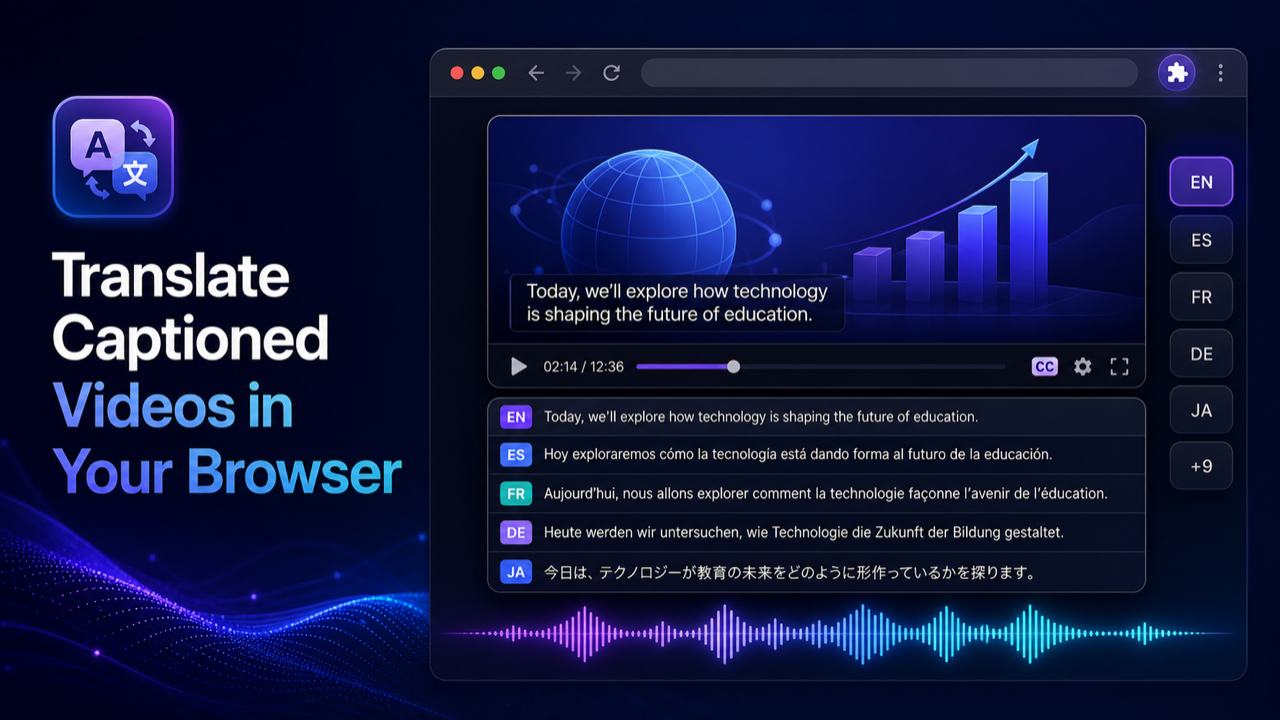
If you want to translate an Italian video to English, the honest starting point is accuracy, not features. Unlimited Universal Video Translator, a Chrome extension, can turn Italian captions into English subtitles or a synced English voice track directly in the player. It reads the caption text the video already carries. It does not listen to the audio and transcribe it. If the video has no Italian captions, there's nothing for it to translate.
What comes through clean, and what doesn't
A single Italian speaker talking directly to camera, such as a language lesson, a university lecture, a product demo, or a TED-style talk, tends to translate well, because the captions are usually well-timed and the sentences are complete. Documentaries with a narrator and scripted commercial content behave the same way: predictable pacing, standard grammar, one voice at a time.
Where it falls apart is fast, overlapping conversation: a panel discussion, a group interview, a comedy sketch with people talking over each other. Auto-generated captions struggle to assign the right words to the right speaker at that speed, and once the caption line is garbled, the English translation just carries the error forward. Strong regional speech causes the same problem for a different reason, covered below.
The one requirement: Italian captions have to exist
Before anything else works, the video needs a caption or subtitle track that the browser can read, either uploaded by the creator or generated automatically by the platform. The extension detects that track and translates it; it does not do speech-to-text of its own. No captions means no translation, full stop.
The video file itself is never uploaded. But translation has to happen somewhere: if you pick Google Translate for the text, or a cloud voice, or an LLM-based translation, the caption text needed for that step is sent to that provider. The free path (Standard mode, Google Translate, and an on-device Piper voice) keeps things closer to local, but it's not a fully offline experience. Real-time mode, LLM translation, and premium cloud voices are PRO features; none of them are part of the free tier.
Setting it up in Chrome
- Install Unlimited Universal Video Translator from the Chrome Web Store.
- Open your Italian video (YouTube, Udemy, Coursera, TED, Vimeo, and Khan Academy are the platforms this has actually been tested against) and make sure Italian captions are turned on in the player itself.
- Click the extension icon and set the target language to English.
- For a first run, stick with Standard mode, Google Translate, and the built-in local voice, so you can judge the baseline quality before spending on anything else.
- Play the video and read along with the original Italian captions where you can, especially for names, numbers, and technical terms.
- If the pacing feels off, switch between subtitle-only and dubbed voice. Subtitles are usually easier to sanity-check against the source.
Where Italian trips up the English translation
A few things about Italian specifically cause English output to go wrong, and they're worth knowing before you trust a sentence:
- Italian drops subject pronouns: it usually doesn't state "he," "she," or "I," because the verb ending already tells you who's acting (parla vs. parlo). In a short, isolated caption segment, that context can be missing entirely, and the English translation has to guess the person. It sometimes guesses wrong, especially right after a speaker change.
- The subjunctive, or congiuntivo, marks doubt, opinion, and hypothesis grammatically: penso che sia vero signals "I think this might be true," not "this is true." English mostly doesn't have an equivalent marker, so a hedged, uncertain claim can come out as a flat statement of fact. That's a real issue in academic or argumentative video, where the difference between "this is" and "this might be" is the whole point.
- Formal Lei and informal tu both collapse into a plain "you" in English, so a shift in register (a student suddenly addressed formally, or a formal interview turning casual) disappears from the translation entirely.
- Regional speech varies unusually widely across Italian: Neapolitan, Sicilian, and Venetian speech patterns differ from standard Italian in vocabulary and pronunciation, not just accent. Auto-generated captions are trained mostly on standard Italian, and their accuracy drops sharply once regional features show up, which then degrades whatever gets translated.
- Idioms tied to gesture or culture cause trouble too. Something like in bocca al lupo ("break a leg," literally "into the wolf's mouth") makes no sense translated word for word, and caption-level translation tools tend to render idioms literally rather than recognizing them.
- Double consonants change meaning in Italian, which relies on consonant length to distinguish words: capello (hair) vs. cappello (hat), nono (ninth) vs. nonno (grandfather). Auto-captions frequently mishear these, and the English translation just inherits whichever wrong word got captioned.
When it won't work
Skip this for live streams: there's no stable caption track to grab. DRM-protected video and players that actively hide their subtitle track are also out of reach; the extension only works with captions the browser can actually read. And it doesn't do anything the caption track doesn't already contain: no lip-sync, no cloned voice, no rendered output file, and no way to export or download a translated version. It's a viewer-side layer over the original playback, not a video editor.
Related guides
For a language-agnostic walkthrough, see the general guide on how to translate a video to English. If you're working across a different Romance language, the Spanish-to-English guide covers a similar but distinct set of pitfalls. And if the Italian content you're watching is a lecture on a course platform, translating Coursera courses walks through that setup specifically.
FAQ
Does it work without Italian captions?
No. There's no built-in speech-to-text, so a video with no caption track, auto-generated or otherwise, can't be translated.
Is any of this fully offline?
No. The on-device voice can run locally, but text sent to an online translator, cloud voice, or LLM leaves your browser to reach that provider.
Can I download the English version afterward?
No. The extension translates what plays in your browser; it doesn't render or export a new video file.
Will it handle a Neapolitan or Sicilian video as well as standard Italian?
Not reliably. Auto-generated captions are weaker on regional Italian, and that weakness carries straight through to the English translation.