
How to Translate Spanish Video to English in Chrome (Captions + Dub)
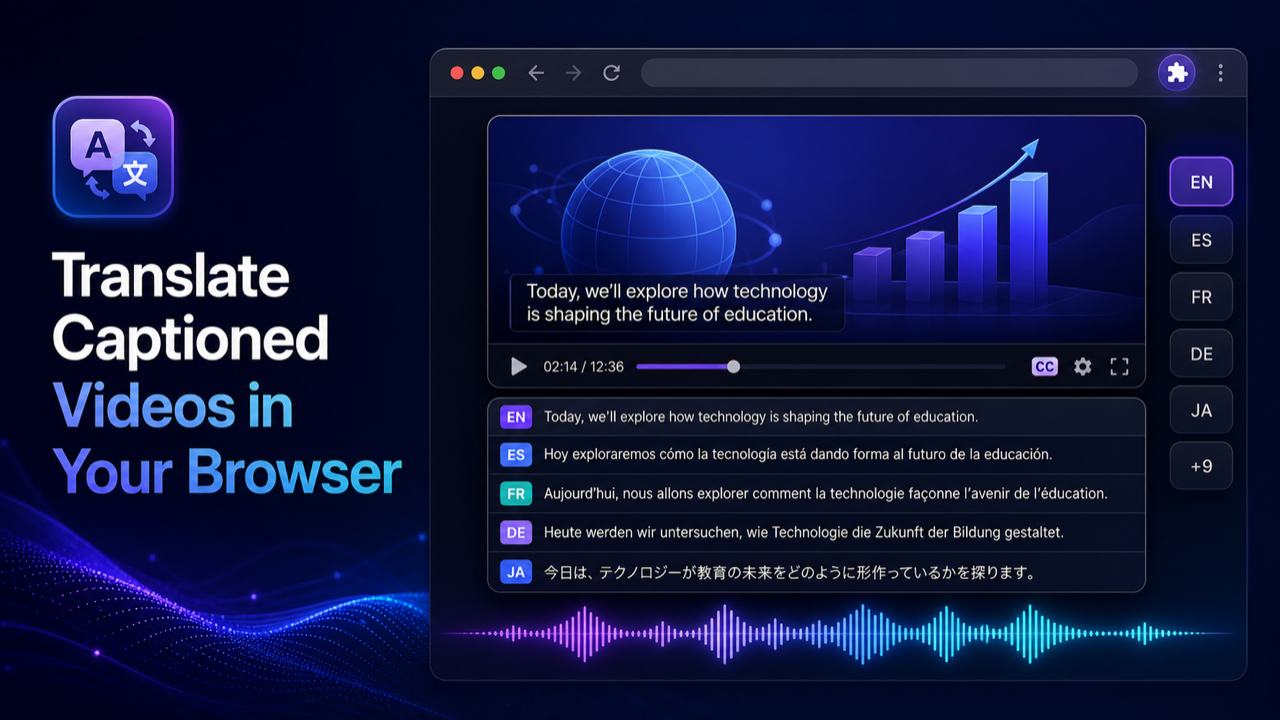
To translate Spanish video to English in the browser, you need a video that already has Spanish captions. Turn them on in the player, and a Chrome extension can translate that caption track into English, show it as subtitles, and read it aloud as an English voice over the quieter original audio. If the video has no captions at all, this method has nothing to work with.
That covers most of the practical cases: a cooking tutorial from Mexico, a lecture recorded in Buenos Aires, a Spanish-language course on Udemy or Coursera, or an interview on YouTube. Below are the requirements, the steps, and the places where Spanish-to-English machine translation tends to slip.
What you need before you start
- Chrome on a desktop or laptop. Mobile browsers are not supported.
- A video with a Spanish caption track the player can display. Auto-generated captions count.
- Unlimited Universal Video Translator installed from the Chrome Web Store.
The extension works as a Spanish video translator on sites where it has been tested: YouTube, YouTube Shorts, Udemy, Coursera, edX, TikTok, TED, Vimeo, Khan Academy, gamedev.tv, Zenva, and Domestika. Many other HTML5 players with caption tracks work too, but if a site is not on that list, try one video before you count on it.
How to translate a video from Spanish to English
- Open the Spanish video and start playing it.
- Turn on captions in the player itself (the CC button, or Settings > Subtitles). Pick the Spanish track if there are several.
- Click the Dub button that appears on the video.
- Set the target language to English. For a first run, choose Standard mode, Google Translate as the engine, and one of the English voices from the list.
- Press play. The extension translates each caption segment, generates English speech, syncs it to the player, and lowers the Spanish audio underneath. You can also turn on the translated English subtitles if you want to read along.
That is how to translate a Spanish video to English without downloading, uploading, or re-encoding anything. The dubbed track lives in the tab you are watching. Close the tab and it is gone, and there is no translated file to save.
If you only want text, YouTube can already do part of this on its own: open Settings (the gear) > Subtitles/CC > Auto-translate and pick English. You get English subtitles, but no English voice.
Doing it for free
You can translate video from Spanish to English free on the default path. Standard mode with Google Translate for the text and the built-in Piper voice for speech costs nothing and needs no account. The Piper voice runs on your own device inside the extension, so speech generation is not sent to a remote text-to-speech service. The caption text does go to Google Translate for the translation step.
There is also an optional "Free Online" voice. It is a separate choice you make in the voice menu, and it needs an internet connection.
PRO adds real-time mode, premium local voices, cloud voices, browser and OS voices, LLM-based translation, and the option to plug in your own AI provider key. None of that is needed to translate Spanish video to English free with an English voice. English target voices are available on the free path; the exact list you see depends on the selected engine and the voices installed on your system.
Spain vs Latin American Spanish captions
Spanish from Spain and Spanish from Latin America are mutually understandable, but captions from each can trip up an English translation in different ways.
Vocabulary is the obvious one. Coche and carro both mean car. Ordenador and computadora both mean computer. Zumo and jugo are both juice. These everyday pairs usually translate fine. The harder cases are words that exist in both varieties with different meanings or different levels of rudeness. A word that is neutral in Madrid can be crude in Buenos Aires, and a caption translator has no idea which country the speaker is in.
Pronouns shift too. Speakers in Spain use vosotros for plural "you"; Latin American speakers use ustedes. In Argentina, Uruguay and parts of Central America, vos replaces tú, with its own verb forms (vos tenés instead of tú tienes). All of these become plain "you" in English, and a less common voseo form can occasionally come out in the wrong person or tense.
Auto-generated captions add another layer. Speech recognition may be better at one accent than another, so a Chilean or Andalusian speaker talking fast can get noisier Spanish captions than a news presenter from Mexico City. The extension translates whatever the caption says. If the Spanish caption has a misheard word, the English output inherits it, and you cannot tell from the English line alone. When a sentence makes no sense, glance at the original Spanish caption: often the problem is there, not in the translation.
If the creator uploaded their own Spanish subtitles, use those over the auto-generated track. Human captions are usually cleaner, and cleaner input gives better spanish to english video translation.
Speed of speech and dubbing timing
Spanish speakers on video often talk fast, and a translated English line is rarely the same length as the Spanish one. That matters for the dubbed track, because the English voice has to fit into the time slot of each caption segment.
With a rapid speaker, caption segments are short and packed. The English voice may need to speak quickly to keep up, and on a very dense line it can finish slightly after the Spanish speaker moves on. With slow lecturers the opposite happens and you get small pauses. The voice is timed to caption segments, not to lip movement, so it will never match the speaker's mouth.
If the timing on a very fast video bothers you, switch to subtitles only. You still get the English text, and there is no voice to keep in step.
Where Spanish-to-English translation goes wrong
Dropped subjects. Spanish routinely leaves out the subject pronoun. "Fue a la tienda" does not say whether he, she, or you went. Captions come in short fragments, so the translator often lacks the earlier sentence that made it clear, and with several people talking it guesses wrong often enough to notice.
Tú and usted. English has one "you". A teacher who addresses students formally with usted and a friend who uses tú both come out the same, so the tone of the relationship disappears.
Ser and estar. Both become "to be". "Está aburrido" (he is bored right now) and "es aburrido" (he is boring) are different claims in Spanish, and a rushed translation can swap them.
Past tenses. The preterite and imperfect both collapse into the English simple past. "Hablaba" (was talking, ongoing) and "habló" (talked, finished) can end up reading the same.
Idioms. These are the lines most likely to come out word for word. "Estar en las nubes" is daydreaming, not being in the clouds. "No tener pelos en la lengua" means speaking bluntly. "Ponerse las pilas" is to get your act together. "Tomar el pelo" is teasing someone. A literal English version of any of these sounds absurd, and regional slang from Mexico, Argentina or the Caribbean is harder still. PRO lets you switch to an LLM engine for translation, which you can try on a slang-heavy video to compare the output.
Names and numbers. Place names, brand names, and people's names are sometimes translated when they should not be. Numbers are usually fine, but check anything where a wrong figure would matter, like prices or dosages in a tutorial.
What this method cannot do
It is a caption translator with a voice, and it has hard limits. It does not transcribe audio, so videos without captions will not work. It does not do lip sync or voice cloning. It does not import or export SRT or VTT files, render a translated video, download anything, or accept local file uploads. It cannot read text burned into the picture. It does not work in mobile browsers, on DRM-protected services like Netflix or Prime Video, or on live streams.
If you need the opposite direction, the guide to translating video to Spanish covers English and other languages into Spanish. For other source languages, the translate video to English hub links to the per-language guides, such as the close cousin Portuguese to English. For YouTube specifics, see the YouTube video translator guide.
FAQ
How can I translate a video from Spanish to English if it has no subtitles?
With this extension, you cannot. It translates an existing caption track and does not do speech recognition. Check whether the platform offers auto-generated Spanish captions first; on YouTube many videos have them even when the uploader added none. If the CC button is missing or greyed out, the video has no caption track to work with.
Can I translate Spanish video to English free?
Yes. Standard mode with Google Translate and the on-device Piper voice is free and needs no account. You get English subtitles and an English voice track. PRO is only needed for real-time mode, premium or cloud voices, LLM translation, or your own AI provider key.
Will the English voice match the speaker's lips?
No. The English voice is a separate audio track timed to the caption segments, played over the lowered Spanish audio. The picture is not changed, so mouth movements stay as recorded.
Does it work on Spanish courses on Udemy or Coursera?
Both are on the tested list, along with edX, Domestika, Khan Academy and others. Turn on the Spanish captions in the course player, click Dub, and choose English. If a lecture has no Spanish caption track, it will not work on that lecture.
Can I save the translated video?
No. The translation and the voice play live in the browser tab. There is no export, download, or subtitle file.
Other ways people search for this
People phrase this in a lot of ways. Some ask how to translate spanish video to english, how to translate video from spanish to english, or simply want to translate a video from spanish to english for a class. Others look for a spanish to english video translator, a video translator spanish to english, or a spanish video to english translation tool, and some ask for an ai translate video spanish to english option. All of these describe the same caption-based process above.
Shorter searches work the same way: translate spanish to english video, translate video spanish to english, video translate spanish to english, spanish to english video, or spanish to english translation video. People who watch a lot of Spanish content often want to translate videos from spanish to english in bulk, or more generally to translate video from spanish or translate videos from spanish into several languages. The steps do not change: one video at a time, with captions on.
Some people say they want to convert spanish video to english, translate spanish videos to english, translate a spanish video to english for a family member, translate spanish video into english without re-uploading it, or translate spanish to english from video they are already watching. In every case the extension does not convert the file itself. It plays an English voice and English subtitles on top of the original while you watch.