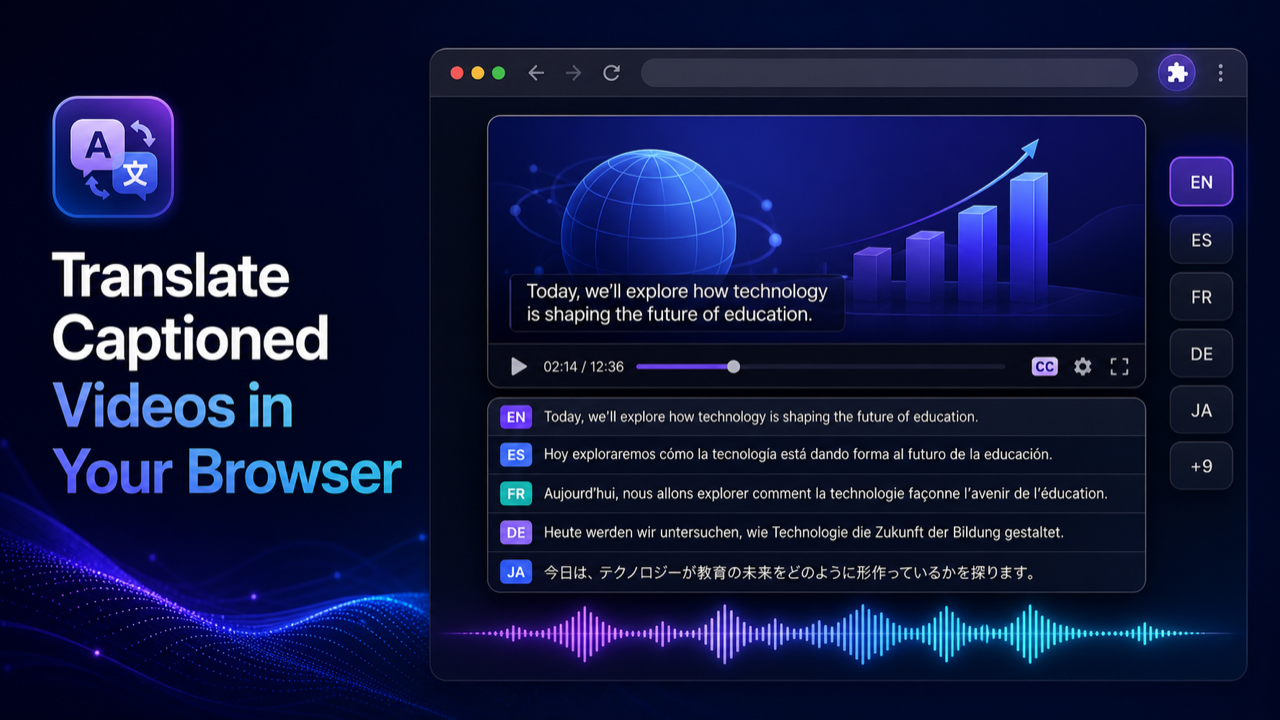
To translate Polish video to English in the browser, you need a video with Polish captions. Turn them on in the player, and the Multiplatform Video Translator extension translates that caption track into English, shows it as subtitles if you want, and reads it aloud as an English voice over the quieter Polish audio. It doesn't listen to the audio itself. No captions, nothing to translate.
I'm Oleg, and I built the extension. Polish is a good test for any caption translator: long inflected words, names that change shape in every sentence, and a polite form of address that English simply doesn't have. Below are the steps, the free setup, and the places where Polish trips up machine translation.
Short answer: a caption track is the timed text a video player can show as subtitles. The extension translates that Polish text into English and voices it with a synthetic English voice. Captions are the input, so a Polish video without them can't be dubbed this way.
What you need
- Chrome on a desktop or laptop. Mobile browsers are not supported.
- A video with a Polish caption track the player can show. Uploader captions and auto-generated ones both work.
- Multiplatform Video Translator installed from the Chrome Web Store.
It's been tested on YouTube, YouTube Shorts, Udemy, Coursera, edX, TikTok, TED, Vimeo, Khan Academy, gamedev.tv, Zenva and Domestika. Other HTML5 players with a caption track may or may not work, so try one video first.
How to translate a Polish video to English, step by step
- Open the Polish video.
- Turn on captions in the player (the CC button or the settings menu) and pick the Polish track.
- Click the Dub button the extension places on the video.
- In the on-video controls, choose English as the target, then the mode, the engine and a voice.
- Press play. Each caption segment is translated, voiced in English, synced to the player, and the Polish audio is lowered underneath. Turn on the English subtitles if you want to read along.
That's the whole way to translate polish to english video without downloading or uploading anything. Close the tab and the dub is gone. There's no file to save.
On YouTube, if text is enough, the player has its own route: gear, Subtitles/CC, Auto-translate, English. You get English subtitles but no voice. The YouTube to English guide compares the two.
The free path
Standard mode, Google Translate and the on-device Piper voice cost nothing and need no account. English voices are available on that path. An optional Free Online voice is a separate choice in the voice menu and needs internet.
PRO adds real-time mode, premium local voices, cloud voices, browser and OS voices, LLM translation, your own AI provider keys, and free unlimited AI translation without a key. You don't need any of it to get an English dub of a Polish lecture.
| Free path | PRO | |
|---|---|---|
| Translation | Google Translate | Google Translate, LLM engines, your own AI keys, unlimited AI translation without a key |
| English voice | On-device Piper voice, optional Free Online voice | Premium local, cloud, browser and OS voices |
| Mode | Standard | Standard and real-time |
The video never leaves your computer. The Polish caption text is sent to Google Translate, or to the cloud or LLM service you pick. Local voices run on your device.
Where Polish-to-English translation goes wrong
Seven cases and inflected names. Polish nouns, adjectives and names change their endings by role in the sentence. "Kowalski" turns into "Kowalskiego", "Kowalskiemu", "z Kowalskim". A city like Kraków becomes "w Krakowie" or "do Krakowa". Translators usually cope with common words, but less familiar names sometimes come out in an inflected form, or get translated as ordinary words. If a speaker's name looks slightly different every time it appears in English, this is why.
Word order. Because endings carry the grammar, Polish can move words around for emphasis. "Ten film zrobił mój brat" puts "this film" first but means "my brother made this film". A caption cut in the middle of such a sentence gives the translator half the clues.
Dropped pronouns. Polish verbs show the person, so speakers skip "ja", "ty", "on". "Poszedł do domu" is "he went home"; the "he" lives in the verb ending. In a short caption fragment with several speakers, English can end up with the wrong subject.
Aspect. Most Polish verbs come in pairs: "robić" and "zrobić", "pisać" and "napisać". The first is ongoing or repeated, the second finished. English past tense often blurs "pisałem raport" (I was writing the report) with "napisałem raport" (I wrote it, it's done).
Pan, Pani and "you". Polite Polish addresses people in the third person: "Czy Pan wie...?", "Pani ma rację". Literal English gives "Does the gentleman know?" or "The lady is right" in a two-person conversation. A good translation turns these into "you", but a machine sometimes leaves "sir", "madam" or a third person where none was meant. Plural "Państwo" for an audience has the same problem.
False friends. A few common words look like English and mean something else:
- "ewentualnie" means "possibly" or "alternatively", not "eventually"
- "aktualnie" means "currently", not "actually"
- "konkurs" is usually a contest or competition, not a concourse
- "sympatyczny" means nice or likeable, not sympathetic
- "ordynarny" means vulgar, not ordinary
Engines usually get these right in context, but they're the first thing I check when an English line sounds off. The other three checks I run on the first minutes of a Polish video: does a person's name stay the same each time, does "sir" or "madam" appear where the speaker just meant "you", and is it clear who "he" or "she" is in each line.
Auto-generated Polish captions
Polish has dense consonant clusters ("szcz", "chrz", "źdź") and diacritics that change words: ą, ę, ł, ó, ś, ż, ź, ć, ń. "Może" is "maybe", "morze" is "sea", and they sound alike. Auto-captions can hear a word right and spell it as its homophone, or drop a short word between clusters. With fast speech, two speakers at once or regional speech from Silesia or the mountains, mistakes add up. The extension translates whatever the caption says, so when an English line makes no sense, look at the Polish caption. If the creator uploaded their own Polish subtitles, use those.
Polish words also run long, and the English line is often shorter. On a fast speaker that helps the dub keep up; on a slow lecture you'll hear small pauses. The voice follows caption timing, not lips.
Limits
The extension translates captions; it doesn't transcribe audio. It doesn't lip sync or clone voices, doesn't import or export SRT or VTT, can't render or download a translated video, doesn't take local file uploads, and can't read text burned into the picture. Netflix, Prime Video and other DRM services, live streams and mobile browsers aren't supported.
On Android there's an app with the same name: the Multiplatform Video Translator app opens video sites in its built-in browser, where you tap Dub on the player. It has 70+ languages and 40 free minutes a day without a subscription, and for some videos without subtitles it can run speech recognition first. There's no iPhone version yet.
Russian is the closest pair to this one, with cases, aspect and dropped pronouns of its own: see translating Russian video to English. For other source languages, the translate video to English hub links every guide.
FAQ
Can I translate a Polish video with no subtitles?
Not with the Chrome extension. It needs a caption track. On YouTube, check for auto-generated Polish captions in the CC menu first; many videos have them.
Is it free?
Yes. Standard mode, Google Translate and the Piper voice are free, with no account. PRO is for real-time mode, premium or cloud voices and LLM translation.
Will the English voice sound like the original speaker?
No. It's a synthetic English voice on a separate track. There's no voice cloning and no lip sync.
Does it handle Polish courses on Udemy or Coursera?
Both are on the tested list. Turn on the Polish captions in the course player, click Dub, pick English. A lecture without a Polish caption track won't work.
Why does the English say "sir" or "the lady" where nobody said it?
That's the Polish polite form. "Pan" and "Pani" address the listener in the third person, and a literal translation keeps them. Read them as "you". With PRO you can switch to an LLM engine on the same video and compare the lines.