
How to Translate a Russian Video to English in Chrome
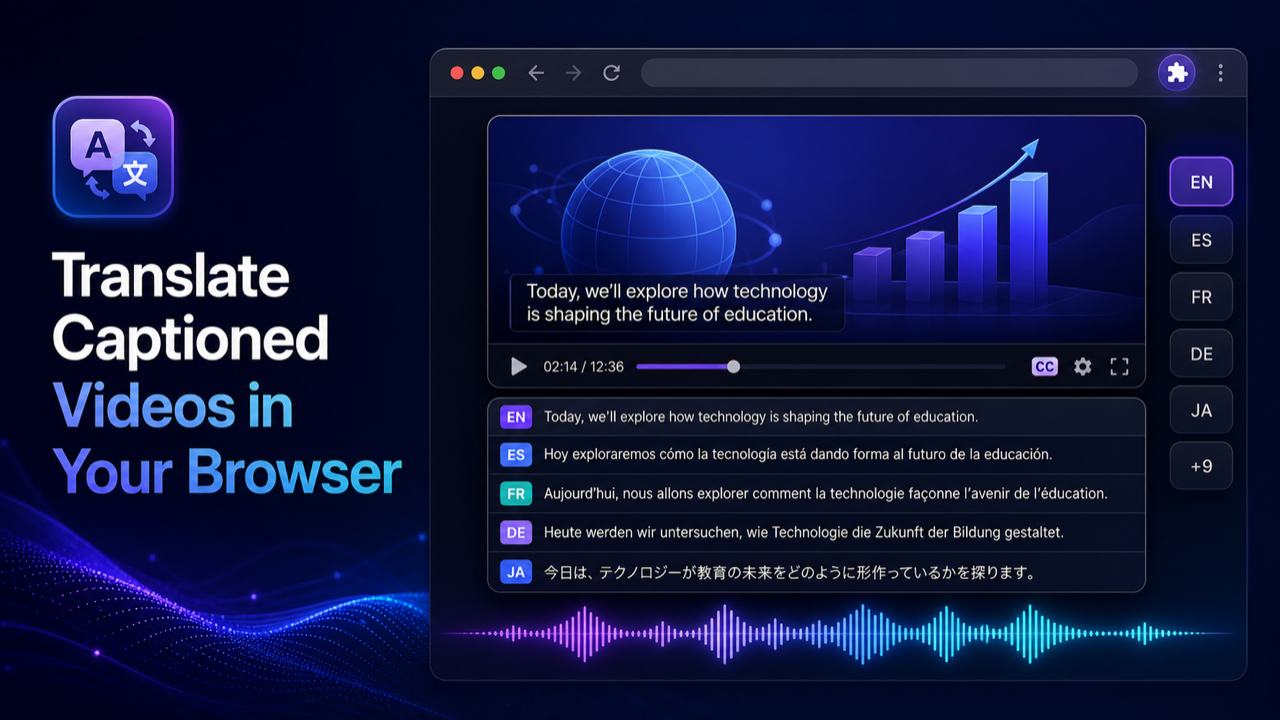
If you want to translate a Russian video to English, the Unlimited Universal Video Translator extension reads the Russian caption track a video already has and swaps it for English subtitles or a synced English voice-over, right in the tab you're watching. It does not listen to the audio and does not transcribe speech. If the video has no Russian captions available to select, there is nothing for it to translate. That single requirement decides whether this works before anything else does.
What you actually get on a lecture, talk, or interview
This tool is built for the kind of Russian video that's genuinely dense: a university lecture on discrete math, a conference talk from a Moscow tech meetup, a long interview with a founder, or a Habr-style explainer walking through a codebase. These are exactly the videos where you need more than a rough gist: names, numbers, and technical terms have to land correctly, and a thirty-minute talk needs sentence-level accuracy sustained the whole way through, not just in the first two minutes.
On a supported platform (YouTube, Udemy, Coursera, TED, Vimeo, Khan Academy), turn on the video's own Russian captions and the extension replaces them with English text, or (if you want to listen rather than read) a synced voice-over that ducks the original Russian audio underneath it. Either way you're watching the source video in place; nothing gets re-encoded, exported, or downloaded, and lip movement stays exactly as recorded.
Setting it up
- Install Unlimited Universal Video Translator from the Chrome Web Store.
- Open the Russian video and turn on its Russian captions in the player controls first. The extension needs that track exposed before it can read it.
- Click the extension icon, choose Dub, and set the target language to English.
- Start with the free tier: Standard mode, Google Translate, and the on-device Piper voice. Confirm the video actually has a readable caption track before reaching for anything paid.
- Play the video and spot-check the first few minutes against names, numbers, and any specialized vocabulary before trusting the rest.
The video file itself never leaves your machine. But once you pick Google Translate, a cloud voice, or an LLM-based translation, the caption text needed for that step is sent to that provider: that's simply how those services work, and it's worth knowing before you translate anything sensitive. Real-time mode, LLM translation, and premium cloud voices are PRO features; the free path is Standard mode with Google Translate and the local voice.
Where Russian grammar actually breaks the English translation
A handful of things about Russian specifically trip up any Russian-to-English translation, automated or not, and they're worth knowing so you can catch them rather than just trusting the output:
- Russian has no equivalent of "a" or "the," so the translator has to guess every time, and in technical material that guess changes meaning. "The algorithm converges" implies one specific algorithm already under discussion; "an algorithm converges" implies any algorithm of that class. A mis-picked article in a lecture can quietly shift what's being claimed.
- Russian's verbal aspect often gets lost in translation: it marks perfective versus imperfective on nearly every verb (it's obligatory, not optional) while English has no matching grammatical slot. "Он решал задачу" (was working on solving it) and "Он решил задачу" (solved it, done) collapse toward the same English sentence unless the translator works to preserve the distinction, and whether something finished or was still in progress is exactly the kind of detail a technical explanation depends on.
- Free word order lets Russian carry emphasis that English can't place the same way. Russian moves words around a sentence to put weight on whatever comes last; English relies on fixed subject-verb-object order and has to use stress, italics, or extra words to do the same job. A sentence engineered in Russian to land hardest on one term can arrive in English sounding flat, or emphasizing the wrong part.
- Case endings, not word position, mark grammatical role in Russian. The six cases tell you who did what to whom through noun endings rather than sentence position. When auto-captions mis-hear a word ending (a common failure with fast or accented speech), the case gets scrambled, and the English translation can genuinely invert subject and object: "the method changed the result" instead of "the result changed the method."
- The вы/ты distinction has no English equivalent. Formal вы and informal ты both collapse into "you," so tone cues about how formally a speaker is addressing their audience (common in interviews and Q&A segments) simply disappear from the English version.
- Names and borrowed technical terms don't always round-trip cleanly. Cyrillic transliteration of proper names is inconsistent (a speaker named Юрий might come out as Yuri, Yuriy, or Iurii depending on the tool), and English technical terms that were borrowed into Russian (say, "шардинг" for "sharding") sometimes get back-translated into a different English word entirely instead of restored to the original.
- One more worth flagging even though it's about English rather than Russian: Russian frequently drops the subject pronoun where English requires one. A caption reading "решил проблему" (literally "solved [the] problem") needs an explicit "he," "she," or "they" supplied in English (a small gap, but it's where an automated translator can guess wrong in a multi-speaker interview).
When this won't work
Skip straight to a transcript or a human translator if the video is a live stream (no finished caption track to read yet), DRM-protected content the player deliberately hides captions from, or a platform outside the tested list: Facebook, Skillshare, and LinkedIn Learning haven't been verified and may behave unpredictably. If a video has no captions at all, in Russian or otherwise, there's genuinely nothing here to translate; this tool converts existing captions, it doesn't generate them from audio.
Related guides
For the general workflow that applies across source languages, see the guide to translating any video into English. German is another language where grammatical case does a lot of the work that word order does in English, and the parallel issues are covered in the German-to-English video translation guide. If you haven't installed the extension yet, start with the Chrome extension setup guide.
Frequently asked questions
Can I translate a Russian video that has no captions at all?
No. The extension reads an existing caption track; it has no speech-to-text engine, so a video without captions in some language can't be translated this way.
Does it fix the article and aspect problems described above automatically?
Not fully. Google Translate and LLM engines both make reasonable guesses at articles and aspect, but neither is perfect, especially in dense technical speech. Treat the translation as a strong first pass, not a final one.
Is the voice-over dubbed by a real actor?
No. The free voice is an on-device synthetic voice (Piper); more natural-sounding cloud voices are a PRO option, and none of them clone the original speaker's voice.
Can I download the English version as a video file?
No. The extension translates what you're watching in the browser tab; it doesn't export a file, generate an SRT, or bypass any DRM protecting the source video.