
Translate German Video to English in Chrome from Its Captions
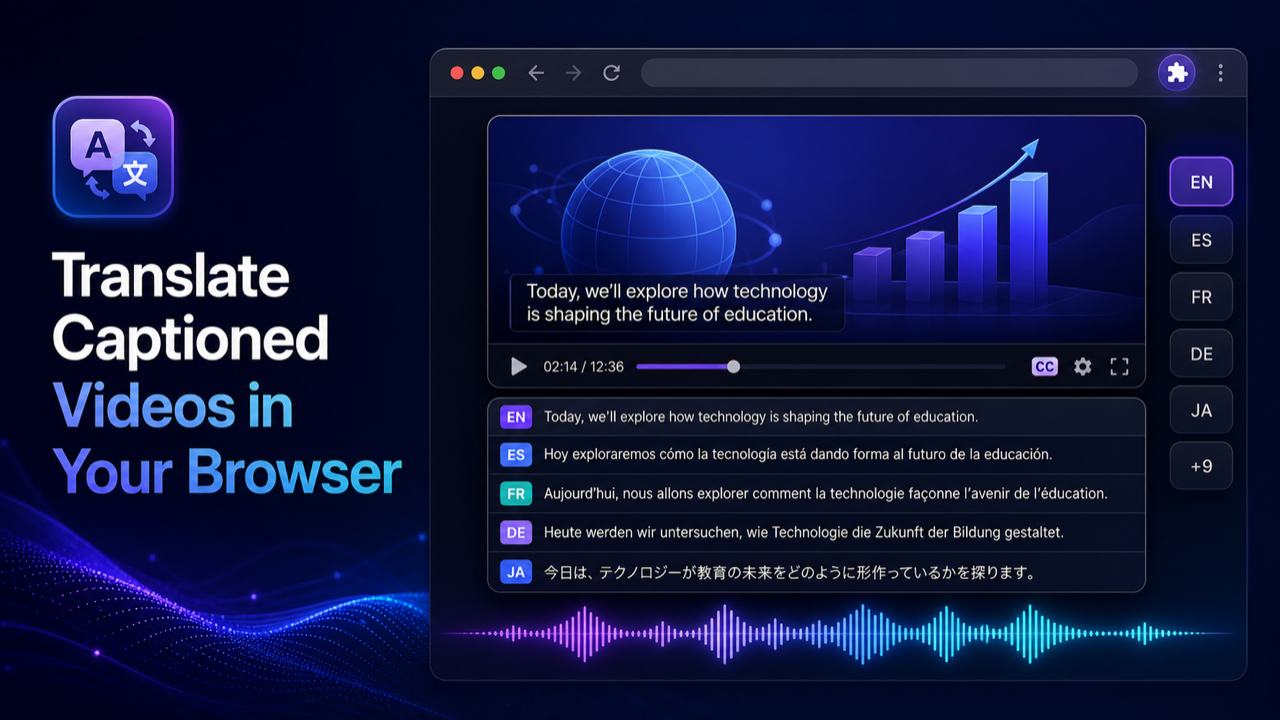
If you want to translate German video to English while you watch, the practical route in Chrome is to work from the video's German captions. Turn the captions on, have an extension translate them, and listen to an English voice track played over a quieter original. This works as long as the player exposes a caption track. If the video has no captions at all, this method has nothing to translate.
German has one habit that makes caption translation harder than it looks: the verb that tells you what actually happened often sits at the end of the clause, sometimes after the caption line has already been shown. The language-pair section below covers that and a few other German quirks.
What you need before you start
- Chrome on a desktop or laptop. Mobile browsers are not supported.
- The Unlimited Universal Video Translator extension.
- A German video with captions the extension can detect. Uploaded subtitles and auto-generated captions both count, as long as the player shows them.
- A site where the player is a regular HTML5 video. The tested list is Udemy, Coursera, YouTube, YouTube Shorts, edX, TikTok, TED, Vimeo, Khan Academy, gamedev.tv, Zenva and Domestika. Many other captioned HTML5 players work too, but anything outside that list is untested.
No account is needed for the free path. It uses Standard mode, Google Translate for the text, and an on-device Piper voice that generates the English speech inside the extension, so the speech generation is not sent to a remote TTS service. English voices exist on the free path, so you can translate German video to English free, with the limits described further down.
How to translate a video from German to English, step by step
- Install the extension from the Chrome Web Store and open the German video.
- Turn on German captions in the player. On YouTube that is the CC button or Settings (gear) > Subtitles/CC. The extension reads the track that is switched on.
- Click the Dub button that appears on the video.
- In the on-video controls, choose English as the language, Standard as the mode, Google Translate as the engine, and one of the English voices.
- Press play. The extension translates the captions, generates a separate English speech track, keeps it in sync with the player, and lowers the original German audio underneath it.
- If you also want to read along, switch on the translated subtitles.
If you are still wondering how to translate German video to English with more options than the free setup, PRO adds LLM translation, a real-time mode, premium local voices, cloud voices, browser and OS voices, and bring-your-own-key AI providers. The workflow stays the same: captions on, Dub, pick settings.
A shortcut if you only need text
On YouTube you can also read a translation without any extension. Turn on the German track, then go to Settings (gear) > Subtitles/CC > Auto-translate and pick English. You get English subtitles as text only. The extension is for when you would rather listen than read, which helps with long lectures or tutorials where your eyes need to be on the screen content.
Where German to English video translation goes wrong
Machine translation of German captions produces usable English most of the time. The failures follow a pattern, and knowing it helps you decide when to trust the voice and when to glance at the original.
The verb comes last
German subordinate clauses push the conjugated verb to the end: "weil er das Auto, das er letztes Jahr gekauft hat, verkauft hat" only tells you he sold the car in its final word. Perfect tense does the same thing in main clauses, with the participle at the end. Captions are cut into short segments by time, not by grammar, so a segment can end before the verb arrives. Translated one segment at a time, the English can read as unfinished or briefly suggest the wrong action until the next line lands. When a sentence sounds odd, wait a second for the following segment before assuming the translation is wrong.
Separable verbs split across lines
Verbs like "anfangen" or "aufstehen" split in a sentence: "Er steht morgen sehr früh auf." The prefix at the end changes the meaning of the stem. "Stellt ... vor" (introduces, or imagines) is a different verb from "stellt" (puts). If the caption break falls between stem and prefix, the translator may pick the meaning of the bare verb.
Compound nouns
German glues nouns together: "Krankenversicherungskarte" is a health insurance card, "Geschwindigkeitsbegrenzung" is a speed limit. Uploaded subtitles usually spell these correctly. Auto-generated captions sometimes split a compound in the wrong place or mishear part of it, and the translation inherits that. Technical courses are full of these words, so check anything that sounds like a strange string of nouns.
Sie, du, and "sie"
German marks formal and informal address with Sie and du. English has only "you", so the difference between a lecturer addressing the audience formally and two colleagues chatting disappears. Lowercase "sie" can mean she, they, or (as the object) her or them, and a translator reading one short line at a time does not always have enough context to choose correctly. When a pronoun in the English dub seems to point at the wrong person, this is usually why.
Swiss and Austrian German
Auto-generated captions are strongest on standard German. Speakers with a strong Swiss or Austrian accent, or speaking dialect, tend to get more recognition errors in the caption track. The extension translates whatever text is in the captions, so those errors carry straight into the English. If the creator uploaded their own subtitles, pick that track over the auto-generated one.
Names, numbers and brand terms
Proper names are sometimes translated as if they were ordinary words, and German writes numbers with a decimal comma (3,5 means 3.5). Keep an eye on figures in finance or engineering content.
What this method cannot do
It only works with captions the extension can detect. It does not transcribe speech from a video without captions, read text burned into the picture, or work on DRM-protected streaming services such as Netflix or Prime Video, live streams, local files, or mobile browsers. There is no lip sync or voice cloning, and it does not import or export SRT or VTT files or render a translated video you can download. The English voice plays in your browser while you watch.
If a German video has no captions at all, the extension cannot work on it. Check first whether the platform offers auto-generated captions for that video.
FAQ
Can I translate a German video to English for free?
Yes, if the video has captions. The free path uses Standard mode, Google Translate for the text, and an on-device Piper voice for the English speech, with no account. An optional "Free Online" voice also exists, but it is a separate choice and needs an internet connection.
Does it work on a German video with no subtitles?
No. The extension translates an existing caption track and does not perform speech recognition. Without captions there is no text to translate.
Will the English voice match the speaker's lips or voice?
No. The English track is a generated voice synced to the caption timing. There is no lip sync and no voice cloning.
Which sites can I use it on?
The tested list is Udemy, Coursera, YouTube, YouTube Shorts, edX, TikTok, TED, Vimeo, Khan Academy, gamedev.tv, Zenva and Domestika. Other captioned HTML5 players often work, but they are not in the tested list.
Related guides
The general guide to translating video to English covers the same workflow for other source languages. For French source material, the French to English guide covers that pair's own problems. If your German video is on YouTube, see translating YouTube videos to English, and for German-language courses on Udemy, the Udemy course translation guide walks through that platform's caption settings.
Other ways people search for this
Some people phrase the question as how to translate a video from German to English, others simply ask how to translate German video to English. Both come down to the steps above: captions on, Dub, choose English.
If you search to translate a video from German to English or to translate video from German to English, you are looking for the same result, an English version you can follow while the German plays underneath. Shorter searches like translate video German to English point to the same workflow, and the pitfalls in the German to English video translation section apply no matter how you phrase it.