Translate YouTube Video to Spanish: Subtitles, Dubbing, Which Spanish
You can translate YouTube video to Spanish in about fifteen seconds when the video carries a caption track, and you cannot do it at all when it doesn't. That split decides which half of this page matters to you. The first half is the clicking. The second half is everything that goes wrong once the Spanish actually appears, and most of it is specific to Spanish: two large regional standards, a formality choice English never forces you to make, and sentences that come out longer than the English they replaced.
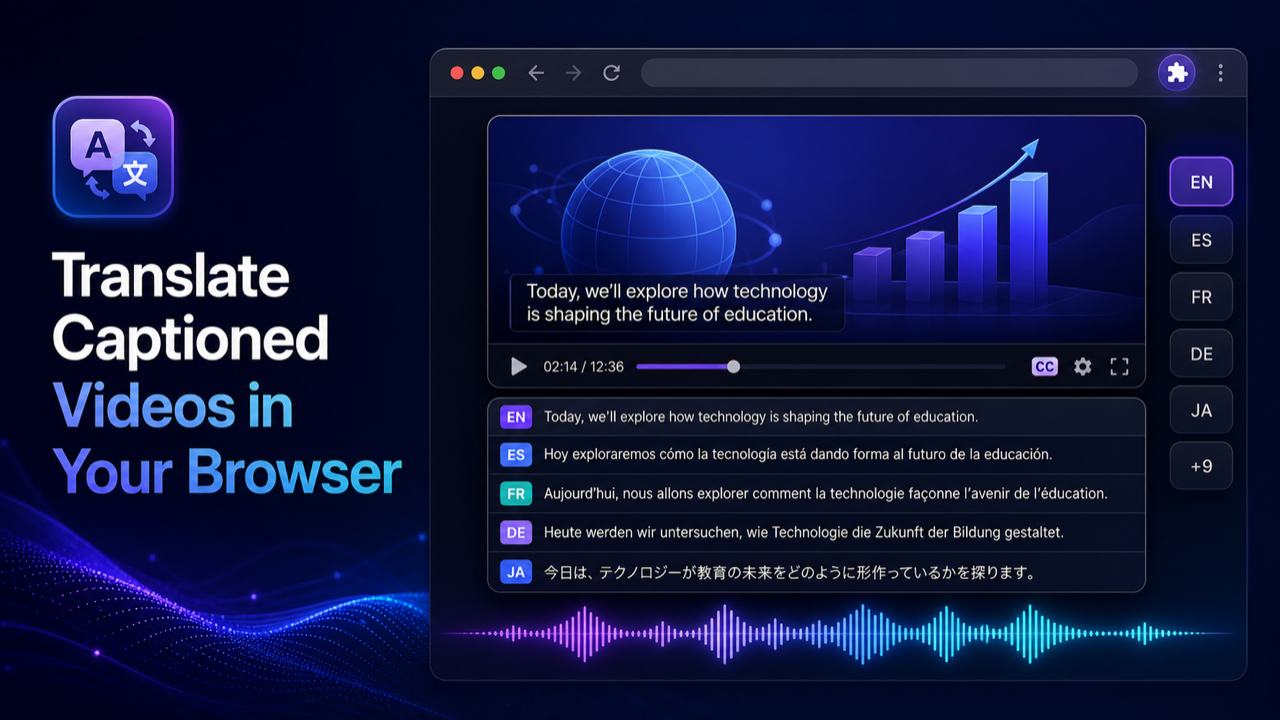
Translated Spanish subtitles, straight from the player
On desktop YouTube, the CC icon turns captions on. Then open the gear icon, pick Subtitles/CC, pick Auto-translate, and choose Spanish from the language list. The captions switch over in place and playback keeps going.
In the YouTube mobile app the path is shorter: tap the CC icon, then Captions, then Auto-translate, then Spanish.
Auto-translate shows up only when the video already has a caption track, including an automatic speech-recognition one. If the uploader switched captions off, or recognition never ran on that upload, there is no Auto-translate row in the menu and YouTube tells you nothing about why. An empty menu is the answer, and it means the source text this whole process depends on does not exist.
Auto-translate gives you Spanish text. It does not speak.
Spoken Spanish: the channel's own track, or dubbing in the tab
Some channels upload multi-language audio themselves. When they have, the gear menu grows an audio track entry, and a Spanish option there is a human dub the creator paid for. Take it over anything machine-made every time.
Most channels have not done that. For those, spoken Spanish comes from dubbing added in your browser. Unlimited YouTube AI Video Translator reads the caption track the page already exposes, translates it, and plays synthetic Spanish speech over the original audio in the same tab. Nothing is uploaded, nothing is downloaded, and the video stays where it is. It runs in desktop Chrome, and it needs the same caption track Auto-translate needs, because the Spanish has to be translated from existing text and nothing here transcribes audio.
That is the mechanical part. Now the part that decides whether the result is usable.
Which Spanish did you want
Spanish is not one target. The two that matter in practice are European Spanish and Latin American Spanish, and they differ in ways a viewer notices within a sentence.
Vocabulary splits on ordinary nouns. A computer is ordenador in Spain and computadora in most of Latin America, a phone is móvil against celular, a car is coche against carro or auto, orange juice is zumo against jugo. None of these are wrong anywhere, but each one is audibly foreign to the other audience.
Second person plural splits harder. Spain uses vosotros and its verb forms for a group; Latin America uses ustedes for every group, formal or not. A tutorial that keeps saying vosotros reads as Peninsular Spanish to a viewer in Mexico City whether or not the content is right.
Machine translation usually resolves this by refusing to resolve it. You get a flattened register that avoids vosotros, avoids strongly regional nouns, and ends up sounding like nobody's Spanish in particular. For a dense technical tutorial that is an acceptable trade. For anything conversational it reads like a manual.
The place you can make the regional call is the voice. If the voice list offers more than one Spanish option, the region label on it tells you what accent it was built for, and a Castilian voice reading neutral vocabulary at a Latin American audience is the mismatch viewers comment on first. Match the voice to the people watching.
Spanish forces a tú or usted decision that English does not encode
English "you" carries no formality. Spanish makes you choose, and the choice is baked into the verb, so the translator cannot sit on the fence the way it can with vocabulary.
Take the instruction "click the gear icon". In tú it is haz clic en el icono de engranaje. In usted it is haga clic en el icono de engranaje. Same meaning, different relationship with the viewer. English gave the translator zero evidence for picking one, so it picks by statistical habit.
Two things go wrong from there. The first is a wrong default: instructional video addressed to one viewer is normally tú in Latin American and Spanish tech content, and machine output often lands on usted, which makes a friendly screencast sound like a bank letter. Inconsistency is the worse problem and the more common one. Register flips between sentences because each caption line was translated as its own little unit with no memory of the previous one, so you get haz clic in one line and haga clic twenty seconds later.
There is no setting that fixes this. What you can do is read the first minute of Spanish output before committing to a long video, because if the register is wrong at the start it will be wrong and unstable for two hours.
Spanish runs longer, and your subtitle line pays for it
Spanish expands. Click the gear icon is 20 characters; haz clic en el icono de engranaje is 33. The pattern repeats: Spanish adds prepositions where English compounds nouns, and it spells out articles English drops.
On screen that shows up in two ways.
In subtitles, the line either wraps to a third row and covers more of the picture, or it stays on two rows and sits there for a stretch of time that was budgeted for shorter English text. You end up reading faster than is comfortable, and on fast dialogue you stop finishing lines before they change. The fix is unglamorous: drop playback to 0.75 on the sections that matter. YouTube's speed control keeps working under both Auto-translate and in-tab subtitles, and a slower video gives every caption line proportionally more time on screen.
In dubbing, the same expansion becomes overrun. The synthetic Spanish for a caption segment takes longer to speak than the original English did, so the voice is still finishing a sentence while the presenter has moved to the next slide. Over a long video small overruns accumulate into a noticeable lag between what you hear and what you see. Two things help. Pause at the end of a section rather than seeking backwards repeatedly, because seeking is what usually breaks alignment badly. And for anything where exact timing matters, such as a keystroke demo, run translated subtitles alongside the dub so your eyes have the synchronised copy while your ears have the slower one.
Tech vocabulary: the words Spanish speakers keep in English
Spanish-speaking developers and designers borrow heavily from English, and they keep the borrowings. Software, hardware, email, framework, deploy, commit, bug, plugin: in real speech and real documentation these usually stay as they are, sometimes with Spanish verb endings attached.
Machine translation over-translates them, because a dictionary entry exists and the model reaches for it. The results range from awkward to actively confusing. Framework becomes marco de trabajo, which is grammatical and which nobody says. Commit turns into a verb about promising or committing yourself, which is a different concept entirely. Bug becomes insecto, and now your debugging tutorial is about insects. Mouse goes to ratón, correct in Spain, less natural in a lot of Latin American tech speech.
This is the failure I would watch for most closely, because unlike a formality slip it can make an instruction unfollowable. It is also the reason I keep the original captions visible when learning something new in Spanish. Seeing commit in the English line next to whatever the Spanish line did with it takes one second and saves the confusion. When the extension is doing the translating, a better translation engine helps here specifically, since context-aware translation is much more likely to leave an established anglicism alone than a word-by-word pass is.
You have a Spanish video and you want English
The same machinery runs backwards, with one asymmetry worth knowing. Spanish is well served by YouTube's automatic speech recognition, so Spanish-language uploads carry an automatic caption track more often than uploads in smaller languages do. That means the input you need usually exists.
The expansion problem also reverses in your favour: English text of the same content is generally shorter than the Spanish original, so subtitle lines get easier to read rather than harder, and dubbed lines are less likely to overrun. The details of that direction, including what to do when the recognition track is poor, are in translate YouTube video to English.
What Spanish subtitles cannot fix
Translation touches the caption track and nothing else. Everything drawn into the picture stays in the language it was recorded in.
That means slide titles, menu labels in a screen recording, code comments, diagram annotations, spreadsheet headers, and the text on a whiteboard. For a talking-head video this barely matters. For a software tutorial it matters constantly, because the presenter says "open the settings panel" and the panel on screen is in English, so a Spanish-speaking viewer gets translated narration pointing at untranslated buttons.
Nothing on this page changes that. There is no optical character recognition here, no re-rendering of frames, and no translated file to export. What actually works is smaller: pause on a screen with text and translate that text separately, and if the video is a walkthrough of software you have installed, switch your own copy of that software to English for the length of the tutorial so the buttons match what you are being shown.
Related guides
YouTube video translator is the overview of every method covered here and a few that are not. For the subtitle side specifically, including where YouTube's own Auto-translate stops being enough, see YouTube subtitle translator. Chrome extension to translate YouTube videos walks through installation and troubleshooting. If the video has no caption track at all, translate YouTube video to English without CC deals with that case honestly, and translate YouTube video to text covers getting a transcript rather than a dub.
Frequently asked questions
How do I translate YouTube video to Spanish for free?
Turn captions on with the CC icon, open the gear icon, then Subtitles/CC, then Auto-translate, then Spanish. That gives free translated subtitles in the player. For spoken Spanish you need either an uploader-supplied Spanish audio track in the gear menu or a browser extension that dubs over the original audio, which is free to start.
Can YouTube read the audio out loud in Spanish?
No. Auto-translate produces translated subtitle text only. Spoken Spanish comes either from a multi-language audio track the channel uploaded itself or from text-to-speech dubbing added in your browser on top of the caption track.
Why is there no Spanish option in the subtitles menu?
Because the video has no caption track to translate. Auto-translate appears only when a creator-uploaded or speech-recognition caption track exists, and YouTube does not explain its absence. Captions disabled by the uploader, music-only audio, and very long or noisy recordings are the usual reasons.
Will the Spanish be Latin American or European?
Machine translation tends to produce a neutral register that avoids vosotros and avoids strongly regional nouns, so it belongs to neither audience precisely. You get more control over the accent than the wording: pick the Spanish voice whose region label matches your viewers.
Why does the Spanish dubbing finish after the presenter moves on?
Spanish usually needs more words and more characters than the English it came from, so synthetic speech for a caption segment can run past the segment's timing. Small overruns add up across a long video. Slowing playback and avoiding repeated seeking both reduce the drift.
Can I translate the text on the slides too?
No. Only the caption track gets translated. Text burned into the video frame, including slide titles and interface labels in screen recordings, stays in the source language, which is worth planning around before you start a long software tutorial.