
Translate YouTube Video to Hindi: Subtitles, Dubbing, Devanagari
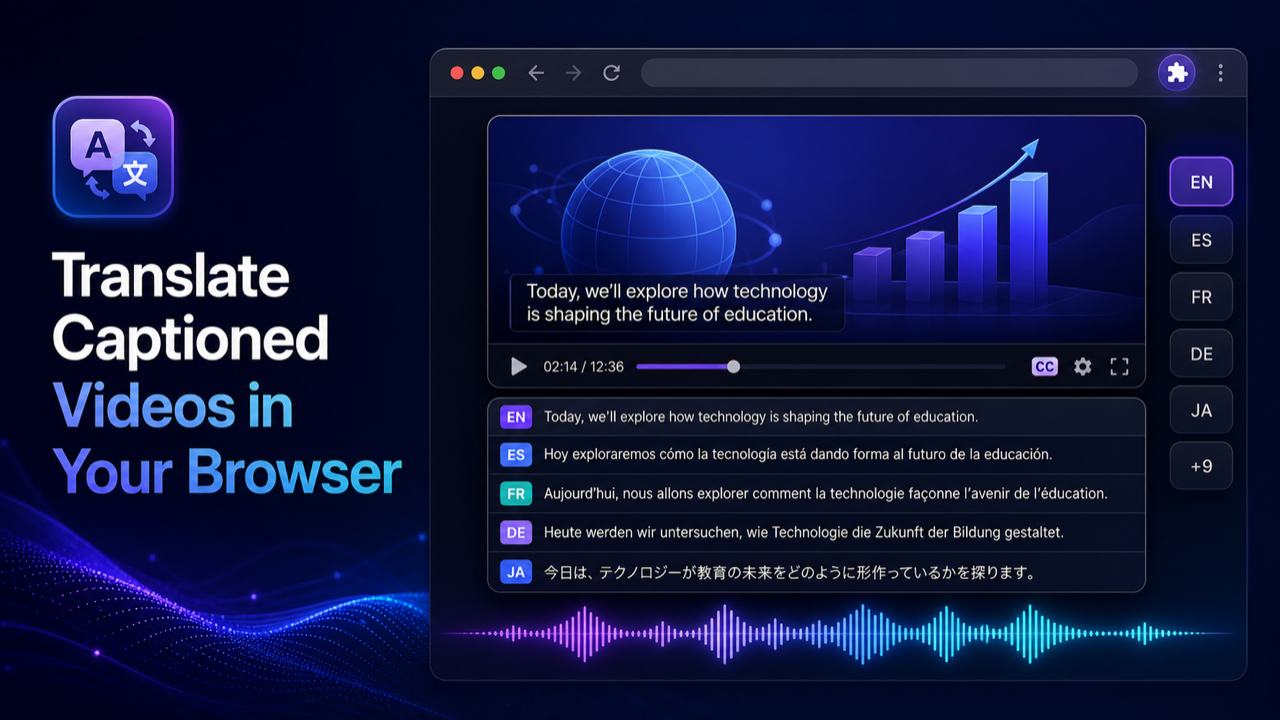
There are two honest answers when you want to translate YouTube video to Hindi. Either you read Hindi text on screen, which YouTube can do for free on many videos, or you hear Hindi spoken over the original audio, which needs something added to the browser. Both of them depend on one thing existing first: a caption track on that specific video.
The procedure is short. The interesting part is what happens after it works, because Hindi output has failure modes that English output does not have. Devanagari rendering, English technical terms getting translated when they should not be, and subtitle lines that suddenly do not fit their timing.
YouTube's own Auto-translate, in Hindi
On desktop, open the video and click the CC icon to turn captions on. Then click the gear icon, choose Subtitles/CC, choose Auto-translate, and pick Hindi from the language list. The captions switch to Hindi text and stay that way for the rest of the session.
In the YouTube mobile app, tap the CC icon, then Captions, then Auto-translate, then Hindi.
Auto-translate only appears when the video already has a caption track, including an automatic speech-recognition one. If the uploader turned captions off, or speech recognition never ran on that upload, there is no Auto-translate entry in the menu at all. YouTube does not tell you why. An empty menu is the explanation.
The other limit matters just as much: Auto-translate gives you Hindi subtitles and nothing else. There is no spoken Hindi in it.
When the channel uploaded its own Hindi audio
Some channels upload multiple audio tracks themselves. When they have, the gear menu shows an audio track option and you can switch to Hindi there. That is a human dub the channel paid for or recorded, not machine translation, and it is usually the best Hindi you will get on that video. Indian tech and education channels do this more often than most, so check the audio track menu before you reach for anything else.
Spoken Hindi over the original audio
If you want to listen rather than read, that is what Unlimited YouTube AI Video Translator does inside the tab. It reads the caption track the player already exposes, translates it to Hindi, and plays text-to-speech Hindi over the original audio. You can also have it show Hindi subtitles instead, or both at once.
Two constraints to know before you install. It is a desktop Chrome extension, so there is no phone version: Chrome for Android has no extension support at all. And it needs the same caption track Auto-translate needs. No captions means no input, and no extension of this kind can transcribe the audio for you.
Devanagari has to render before it can be read
Hindi is written in Devanagari, and subtitle text is drawn by whatever font the player and the device can supply. That is where the first Hindi-specific problem shows up.
What you see when it goes wrong is not a translation error. It is boxes instead of letters, a matra sitting in the wrong place, or a conjunct consonant clipped at the top so the line looks like a different word. Old Windows installs, minimal Linux setups without an Indic font package, and some smart TV browsers are the usual suspects. Full-screen playback can also crop the tallest glyphs when the subtitle box was sized for Latin text.
If the Hindi comes out unreadable, test it outside the player first. Open any Hindi Wikipedia article in the same browser. If that renders cleanly, the problem is the player's subtitle styling and you can often fix it by changing the caption font size or font family in YouTube's subtitle options. If Wikipedia is broken too, it is a missing system font and no video setting will help.
Hinglish is the real accuracy problem
A lot of Indian technical and educational speech is Hindi sentences with English words left in. Not loanwords that have been absorbed, but the actual vocabulary of the subject: array, commit, deployment, interest rate, controller, migration. Speakers switch mid-sentence and the audience expects it.
Machine translation into Hindi does not know that. It translates the term along with everything else, and you end up with a formal Sanskritised equivalent that is technically correct and useless, because nobody in the field says it and you cannot search for it. I find this the single biggest reason a Hindi dub of a programming tutorial is harder to follow than the English original, not easier.
There is no setting that fixes this. What helps is keeping the original captions visible alongside the Hindi, so the English term is on screen while you hear the Hindi sentence around it. For a dense tutorial that is usually the combination worth using: Hindi audio for the explanation, source captions for the vocabulary.
Roman-script Hindi is a different request
Plenty of people who want Hindi want it typed in Latin letters, the way they text. They read Hindi fluently by sound and slowly in Devanagari, especially anyone who grew up reading English at school.
Say it plainly: subtitle and dubbing tools give you Devanagari. Auto-translate has one Hindi entry and it is Devanagari. Transliteration into Roman script is a separate operation from translation, and the video pipeline does not offer it. If Roman-script Hindi is what you actually need, the workable route is audio: listen to spoken Hindi and skip the reading problem entirely.
Hindi subtitles take longer to read
Translated Hindi tends to run longer than the English it came from, both in characters and in how long a line takes to read. Devanagari stacks matras above and below the line and joins consonants into conjuncts, so a line that fits comfortably in Latin script becomes denser and taller in the same subtitle box.
The timing does not move to compensate. Subtitle cues keep the original in and out points, so a longer Hindi line gets the same handful of frames the shorter English line had. On fast speech you will catch the front half of a line and lose the rest. Two things help: drop playback speed to 0.75 for the sections that matter, and use a smaller caption font so the line wraps to two lines instead of overflowing one.
Synthetic Hindi voices vary more than English ones
Text-to-speech quality is not equal across languages, and Hindi sits below English on most engines. Expect a narrower choice of voices, and expect some of them to sound flat over long stretches.
The specific weak spot is the one Hinglish creates. A Hindi voice reading an English word inside a Hindi sentence often pronounces it by Devanagari spelling rules, so a familiar technical term comes out as something you have to decode. It is not wrong so much as unhelpful at speed. If a voice mangles the vocabulary of the subject, switch voices before you conclude the translation is bad, and let the original captions carry the terms.
What people mean by youtube to hindi
Search for youtube to hindi and you get results for two completely different jobs mixed together, because the same three words cover both. Some people want Hindi text on screen. Some want a Hindi voice they can listen to while they work.
Which one you get by default depends on where you ask. YouTube's own menus give you subtitles, because Auto-translate is a text feature and the audio track menu only shows tracks the channel uploaded. Hindi speech over a video that has no Hindi audio track has to be generated in the browser, which is the part YouTube does not do.
Hindi video into English instead
The reverse direction is the more common request on this site, and it runs through the same caption dependency with different failure modes: ASR quality on Hindi audio, and Hinglish again, this time in the other direction. Translate YouTube video to English covers that side.
Related guides
YouTube video translator is the overview of every method for a viewer, if you want to compare them side by side before committing to one. YouTube subtitle translator goes deeper on the subtitle path specifically. If you want the words as a document rather than on screen, translate YouTube video to text is the one. And Chrome extension to translate YouTube videos covers install and setup step by step.
Frequently asked questions
Can I translate a YouTube video to Hindi for free?
Yes, if the video has a caption track. YouTube's Auto-translate gives Hindi subtitles at no cost through the gear icon, Subtitles/CC, Auto-translate, Hindi. Spoken Hindi needs a browser extension, which is free to start with a paid unlimited tier.
Why is Hindi missing from the Auto-translate list?
Because the Auto-translate menu itself is missing, not the language. Auto-translate appears only when the video has captions, either uploaded or generated by speech recognition. If the uploader disabled captions or recognition never ran, there is no menu to pick Hindi from.
Can I get Hindi audio instead of Hindi subtitles?
Only two ways. If the channel uploaded a Hindi audio track, switch to it in the gear menu. Otherwise the Hindi speech has to be generated from the captions in your browser, which is what the extension does while the original audio plays underneath.
Why do the Hindi subtitles show boxes or broken letters?
Missing Devanagari font support on the device or in the player's subtitle styling. Open a Hindi page in the same browser to check: if that renders correctly, adjust the caption font in YouTube's subtitle settings. If it does not, install an Indic font package.
Does this work on my phone?
YouTube's Auto-translate does, through the CC icon, Captions, Auto-translate, Hindi in the mobile app. The dubbing extension does not, because Chrome for Android has no extension support and Chrome on iOS cannot run extensions either.
Why does the Hindi translation change technical terms I wanted left in English?
Machine translation treats every word as translatable, including the English terms Indian speakers normally keep. The fix is not a setting. Keep the original captions on while you listen to the Hindi so the English vocabulary stays visible.