Translate YouTube Video to Text: Copy the Transcript, Then Translate
People type translate youtube video to text with two separate tasks in mind, and the two want different tools. One is reading along in your own language while the video plays. The other is getting the words out as text you can search, quote, paste into a document or hand to a colleague. Only the second one is really a text job.
Here is the short version for that second job. If the video has a caption track, YouTube already holds the words and will show them to you on desktop in a panel you can select and copy. That copy comes out in the original language. Turning it into your language is then ordinary text translation, with one wrinkle that ruins a lot of first attempts: caption lines are chopped for reading speed, not into sentences.
Two jobs behind one phrase
The reading job ends when the video ends. You want subtitles you can follow, or a voice speaking your language over the original audio, and when you close the tab there's nothing left to keep. Nothing gets saved because nothing needs to be.
The text job produces an artifact. A quote for an article, a paragraph for your notes, a searchable block you can grep later for the one command the presenter typed at 14:20. The phrasing in search shifts around, and translate from youtube video to text usually signals this one: somebody wants the words in hand, not painted over the picture.
Mixing them up is what leads to the common dead end, where people spend an hour hunting for a tool that both watches the video and mails them a translated document, when the words were sitting one click away in the player the whole time. The generic, platform-agnostic version of this split is covered in translate video to text; this page stays on YouTube.
Copy the original words out of YouTube's transcript panel
This is the reliable route, and it costs nothing. Desktop browser, captioned video.
- Open the video in a desktop browser. This part has no mobile equivalent worth using.
- Check that captions exist. The CC icon in the player turns them on. If CC does nothing and the gear menu offers no subtitle language, the video has no caption track, and step 3 will have nothing to show.
- Expand the description area under the video and look for the transcript control. When a caption track exists, YouTube can render the whole track as a scrollable panel beside the video.
- Deal with the timestamps. The panel carries a time against every line by default, and its own small menu lets you switch them off. Keep them if you plan to cite a moment; drop them if you're pasting prose.
- Select the text in the panel, copy it, paste it into a plain text editor rather than straight into a document. A plain editor is where you'll clean it up.
Two things to be clear about before you go further. The panel gives you the original language only, because it is the caption track, not a translation of it. And if the track was generated by speech recognition rather than written by the uploader, what you just copied is a machine transcript with all the errors that implies. More on that below, because it decides how much you can trust the translated version.
Reflow the lines before you translate them
Caption text is cut into cues short enough to read at the bottom of a screen. One sentence often spans three cues, and a cue often ends in the middle of a clause. That formatting is invisible while you watch and destructive the moment you translate.
Feed raw caption lines to any translation route and it treats each line as a unit. A clause that lost its verb to the next line gets translated as a fragment, and for target languages that reorder words, the pieces come back in an order that can't be reassembled. You end up rewriting the translation by hand.
So reflow first:
- Strip the timestamps if you kept them. Left in place, they split every sentence at a number and the translator carries them into the output.
- Join the lines back into sentences. Delete the line break inside a sentence, keep one break between sentences.
- Add the punctuation the caption track never had, and mark paragraph breaks where the speaker changes topic.
- Then translate, one paragraph at a time rather than line by line.
The difference in output quality between raw cues and reflowed sentences is bigger than the difference between two translation engines. It is also the step nobody wants to do, so budget ten minutes for a twenty-minute talk.
Translated captions are a reading aid, not a file
The other half of the intent deserves an honest answer, because two decent options exist and neither produces text you can keep.
YouTube's own Auto-translate is the first. In the desktop player, the gear icon leads to Subtitles/CC, then Auto-translate, then a language list. In the mobile app the path is the CC icon, then Captions, then Auto-translate, then the language. It shows translated subtitles while the video plays, and that's all it does. No spoken audio, no download, nothing to paste anywhere. It also appears only when the video has a caption track, and when it's absent the menu says nothing about why.
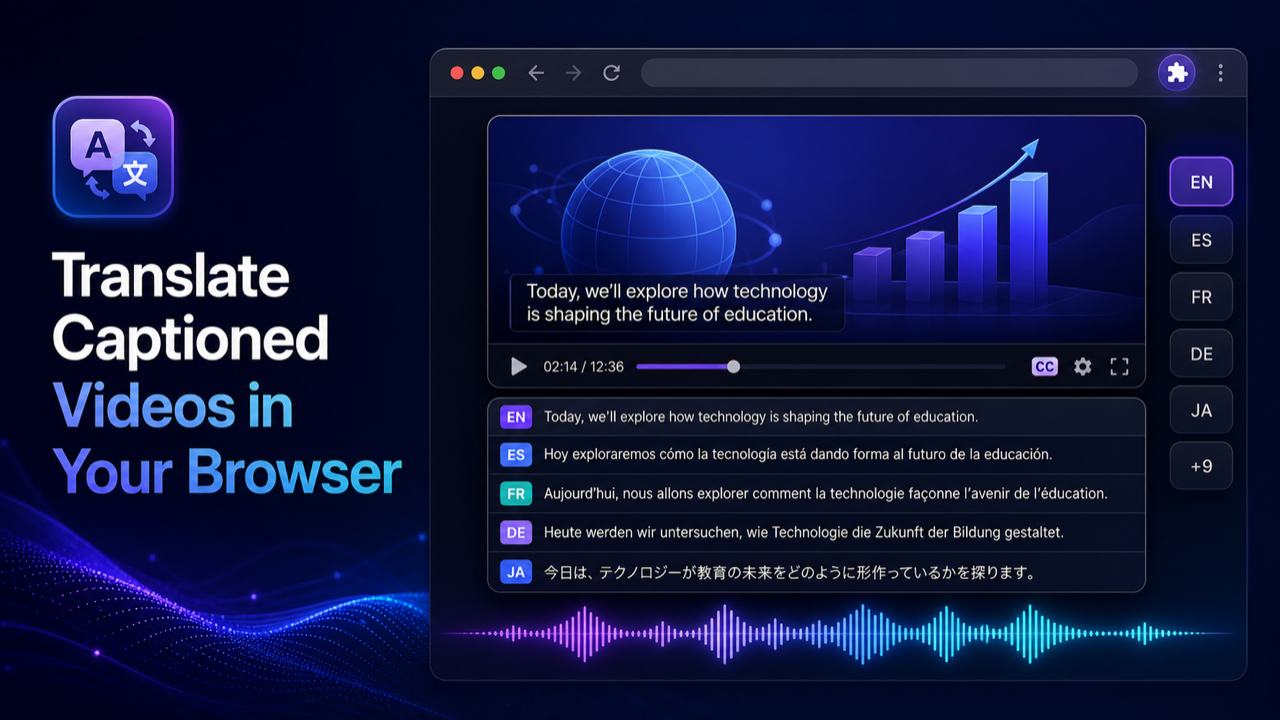
The second is translating inside the tab. My own Unlimited YouTube AI Video Translator is a desktop Chrome extension that reads the caption track the player already exposes, translates it, and then speaks it with AI text-to-speech over the original audio, shows translated subtitles, or both at once. Free to start, with a paid unlimited tier.
Stated plainly so nobody buys the wrong thing: it does not export text and it does not transcribe audio. There is no copy-all button, no file, no .srt or .vtt output, and no speech recognition step. It needs an existing caption track as input, exactly like Auto-translate does. If your deliverable is a document, use the transcript panel route above. If your deliverable is understanding the video, in-tab translation is the faster path. For the full map of every YouTube translation route, including dubbing and per-language cases, start at the YouTube video translator hub.
When the video has no caption track
Then there's no text to get, from anything, and it's worth understanding why rather than reinstalling things. The transcript panel reads the caption track. Auto-translate reads the caption track. Browser extensions of this kind read the caption track. No track means all three have the same amount of input, which is none.
This happens more often than you would guess: the uploader disabled captions, the audio is music with no speech, the source language is not covered by automatic captioning, or the recording is long and noisy enough that automatic captioning never produced anything usable. Nothing in the interface explains which case you hit.
What actually works is a speech-to-text service, billed by the minute, run against the audio to produce a source-language transcript that you then clean and translate. That is a different category of software from anything in the browser tab, and it is the only route that starts from sound. The no-captions case has its own walkthrough in translate YouTube video to English without CC.
Automatic captions make a rough transcript
If the track was written or corrected by the uploader, you're in good shape. Punctuation is real, names are spelled correctly, technical terms survive. Translate that and the output reads like text.
Automatic captions behave differently, and the failures are predictable:
- Punctuation is guessed. Sentence boundaries land in odd places, and long stretches arrive with none at all, which is why the reflow step above exists.
- There are no speaker labels. A two-person interview reads as one continuous monologue, and attributing a quote from it is guesswork.
- Homophones wreck names and jargon. A library name, a drug name, a surname, a version number: these are exactly the words with no context to rescue them, and exactly the words you came for.
Translation makes each of those worse rather than better, because the translated output states the misheard word with complete confidence in a second language, and nothing marks the spot. An error you'd have caught in English becomes invisible once it's in Spanish.
A short cleaning pass before you trust a translated transcript:
- Fix sentence boundaries and punctuation.
- Check every proper noun and technical term against the video description, the pinned comment, or the speaker's slides.
- Add speaker labels wherever more than one person talks.
- Cut false starts and repeated filler words; speech recognition transcribes them faithfully and they read as noise.
- Re-listen to any numbers, units, dates and prices, and correct them in the source before translating.
- Keep the cleaned original next to the translation, so anything strange in the output can be checked against the line it came from.
For notes you're the only reader of, skip the pass and accept the noise. For anything you publish or quote, do it. A translated automatic transcript is two layers of machine guessing stacked on each other, and the second layer hides the first.
Related guides
The YouTube subtitle translator guide covers the subtitle side in detail, including what YouTube's own translated captions can and cannot do. If your text arrived as a subtitle file rather than a copied panel, SRT translator explains which lines to touch and which to leave alone. For subtitle translation across platforms in general, see translate video subtitles.
Frequently asked questions
Does every YouTube video have a transcript I can copy?
No. The panel exists only for videos that carry a caption track, uploader-written or automatic. If the CC icon does nothing and the gear menu lists no subtitle language, there's no track, and no transcript panel will appear for that video.
Can I download the transcript instead of copying it?
There is no viewer-facing download in the player. The panel is a copy-and-paste surface, which is why pasting into a plain text editor first matters: you want somewhere to strip timestamps and rejoin lines before the text goes anywhere else.
Will Auto-translate give me translated text I can keep?
No. Auto-translate draws translated subtitles on the video while it plays and hands you no file. To get translated text you can keep, copy the original from the transcript panel and translate that yourself.
Does your extension export a transcript or transcribe the audio?
Neither. It translates a caption track that already exists and presents the result as dubbing or subtitles during playback. No text export, no speech recognition, and no output when the video has no captions.
Why does my translated transcript read worse than the subtitles I watched?
Because you probably translated raw caption cues. Each cue is a fragment sized for the screen, and translating fragments loses the grammar that crosses the line break. Join the lines into sentences first, then translate, and most of the difference disappears.