Vimeo Video Translator: Watch Videos In Your Language
You've been sent a Vimeo link, maybe a course video, a conference talk, or a client film, and it's in a language you don't fully follow. So you look for a Vimeo video translator, open the captions menu, and find whatever the creator uploaded, if anything, and no way to switch it into your language.
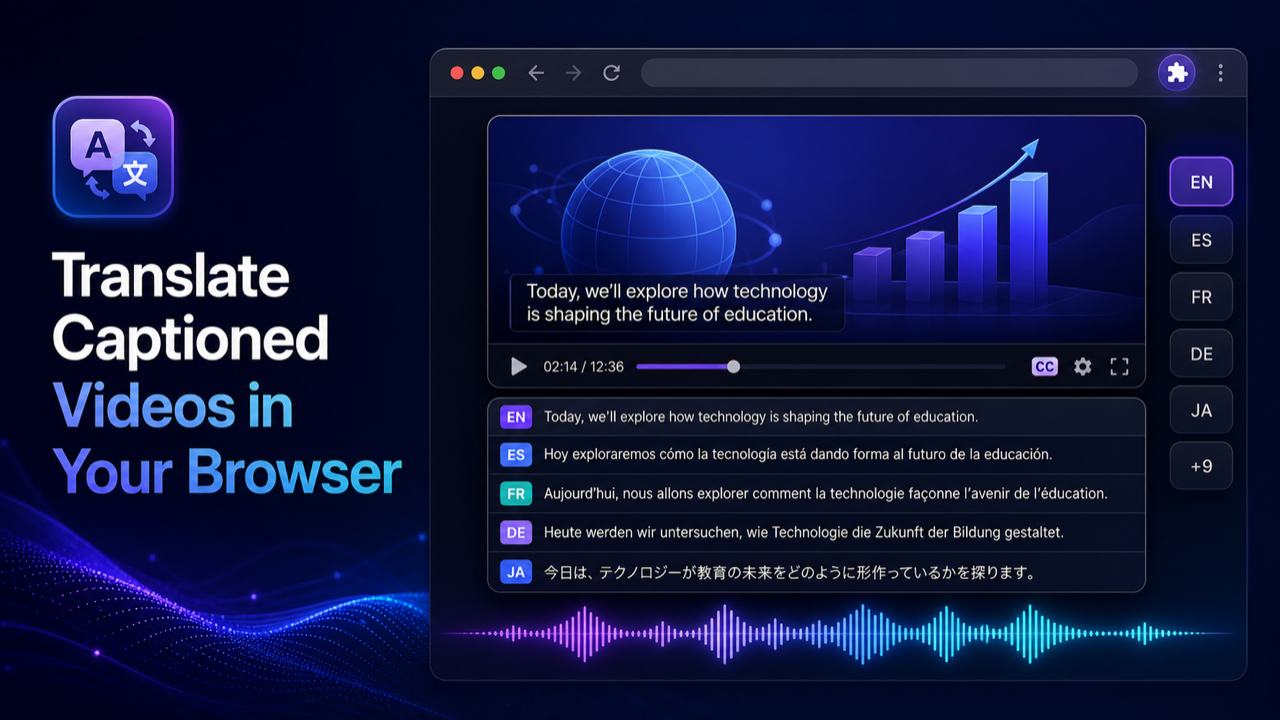
Here's the short version: Vimeo shows the captions a creator chose to add, and nothing more. There's no universal viewer-side auto-translate or dubbing. On a tested Vimeo player that exposes a caption track, Unlimited Universal Video Translator, a browser extension can translate those captions and generate a spoken track in another language. It cannot translate a video that has no detectable source captions.
Vimeo's subtitle situation
Vimeo is built for creators, and captions are entirely in their hands. Depending on the video, you get:
- Creator-uploaded captions. If the uploader added a subtitle file, you can turn it on from the player, usually in the video's own language.
- Occasionally multiple languages. A well-resourced creator might upload captions in a couple of languages.
- A captions menu. Where captions exist, you'll see the available languages in the CC control.
The catch is that everything depends on the creator. Vimeo doesn't machine-generate captions the way some platforms do, and it doesn't translate them. If the uploader didn't add your language, and most didn't, it isn't there.
Why the built-in captions fall short
If Vimeo's captions haven't solved it for you, here's why:
- No auto-translate at all. Vimeo won't turn English captions into your language. What the creator uploaded is what you get.
- Most videos have one language or none. Uploading captions is manual work, so many videos ship with just the original language, or nothing.
- Subtitles keep you reading. Even when captions exist, your eyes are on the bottom of the screen instead of the film, the slides, or the demo.
- No spoken translation. Vimeo gives you text at best, never the video spoken aloud in your language.
For polished creator content like films, courses, and conference recordings, reading rough or absent captions undercuts work that was made to be watched.
The better approach: AI dubbing in your browser
Instead of depending on what the creator uploaded, you add your own translation layer with a Chrome extension that runs on the Vimeo page. It reads the video's detectable captions, translates them, and gives you two things Vimeo doesn't. The first is AI-dubbed audio: the video spoken aloud in your language, synced to playback. The second is clean subtitles in any language you pick, when the video exposes a source caption track.
The video file stays on its original page. Free Standard mode prepares a synchronized track; PRO offers realtime-capable engines.
How to translate a Vimeo video, step by step
The first setup takes about two minutes. After that it's one click per video.
- Install the extension. Add the Universal Video Translator to Chrome from the Web Store. It's free to start.
- Open the video on Vimeo and press play. It works on Vimeo pages and, in most cases, on embedded Vimeo players too.
- Pick your target language. Open the extension and choose the language you want to hear and read. This is where you get languages the creator never added.
- Choose dubbing, subtitles, or both. Want to just watch? Turn on AI dubbing. Prefer to read? Turn on subtitles. Both together works well for courses.
- Generate the translated track in Standard mode, or use a supported realtime engine in PRO, then press play.
Tips for the best results
- Lead with dubbing for films and talks. Vimeo content is often made to be watched closely, and hearing it in your language keeps your eyes on the screen.
- Turn on subtitles for course videos with terms and steps, so the vocabulary lands.
- Keep original captions handy for names when the creator uploaded them, since proper nouns read best in the original.
- Pick the closest regional variant of your language when offered. It usually sounds more natural.
Related guides
Compare Vimeo with the YouTube video translator guide, or install first via the Chrome extension guide. The caption translation workflow explains the shared requirement.
Frequently asked questions
Can I translate Vimeo videos for free?
Yes. The Universal Video Translator is free to start, so you can dub and subtitle Vimeo videos without paying upfront. Heavier use may move you to a paid tier.
Does Vimeo translate captions into my language?
No. Vimeo only shows the captions a creator uploaded and doesn't auto-translate them. To get your language, you add a translation extension.
Does it work on embedded Vimeo players?
In most cases, yes. The extension attaches to the Vimeo player, so it works on Vimeo pages and on many sites that embed Vimeo, as long as the player exposes audio and captions.
Can I hear a video in my language instead of reading?
Yes, and that's the main advantage over creator captions. AI dubbing plays the video aloud in your language, so you can watch instead of reading.
What if the translation gets a term or name wrong?
Any machine translation can slip on jargon and proper nouns. Where the creator uploaded captions, you can glance at the original when something sounds off.
Does it work on mobile?
It's a desktop Chrome extension, so it runs where Chrome extensions run. For a course or film, a laptop is usually the better setup anyway.