
Best Video Translator App: Choose by Output
There is no single best video translator app because “translate a video” can mean three different deliverables:
- a finished localized video to publish;
- a translated transcript or subtitle file;
- translated subtitles and speech while watching an existing video.
Choose the category first. Comparing tools before defining the output produces misleading “best app” lists.
1. Best category for publishing: creator localization tools
Use a creator platform such as HeyGen or Akool when you own the source and need a downloadable result. These tools may provide transcription, script review, voice cloning, lip sync, subtitle editing, and rendered output.
The trade-offs are processing time, plan limits, credits, and the need to provide the source by upload or supported link. Current features should always be checked in the provider’s official documentation:
2. Best category for text: transcription and subtitle editors
Use a transcription tool when you need TXT, DOCX, SRT, VTT, speaker labels, search, or a reviewed translation. A caption overlay in a browser is not a substitute for a clean exportable document.
This is also the required category when a video has no captions and speech-to-text must happen first.
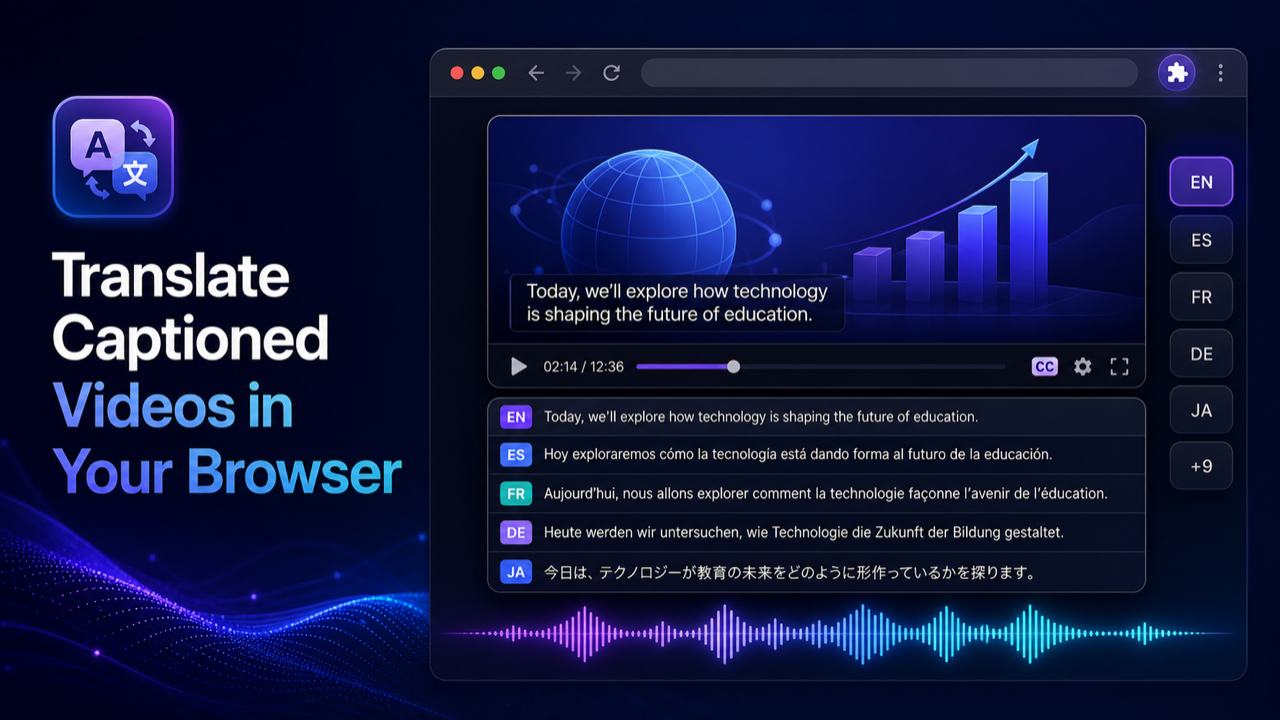
3. Best category for watching: a caption-based browser translator
Use a browser extension when:
- the video already has captions;
- the player is supported;
- you want to stay on the original page;
- you need translated subtitles or speech rather than a file.
Unlimited Universal Video Translator translates the caption track and generates a synchronized voice. The free path uses Standard mode, Google Translate, and an on-device voice. It does not transcribe captionless audio, bypass DRM, clone the speaker, lip-sync the picture, or export a new video.
Decision table
| Your required result | Choose |
|---|---|
| Publish a localized video | Creator localization platform |
| Preserve or clone a speaker’s voice | Creator localization platform |
| Generate text from raw audio | Transcription tool |
| Download translated SRT/VTT | Subtitle editor |
| Watch a captioned course in another language | Browser caption translator |
| Translate a DRM stream or captionless live video | None of these is guaranteed |
How we evaluate a viewer tool
For the browser-viewing use case, test these points on a real video:
- Does it detect the player and caption track?
- Does pause, seek, and playback speed remain synchronized?
- Which language and voice combinations are available?
- Does the chosen mode keep speech local or send text to a provider?
- Is realtime actually included, or is it a paid feature?
- Does the product state unsupported cases clearly?
Do not choose based on a claimed language count alone. A language may be available for translation but not for a particular local voice engine.
For the browser workflow, continue with How to Translate a Video. For transcript requirements, see Translate Video to Text.
Related guides
The viewer category is covered in depth by AI Video Translator and the Chrome extension guide. Two comparisons work through specific tools: HeyGen versus a caption-based viewer and Akool versus a caption-based viewer.
Frequently asked questions
What is the best free video translator for watching?
A caption-based browser translator can be the simplest option when the video is supported and already has captions. Test the free Standard mode on your actual language pair.
What is best for publishing?
Use a creator localization platform that provides editing and downloadable output. A viewer extension is not a publishing workflow.
What is best for a video with no captions?
Start with a transcription tool. The current Unlimited Universal Video Translator cannot create captions from raw audio.