
How to Translate a Video (Free, in Your Browser)
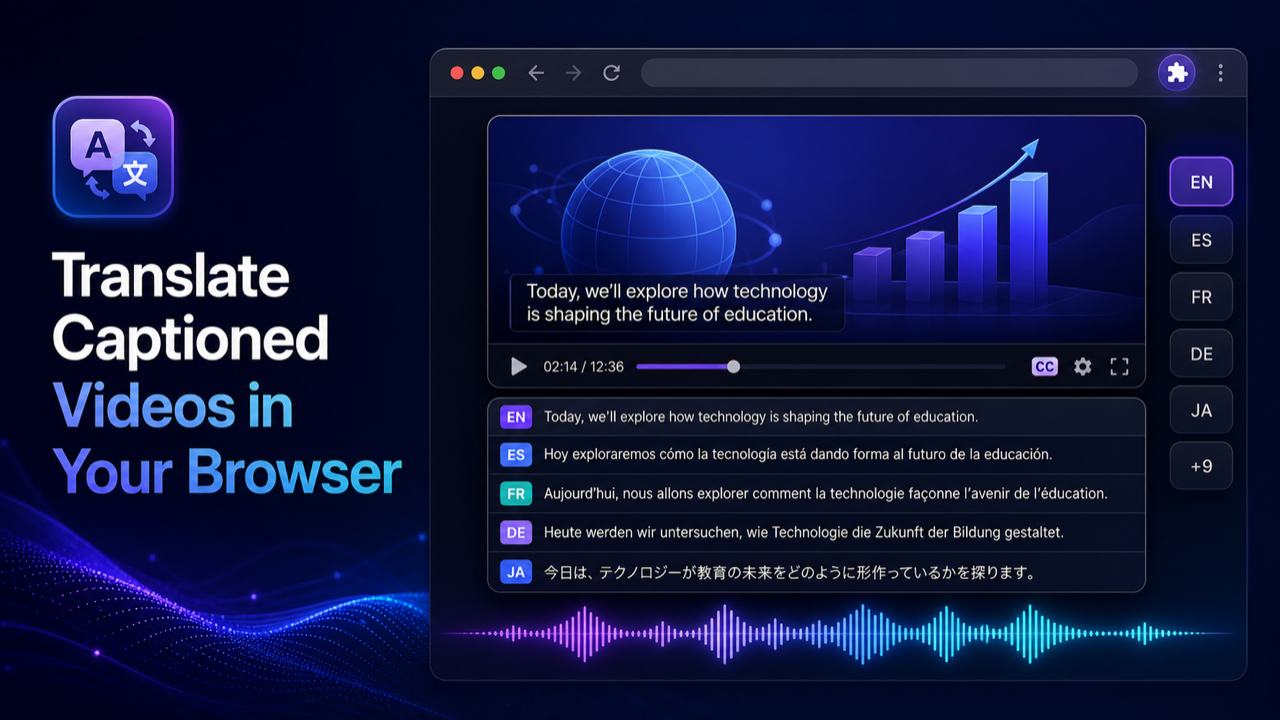
If you have ever tried to follow a tutorial or a lecture in a language you barely speak, you already know the problem. The content is good. You just cannot understand it. So you start looking up how to translate a video into your own language, and ideally you want to hear it dubbed instead of reading subtitles the whole time.
There are a few ways to do this, and most of them are more painful than they need to be. You do not have to download the file, re-upload it to some site, wait in a queue, and then juggle a separate player. If the video already has captions, you can translate it right where it plays, in your browser, for free.
This guide covers what video translation involves, the three routes people take, and the one that gets you watching fastest.
What "translate a video" actually means
People mean two different things when they say they want to translate a video. The first is translated subtitles: the spoken words get converted to text in your language and shown at the bottom of the screen, so you read while you watch. The second is AI dubbing, where the words are translated and spoken out loud by a generated voice, synced to the video, so you listen instead of read. With dubbing, the original audio is turned down underneath.
Dubbing is the one most people actually want, because reading subtitles for a 40-minute lecture is exhausting. The same tool can do both, though, and you pick per video.
Search pages use a pile of names for those same two outputs. A video language changer, a video language converter, a video language translator: they all describe subtitles, dubbing, or both. One name deserves a caveat. In accessibility and healthcare work, a video interpreter is a live human on a video call, often a sign language interpreter. That is a different service, and no extension replaces it.
Three ways to translate a video
| Route | How it works | Best for |
|---|---|---|
| Browser extension | Reads the captions the page exposes, translates them, speaks them over the video | Watching content you did not make |
| Upload-based video translation software | You export the file, upload it, wait for processing, download a dubbed copy | Video you own and need to publish |
| Manual subtitle editing | Pull the subtitle file, translate the text yourself, load it back into a player | Small fixes and exact wording |
The middle route is what most web apps sell. If the video is yours and you need a finished dubbed master, that is the honest answer. For watching something you found, the first route wins, because nothing has to move.
The fastest way to translate video online where it plays
Most of the time you do not want a project. You want to translate this video, right now, in the tab where it is already open. That is what a browser extension does: it attaches to the player, reads the captions the page already exposes, translates them, generates a spoken track, and plays that track over the video with the original audio ducked down.
Here is the whole flow with the Unlimited Universal Video Translator extension:
- Install the extension and open the video to translate, as long as it has captions. This works on YouTube, HTML5 players, and course sites like Udemy and Coursera, anywhere the page exposes a subtitle or caption track.
- Turn on captions in the player if they are not already on. The extension needs to detect them to know what to translate.
- Click the floating Dub button that appears on the video. Pick your target language, the mode, the speech engine, and the voice.
- Press play and listen. The translated speech is synced to the video and played while the original audio is lowered underneath. If you would rather read, you can use translated subtitles instead.
That is it. No file to move around, no upload, no account required to start.
Online video translation without handing over the file
Calling this an online video translator is half right. The video file stays where it is: not downloaded, not uploaded, no processing queue. The caption text does travel, since the translation route receives it and optional cloud voices receive it too, so online video translation describes that step accurately. On the free path the speech is generated on your device inside the browser rather than on a remote server.
That distinction is the practical reason to translate a video online this way instead of through an upload form. Most video translation online tools want the file before they will do anything. A video translator online built that way turns a two-minute job into a twenty-minute one, and you end up watching a copy in a second player instead of the page you started on.
Why the caption requirement matters
The reason this method is fast is also the reason it has a boundary: it works from captions the page provides. If a video has no captions at all, is a live stream, or is DRM-protected, there is nothing for the tool to translate cleanly. So the first thing to check when a video will not translate is simple. Does it have captions you can turn on? If yes, you are almost always good to go.
For most educational and informational content, captions exist. Course platforms add them for accessibility, and YouTube auto-generates them. That covers the vast majority of what people want translated.
Automatic video translation, and what "automatic" really covers
When people search for automatic video translation, they mean they do not want to touch a transcript. That part is real. The caption text gets translated and spoken without you editing a single line, so you can auto translate video after video without opening an editor.
What is not automatic is the setup. You still choose the target language, the mode, the speech engine, and the voice. The extension keeps those settings per video, so a Spanish lecture and a Japanese interview do not have to share one configuration. Once they are set, press play and it will translate the video from its caption track, and automatically translate video after that with the same choices.
Timing comes from that caption track, which is why the dub lands where the speech lands. Browser speech can start quickly. Other standard voices may need the track generated before playback, and the PRO real-time mode starts speaking sooner instead of waiting for a full track to finish. If you auto translate videos in long sessions, that mode is the part worth paying for.
Do you need video translation software?
No. You already have a browser and the video, and that is the whole toolchain. Add one extension and the translate controls appear on the player. Nothing installs on your computer beyond the extension, and nothing runs on a server you have to manage or pay for by the minute.
That is the real split between a browser tool and classic video translation software. Desktop translate video software and hosted automatic video translation software are built around a file: import, render, export. If you are buying a video translation solution for a team that publishes localized courses, that pipeline is the right shape, and many vendors file it under a general "media translate" label that covers audio and documents too. For one person trying to get through a lecture tonight, video translator software that renders files is the wrong tool.
Picking the target language
Video language translation only stretches as far as two things allow: the translation route and the voice catalog. Text is the wide half. The free path sends caption text through Google Translate, which covers a long list of languages. Voices are the narrow half. The on-device catalog that speaks the translation does not include every language or every style, which is why PRO adds premium local voices and cloud voices that cover more of them.
So the order matters when you translate video language into something less common. Turn captions on, check the source language is what you expected, then translate video language online in the player. If subtitles appear but nothing speaks, the language you picked has no on-device voice, and a premium or cloud voice fills that gap. Any language translator for videos hits the same wall, whether it is sold as a language video translator or an online video language translator.
Where this works
YouTube auto-generates captions for most uploads, so translating a video there usually works on the first try. Translating video on course platforms is the second big case: Udemy and Coursera add captions for accessibility, and those lectures are what people sit through for hours. Beyond that, any standard HTML5 player with a caption track the page exposes is fair game.
The limits stay the same everywhere. Live streams, DRM-protected video, and caption-free uploads may not work, because there is no caption text to read. Nothing you watch gets uploaded, and the video file itself is never sent anywhere.
Free vs. paid, honestly
You can translate video for free. The free path uses Google Translate for the text and an on-device voice that runs inside your browser to speak it. No API key, no subscription, no watermark. For a lot of people that is all they will ever need.
If you translate video constantly and want higher-quality voices, a real-time mode that starts speaking faster, smarter LLM-based translation, or your own provider key, a PRO tier adds those engines. Start free. Upgrade only when you can name the thing the free path would not do.
Related guides
This page is the hub, so the deeper answers live elsewhere. AI Video Translator explains the detect, translate, speak, sync pipeline. Free Video Translator sets out where the free path stops and PRO starts. To install, read the Chrome extension guide. If English is your target, use the translate video to English guide. If you only want on-screen text, see translate video subtitles. For alternatives, compare the best video translator app options. Platform guides cover YouTube and Udemy courses.
Two narrower cases have their own pages: translate a video to text if you want the words rather than a dub, and the Hindi video translation guide for that language pair specifically.
Frequently asked questions
How do I translate a video for free?
Use a browser extension that reads the video's captions, translates them with a free translation route, and speaks them with an on-device voice. No account or payment is needed to start, and there is no watermark on anything.
How can I translate my video?
If it is already published somewhere with a caption track, treat it like any other page: open it, turn captions on, and dub it in the player. If it is still a local file, the in-browser route has nothing to read, so you would need it hosted with captions first.
How can I translate a video that someone else made?
The same way. Nothing here depends on owning the video, because the extension only reads the caption track the page already serves.
How do you translate a video without editing software?
You add a browser extension, pick a language, and press play. No timeline, no render step, no export. The only skill involved is turning captions on.
How to translate language from a video into subtitles I can read?
Choose translated subtitles instead of dubbing. The extension translates the same caption text and shows it on screen, which helps when you need exact terms for code or product names.
How to translate from a video when you only want the words?
Run translated subtitles and read them in place. The extension is built for watching rather than exporting, so it gives you on-screen text, not a transcript file.
How to translate videos to other languages, beyond English?
Pick any target the translation route supports, then check that a voice exists for it. Text coverage is wide. Voice coverage is narrower on the free on-device catalog, and PRO adds premium and cloud voices.
How to translate video that has no captions?
Not with this method. The extension works from the caption track the page exposes, so a caption-free upload, a live stream, or DRM-protected video may not work at all.
Can you translate a video for me?
No, this is self-serve. You install the extension and it runs in your browser on the page you are watching, so nothing of yours lands on someone else's server.
Can I translate a video without downloading it?
Yes. If the video plays in your browser and has captions, you can translate and dub it in place. You never download or re-upload the file.
Can I hear the video dubbed instead of reading subtitles?
Yes. AI dubbing generates a spoken voice in your language and plays it synced to the video, with the original audio turned down. You can also choose translated subtitles if you prefer reading.
Which sites does this work on?
It is built for videos across the web, including YouTube, standard HTML5 players, and course sites such as Udemy and Coursera, as long as the page provides captions the extension can detect.
Is the quality good enough for lectures?
For most educational content, yes. The free voice is clear and the translation is solid. If you translate video often and want premium or real-time voices, the PRO tier adds them.
Other ways people search for this
Queries for this job arrive in a lot of shapes, and plenty of them are typos. None of them is a different product, so here they are as people type them:
- Word order variants: video translate, translate videos, videos translate, video translators, videos translator, translator video, video translations, videos translation, translations videos, translation video, video to translate
- Wording around the source: translate from video, translation from video, translator from video, translate by video, translate language from video, language translator video
- Automatic phrasings: automatic translate video, video auto translate, auto translate a video, auto translate for videos, auto translate from video, auto translate video online, auto translate video player
- Misspellings, left as typed: video translater, translete video, translat video, traslate video, vidio translate, translate vidio, translate vidoe
- Autocomplete punctuation: video.translator and video translator.