
Translate Video to Text: Caption Track or Real Transcript
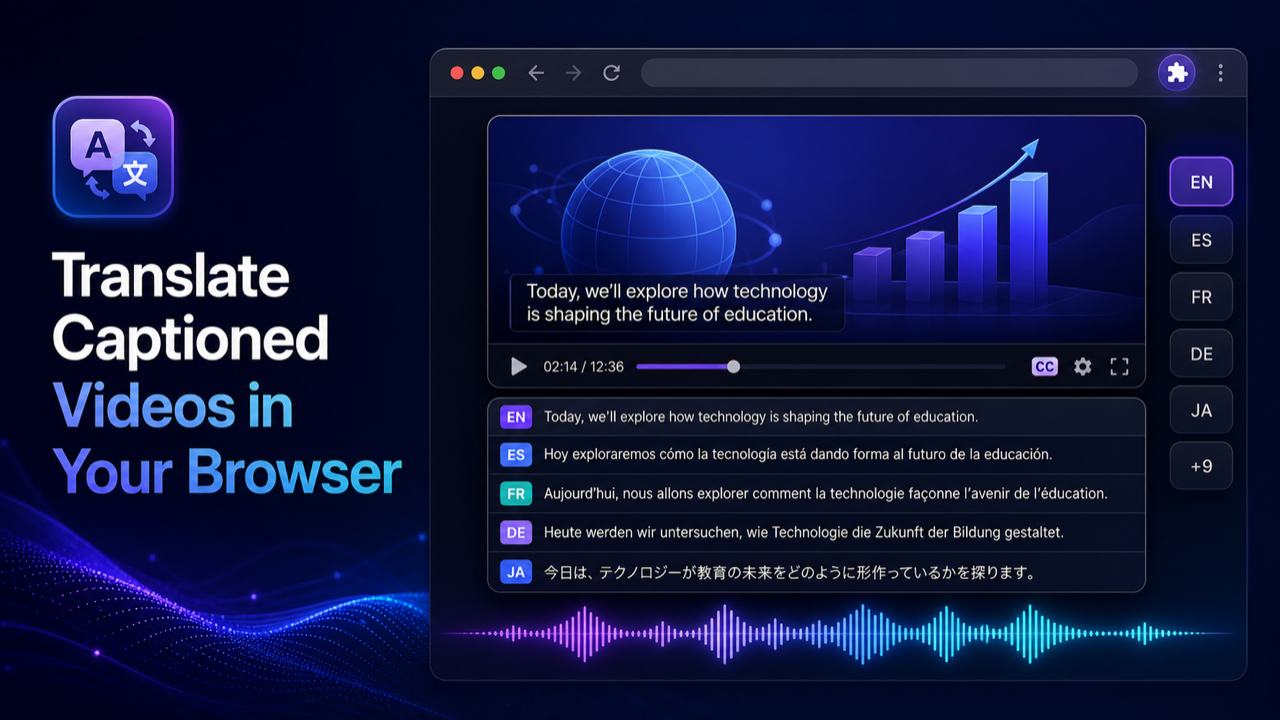
Type translate video to text into a search box and you could mean one of three different things. Words on screen in a language you read, while the video plays. A document you can search, quote and send to a colleague. Or words pulled out of spoken audio that has never been written down anywhere.
Those are separate jobs, and the distance between them is where most of the frustration in this topic lives. The Unlimited Universal Video Translator extension sits on one side of the line. It reads a caption track the page already exposes, translates that text, and shows it on screen or speaks it aloud. No speech recognition runs anywhere in it, and there is no file at the end.
The two jobs behind one phrase
Job one starts from text that already exists. A caption or subtitle track is a list of short lines with a start time and an end time attached to each one. Translating it is a text problem. The lines are written, the timing is done, and a translation route only has to rewrite each line in another language. That is what happens when you translate a video to text in a browser tab: a text-to-text operation on somebody else's work.
Job two starts from sound. Nobody wrote anything down, so a model has to listen to the waveform, guess the words, punctuate them, then split them into sentences and speakers. That is speech recognition. Different computation, different failure mode, and real money to run at scale.
Search phrases mix the two freely. transcription and translation video, transcription translation video, video transcription translation: all three describe a chain where something listens first and translates second. A caption-based browser tool only ever performs the second link. If your requirement is to transcribe and translate video to text in one pass, the transcribe step has to come from a transcription service, because no caption reader produces it.
Hold that split in your head and the rest of this page is bookkeeping.
What an existing caption track can give you
When the video already carries captions, the words are there and you have three ways to use them.
Read them in the original language. Turn captions on in the player. On most platforms the control is a CC button in the player bar, with a gear menu for picking a track. Some sites also render the whole track as a scrollable panel beside the video, and where that panel exists you can select the lines and copy them out. That is the cheapest way to get words out of a video, and it needs no tool at all.
Read them translated, in place. This is where the extension fits. It detects the track, sends each line through a translation route, and draws the translated line on screen on the source timings. Used that way it behaves as a video text translator: text in, text out, nothing rendered and nothing saved. For the subtitle-shaped version of this workflow, with the player details and the per-site quirks, the video subtitle translator guide goes deeper.
Hear them translated. The same caption text can be read out by a text-to-speech voice over the video while the original audio is ducked underneath. That path is covered in the video audio translator guide.
What you cannot do from inside the extension is collect those lines into a document. There is no export, no SRT or VTT download and no editing surface. The translated text exists while you watch it.
How to translate from video to text while you watch
- Install the extension from the Chrome Web Store.
- Open a supported video and turn its captions on in the player. If the Dub control does not appear, reload the page with captions already enabled.
- Click the floating Dub button on the video.
- Pick the target language, the mode and, if you also want audio, a voice.
- Switch translated subtitles on and press play.
Settings are stored per video, so a Korean interview and a German lecture keep their own configuration. To translate videos to text one lecture after another inside the same course, the second one is a single click. If English is the target specifically, translate video to english covers that direction.
How to translate words from a video that has no captions
The honest answer is that the extension gives you nothing here. It looks for a track, finds none and stops. There is no fallback that listens to the audio, which is why a caption-free upload, a live stream or a DRM-protected player may fail with no useful error.
What works instead is a staged workflow, and the shape of it is worth knowing even if you never build one yourself.
- Get a source-language transcript. Either the platform offers one to download, or you run the audio through a speech-to-text service. Platform-supplied text usually beats re-transcribing compressed audio, so check before paying anyone.
- Clean it. Machine transcripts arrive with unreliable punctuation, proper nouns spelled phonetically and no speaker labels. Fifteen minutes of editing here stops you translating errors into a second language.
- Translate the cleaned text. If it arrived as an .srt or .vtt file, open it in a plain text editor, leave the timecode lines untouched and translate only the text lines. Translate a timecode and the file stops loading.
- Export the format you actually need: plain text, a document, or a subtitle file in the same shape it came in.
That chain is what people are shopping for when they look for an app to translate video audio to text. It is a category of software built around speech recognition, usually billed by the minute, and it produces an artifact you keep. A browser extension that reads captions is built around comprehension and produces a view that disappears when you close the tab.
Why caption text reads badly as a document
A caption track is cut into fragments sized for the bottom of a screen rather than for a paragraph. One sentence can be split across three cues. An idea gets repeated because the speaker restarted it. Nothing marks who is talking. Read a line at a time in sync with the picture and none of that registers. Paste two hundred of those lines into a document and you have something nobody wants to read.
So the honest expectation for a video translator transcript assembled out of caption cues: fine for following along, weak as a deliverable. Study notes, usually enough. Quoting someone accurately, publishing, or shipping an accessibility artifact, and you want a transcript a person has reviewed.
Accuracy depends on who wrote the captions
Two kinds of caption track exist and they behave nothing alike.
Creator-supplied captions were written or at least corrected by a human. Punctuation is real, names are spelled right, technical terms survive the trip. Run video text translation over that and the output generally reads well.
Automatic captions are a machine transcript, so translating them stacks one guess on another. When the platform mishears a library name, the translation route renders the misheard word confidently in your language, and nothing in the output tells you it happened. Accents, music beds and crosstalk all make it worse. Technical vocabulary suffers first, which is exactly the vocabulary you came for.
The working rule: treat translated auto-captions as a strong hint rather than a record. Check numbers, units and product names against the original line before you rely on them. Keeping the source captions visible next to the translated ones costs a strip of screen and catches most of it.
That habit also explains why a video word translator is the wrong mental model for any tool in this category. These routes translate lines in context, and a single word plucked out of a caption fragment often does not mean what it looks like it means.
What it costs
The free path is the default state of the extension, with no trial clock attached. Standard mode, Google Translate for the text, an on-device browser voice if you want to listen as well, no watermark, no account. For reading translated caption lines, that is the real answer for anyone searching translate video to text free.
PRO adds LLM translation, which handles phrasing and context better on dense technical speech, premium local voices, cloud voices for languages the on-device catalog misses, a real-time mode that starts speaking sooner, and bring-your-own-key support. Free video translator sets out where the free path stops.
One privacy detail belongs in the price section. The video file is never uploaded. The caption text does travel: the translation route receives the lines it has to translate, and a cloud voice receives them too if you pick one. Decide with that in mind before running an internal recording through any translation route, paid or free.
Which route matches your deliverable
| What you need | Where to go |
|---|---|
| Understand a captioned video now | Browser caption translator |
| Hear it in your language | Caption-based dubbing |
| Copy the original words out | Player transcript panel, where the site offers one |
| Text out of audio with no captions | Speech-to-text service |
| A subtitle file to publish | Subtitle editor |
| A reviewed transcript document | Transcription plus human editing |
Two of those six rows are what the extension does. The other four belong to different software. When somebody sends you a link and asks you to translate the video to text, ask which row they mean before you pick a tool, because the answer decides whether this takes one click or an afternoon.
Related guides
How to translate a video is the hub page for every route. AI video translator walks through the detect, translate, speak and sync stages in more depth, including why the detection stage reads text instead of listening.
Frequently asked questions
Can the extension translate video into text without captions?
No. It reads a caption track the page exposes, so a video with no detectable track gives it nothing to work from. There is no speech recognition step in the extension, and adding captions to a caption-free upload is a transcription job that happens elsewhere.
Is this a video to text translator or a transcription tool?
A translator. It takes caption text that already exists and rewrites it in your language on screen. Transcription means producing text from audio, which is a separate category of service with its own pricing and its own accuracy problems.
Can I download the translated text?
Not from the extension. There is no SRT or VTT export, no copy-all button and no transcript file. The translated lines are drawn over the video for watching. Use a subtitle editor or a transcription service when the deliverable is a file.
Which is more accurate, translated captions or a translated transcript?
A reviewed transcript wins, because a human fixed the names and punctuation before translation. Translated auto-captions inherit every mishearing in the source track. Creator-written captions sit close to transcript quality already, so the gap depends entirely on the track.
Does the video file get uploaded anywhere?
No. Nothing is uploaded and nothing is downloaded. Caption text is sent to the selected translation route, and to a cloud voice if you chose one on PRO. On the free path speech is generated inside your browser rather than on a server.
Does it work on every site?
No. It works on supported players that expose a caption track you can switch on. Live streams, DRM-protected playback and uploads with no captions may not work at all, and detection usually fails with no message rather than an explanation.
Other ways people search for this
One job, a long list of names, several of them typed exactly as autocomplete left them. None is a different product.
- Word order variants: video translate text, video translator into text.
- AI phrasings: ai translate video to text, ai to translate video to text, ai video text translator
- App phrasings: app to translate video to text, app that translates video to text, app that translate video to text
- Free variants: video to text translator free
- General wording: audio video text translation