
How to Translate Chinese Video to English in Chrome
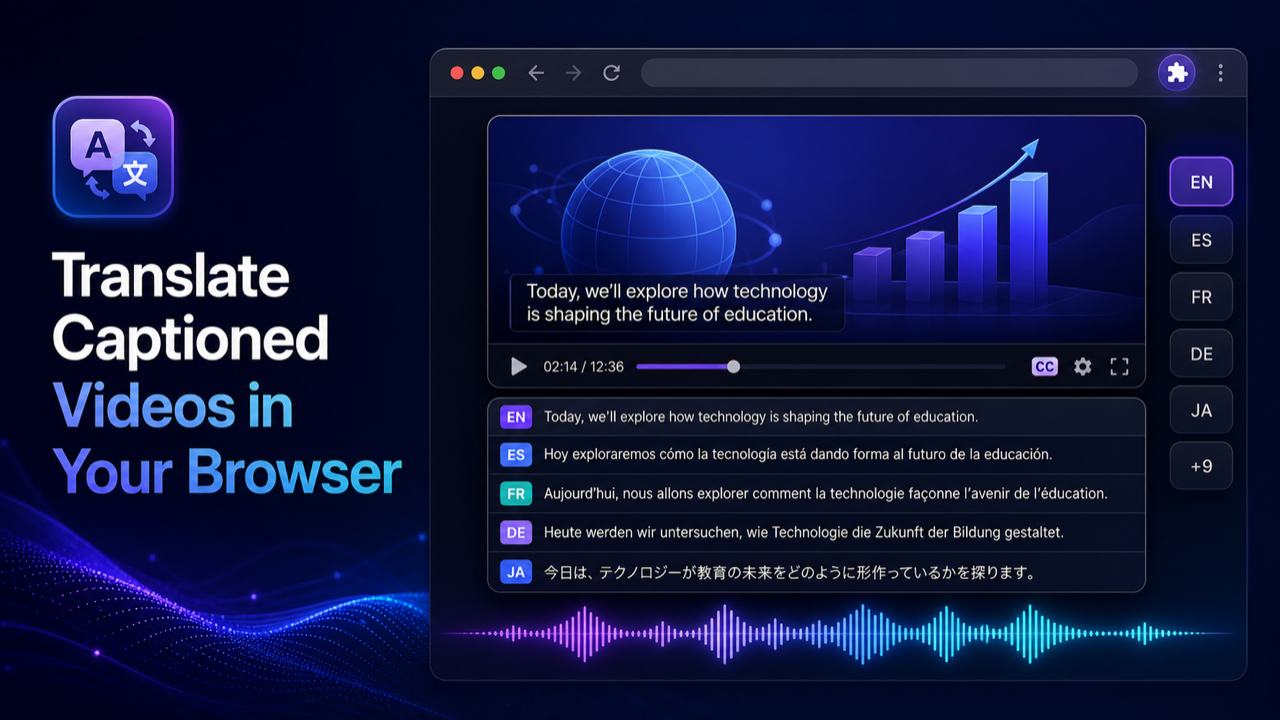
You can translate Chinese video to English in Chrome if the video has Chinese captions the browser can read. Unlimited Universal Video Translator takes that caption track, translates it into English, and plays a synced English voice over the video with the original audio turned down underneath. You can show English subtitles as well. The video stays on its own page; nothing gets uploaded or re-rendered.
The whole method rests on one condition: the captions have to exist as text. If a video has no Chinese captions, or its subtitles are painted into the picture, the extension has nothing to work with.
"Is there a Chrome extension that translates Chinese to English from video?"
People type this question in many forms, including the misspelled "is there chrome extension translate chinese to enlisgh from video". The answer is yes, as long as the video has captions the extension can detect. It works in HTML5 players that expose caption tracks. It does not listen to the audio and write its own transcript, so a video without captions stays untranslated.
It has been tested on YouTube, YouTube Shorts, TikTok, Udemy, Coursera, edX, TED, Vimeo, Khan Academy, gamedev.tv, Zenva, and Domestika. Many other captioned HTML5 players work too, but anything outside that list is untested.
What you need before you start
- Chrome on a desktop or laptop. Mobile browsers are not supported.
- A video that plays in the browser, not a file on your disk.
- A Chinese caption track you can switch on in the player: uploaded captions or auto-generated ones.
- For the free setup, nothing else. No account, no API key.
The quickest check is to open the video, press the CC or subtitles button, and see whether Chinese text shows up in the player. If it does, you can go ahead. If the button is missing or greyed out, look at the picture itself: Chinese characters already printed on screen are usually burned-in subtitles, which is a different case covered below.
Steps for Chinese to English video translation
- Install the extension from the Chrome Web Store.
- Open the video and turn on the Chinese captions in the player. The extension reads the track the player is showing, so this step comes first.
- Click the Dub button that appears on the video.
- In the on-video controls, set the target language to English, then choose a mode, a translation engine, and a voice.
- For a first run, use Standard mode, Google Translate, and a free local English voice. The voice is generated on your device by Piper inside the extension, not sent to a remote speech service.
- Press play. Listen for whether the English voice keeps pace with the speaker, and turn on translated subtitles if you want to read along.
On the free path, the caption text is sent to Google Translate for the translation step; the speech is generated locally. There is also an optional "Free Online" voice, which you have to pick explicitly and which needs an internet connection. PRO adds a real-time mode, premium local voices, cloud voices, browser and OS voices, LLM translation, and your own AI provider keys.
Free English subtitles without a voice
If you only want to read, you may not need a voice at all. On YouTube, open Settings (the gear) > Subtitles/CC > Auto-translate and pick English. YouTube then converts the Chinese caption track, uploaded or auto-generated, into English text on screen. That is the simplest way to translate Chinese video to English subtitles free on that platform, and it relies on the same condition: a Chinese caption track has to exist first.
Outside YouTube, most players have no built-in auto-translate, and that is where the extension helps. Its translated subtitle display gives you Chinese to English subtitle translation on any player it can read, with or without the dubbed voice.
What is different about Chinese videos
Burned-in subtitles
A lot of Chinese content, especially dramas, variety shows, and short clips, carries subtitles drawn directly into the video frames. They look like captions but they are pixels, not text. The extension does not do OCR, so it cannot read burned-in subtitles. If the only Chinese text you see is part of the image and the CC button offers nothing, this video will not work.
Simplified and Traditional characters
Both Simplified and Traditional Chinese caption tracks can be used as the source. The character set does not decide whether the translation works. What decides it is whether the platform actually loads a caption track into the player. If a video offers both a creator-uploaded track and an auto-generated one, try the uploaded one first.
Mandarin and Cantonese
Most Chinese captions use standard written Chinese, which follows Mandarin grammar. Cantonese videos are trickier. Some carry standard written Chinese captions that paraphrase what is said, and those behave like any Mandarin track. Others use written Cantonese, with its own characters and colloquial words, and machine translation may handle those lines less reliably. Check a few captions against what you hear before relying on the result.
What machine translation gets wrong from Chinese to English
The English you get is only as good as the Chinese caption text, and Chinese has a few traits that cause predictable mistakes.
Speech recognition mixes up characters that sound the same. 是 and 事 are both pronounced shi, and 在 and 再 are both zai. When auto-generated captions pick the wrong one, the translation carries the wrong word straight into English.
Pronouns get guessed. Spoken Chinese uses the same sound for he, she, and it (他, 她, 它), and it often drops the subject entirely. English needs a subject in almost every sentence, so the translator fills one in, sometimes wrongly. If a speaker suddenly becomes "she" halfway through a lecture, that is usually why.
Tense and number get flattened. Chinese marks time with context and particles such as 了 and 过, not verb endings, and nouns have no plural form. When a sentence is split across two caption lines, the English can land in the wrong tense or switch between singular and plural.
Politeness and idioms shrink. The respectful 您 and the plain 你 both come out as "you". Four-character idioms (chengyu) and internet slang often get translated word by word, which produces lines that are technically correct and make no sense.
Names are a mess. Personal and place names may be turned into pinyin, into a literal meaning, or left in characters, and the same name can come out differently from one line to the next. Technical terms that speakers say in English, like "API", sometimes get mangled on the way through.
For lectures, tutorials, and interviews, the output is usually good enough to follow along. For dialogue-heavy drama, expect some lines to need guesswork.
Limits
The extension works only from existing captions. It does not transcribe audio, do lip sync or voice cloning, import or export SRT/VTT files, download or render a translated video, accept local file uploads, or read burned-in text. It does not run on mobile browsers, DRM-protected streaming services such as Netflix or Prime Video, or live streams.
Bilibili is not in the tested list. If that is where your video lives, read the Bilibili video translator guide before you rely on it.
Related guides
For other source languages and the general method, see how to translate a video to English. The Japanese to English video guide and the Korean to English video guide cover similar caption issues for those languages, and the video translator Chrome extension guide walks through the full setup.
FAQ
Can it translate a Chinese video that has no captions?
No. The extension translates caption text the player already has. It does not run speech recognition on the audio. If there is no caption track, or the Chinese you see is burned into the picture, there is no text for it to work from.
Is it free?
Yes. Standard mode with Google Translate and a free local English voice costs nothing and needs no account. PRO is optional and adds a real-time mode, LLM translation, premium local voices, cloud voices, and your own AI provider keys.
Does it work on TikTok and YouTube Shorts?
Yes, both are in the tested list, along with regular YouTube videos. The same rule applies: the clip needs a Chinese caption track the extension can detect, and captions drawn into the video frames will not work.
Does it work with Traditional Chinese captions?
Yes. Simplified and Traditional caption tracks both work as a source. The deciding factor is whether the player loads the track, not which character set it uses.
Can I download the English subtitles or the dubbed video?
No. The English subtitles and voice play live on top of the original video. The extension does not export SRT or VTT files and does not render a new video file.