
Translate Japanese Video to English: Subtitles or an English Dub
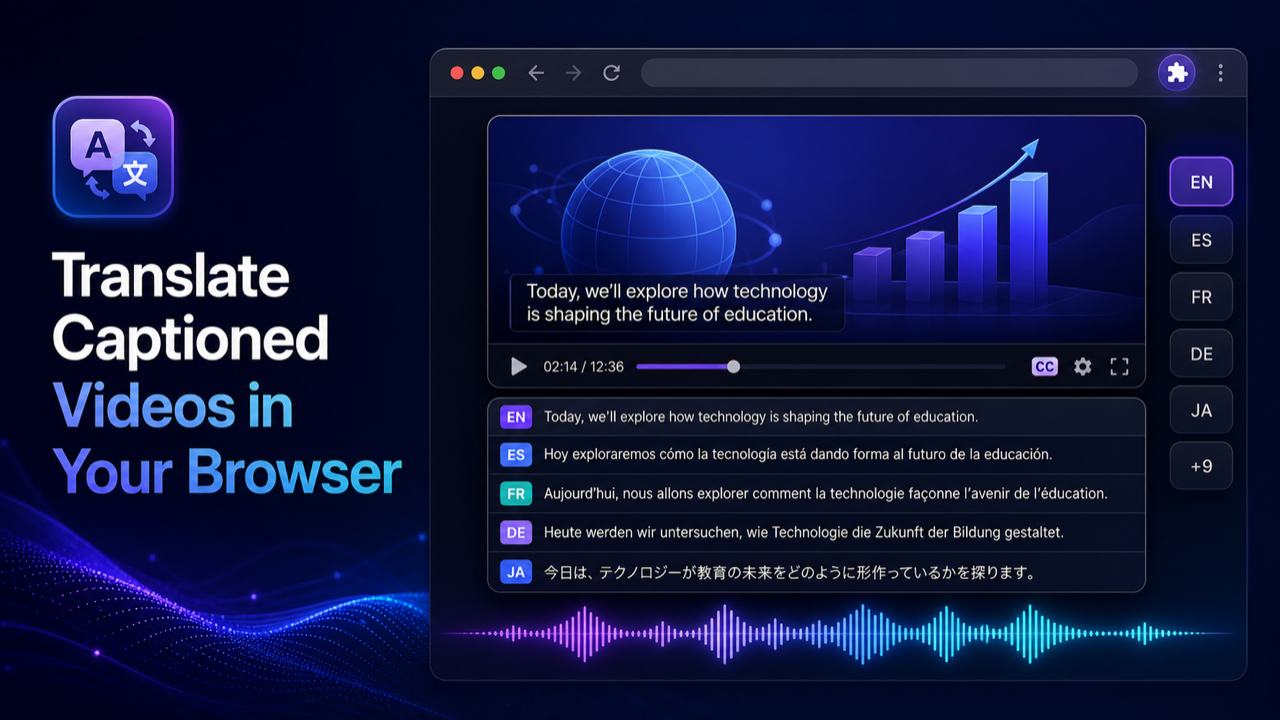
To translate Japanese video to English in a browser, you need a video that already has Japanese captions. Turn those captions on, and a Chrome extension can translate them line by line, show English subtitles, or read them aloud in English over the original audio. If the video has no caption track, this method has nothing to work with. The rest of this page covers the setup, the free path, and the places where Japanese in particular gives machine translation trouble.
The short answer
Open the video on a desktop Chrome browser, turn on the Japanese (or auto-generated Japanese) captions in the player, and use Unlimited Universal Video Translator to translate them. You pick English as the target and choose whether you want only translated subtitles or an English voice as well. The extension translates the captions, generates a separate speech track, keeps it in sync with the player, and plays it with the original Japanese audio turned down underneath.
If all you need is text, YouTube can do part of this by itself: open Settings (the gear icon), go to Subtitles/CC, then Auto-translate, and choose English. That gives you English text only, no voice. The walkthrough for that is in translating a YouTube video to English.
What you need before you start
- A desktop Chrome browser. Mobile browsers are not supported.
- A video with captions the player exposes: uploaded Japanese subtitles, YouTube's auto-generated Japanese captions, or a caption track on a course platform.
- A site that plays the video in a normal HTML5 player. The tested and working list is Udemy, Coursera, YouTube, YouTube Shorts, edX, TikTok, TED, Vimeo, Khan Academy, gamedev.tv, Zenva, and Domestika. Many other captioned HTML5 players work too, but anything outside that list is untested.
You do not need an account for the free path.
How to translate a Japanese video to English, step by step
- Install the extension from the Chrome Web Store.
- Open the Japanese video and turn captions on in the player itself. The extension reads the caption track the player has loaded, so if captions are off, it has nothing to read.
- Click the Dub button that appears on the video.
- In the on-video controls, set English as the target language, then pick a mode, a translation engine, and a voice.
- Press play. You should hear an English voice over quieter Japanese audio, and you can switch on translated subtitles if you want to read along.
You never upload a file; the translation plays over the original video while you watch it.
Translate Japanese video to English free
The free setup is Standard mode, Google Translate for the text, and an on-device Piper voice for speech. Piper runs inside the extension, so speech generation is not sent to a remote text-to-speech service. The caption text does go to Google Translate, because that is the engine doing the translation. English target voices are available on this free path, which suits Japanese-to-English viewing.
There is also an optional "Free Online" voice. It needs an internet connection and is only used if you pick it.
PRO adds real-time mode, premium local voices, cloud voices, browser and OS voices, LLM translation, and bring-your-own-key AI providers. If Google Translate handles a dialogue-heavy Japanese video poorly, LLM translation is the PRO option to try. Compare the two on your own material before deciding.
Subtitles only, or an English voice?
If you want to add English subtitles to Japanese video without replacing what you hear, keep the voice volume down and turn on translated subtitles. You still hear tone, laughter, hesitation, and how politely someone is speaking, which matters a lot in Japanese. You can also glance back at the Japanese line when a name or technical term looks wrong in English.
The English voice helps when your eyes are busy: a coding tutorial, a cooking demo, a drawing class on Domestika, or a lecture with dense slides. For courses like these, a Japanese to English video translator with a voice track saves you from reading every line. For interviews and vlogs, subtitles often work better. For more on the subtitle side, see adding translated subtitles to a video.
Where Japanese to English video translation goes wrong
Any Japanese to English video translation built on captions inherits a few problems from the language itself. Knowing them makes it easier to tell a bad translation from a bad caption.
Dropped subjects
Japanese sentences often leave out who is doing what. "Ikimashita" means "went", and the listener works out whether that is I, you, she, or they. A translation engine working on short caption segments has to guess, and in a conversation with several speakers it will sometimes put the wrong pronoun in. A single presenter talking to camera translates more reliably than a group chat or a panel.
Keigo and honorifics
Japanese has polite, humble, and respectful forms (keigo) that show the relationship between speakers. English has no grammar for this, so a junior employee speaking to a manager and two friends talking often come out sounding equally neutral. Suffixes such as -san, -sama, -kun, and -chan may be kept, dropped, or turned into "Mr." or "Ms." without any consistency. If politeness carries meaning in the scene, listen to the Japanese under the English voice.
Names and their order
Japanese names are usually said family name first. Captions may keep that order while the English text flips it, or not, so the same person can appear as "Tanaka Yuki" in one line and "Yuki Tanaka" in the next. Names written in kanji can also be read several ways, and an engine may translate a name's meaning instead of keeping the name. Product, company, and place names have the same risk.
Homophones in auto-generated captions
Auto-generated Japanese captions sometimes pick the wrong kanji for a word that sounds like another one, such as 橋 (bridge), 箸 (chopsticks), and 端 (edge). The translation then renders the wrong word with full confidence. When a line makes no sense in context, the caption itself is the likely culprit.
Particles, plurals, and articles
Japanese does not mark singular and plural and has no "a" or "the", so English output has to guess. Sentence-ending particles like ne, yo, and ka carry agreement, emphasis, or a question, and they often get flattened into plain statements.
Burned-in Japanese subtitles are not captions
Anime, Japanese variety shows, and many clips have text drawn directly into the picture: subtitles, jokes in big colored letters, sound effects, signs. None of that is a caption track. The extension does not do OCR of on-screen text, so it cannot read or translate it. If the video only has burned-in text and no selectable caption track, it will not work. More on this in translating text in a video.
What this approach does not do
It will not transcribe a Japanese video that has no captions; there is no speech recognition. It also does not do lip sync or voice cloning, does not import or export SRT or VTT files, and does not render or download a translated video. Local file upload, mobile browsers, DRM-protected streaming services such as Netflix or Prime Video, and live streams are out of scope.
Other languages and the general method
The steps are the same for any source language. The general guide to translating a video to English covers the method without the Japanese-specific issues. Korean shares several of them, including dropped subjects and honorific speech levels, and is covered in translating a Korean video to English.
FAQ
Can I translate a Japanese video that has no captions?
No. The extension translates caption tracks the player already has. It does not listen to the audio and write a transcript, so a video with no captions, or with only burned-in text, gives it nothing to translate.
Does YouTube's Auto-translate replace the extension?
For reading, it can. Settings > Subtitles/CC > Auto-translate turns Japanese captions into English text. It does not give you an English voice. If you want to hear English while watching, you need a tool that generates speech from the translated captions.
Is the English voice free?
Yes, on the free path: Standard mode, Google Translate, and a local Piper voice, with no account. Cloud voices, premium local voices, and real-time mode are PRO.
Will it work on anime streaming sites?
Only the tested list is confirmed, and none of those are anime streaming services. DRM-protected streaming services are out of scope. If an anime clip is on YouTube with a real caption track, it works like any other YouTube video.
Why do names come out differently in different lines?
Captions arrive in short segments, and Japanese names can be read and ordered in more than one way, so the translation of one line does not always match the next. Keeping translated subtitles visible next to the Japanese line makes these slips easy to spot.
Other ways people search for this
People describe this task in many ways. Some search for how to translate japanese video to english, some want to translate a video from japanese to english for a course, and others look for a japanese video to english translator or a japanese to english translator video tool they can use without installing desktop software. In every case the video needs a caption track first, because the translation is built from it.
Searches such as translate japanese to english video, translate video from japanese to english, and translate video japanese to english all describe the workflow above. The same goes for japanese video translation to english: if the Japanese captions are there and the site plays video in a regular HTML5 player, you can get English subtitles and an English voice in the browser.