YouTube Live Translation: Why Live Streams Are a Different Problem
YouTube live translation is the request I get most often from people who already translate recorded video without thinking about it. The assumption underneath it is reasonable: if software can dub a two hour lecture, surely it can dub the same lecture while it is being given. It cannot, and the reason is not that nobody has written the code yet. A live stream hands the translator a fundamentally worse input, and every part of the pipeline pays for it.
This page is the honest version. I'll explain what breaks, in what order, and then what you can actually do this evening if the keynote you need is streaming right now in a language you don't read.
A recording is finished before you press play
When you open a normal YouTube video, the caption track already exists in full. Every cue has a start time, an end time and final text. Nothing in it is going to change while you watch. A translator can look ahead, see where a sentence ends, translate the whole sentence, and schedule the spoken result against a timestamp it already knows.
A live stream gives you none of that. Text arrives a few seconds behind the speaker, a fragment at a time, and the stream keeps moving whether or not anything downstream has caught up. There is no end of sentence to look ahead to, because the sentence hasn't been said yet. That single difference is what separates the two jobs. Recorded translation is a scheduling problem with all the data in hand. Live translation is a guessing problem under a deadline.
The latency budget is the whole story
Three delays stack, and they don't overlap much.
Recognition comes first. Speech has to be turned into text, and recognizers need context to commit to a word. Two to five seconds behind the speaker is normal, and that is before anyone has translated anything.
Translation is next. It is the cheapest stage, usually well under a second, but it can only start on text that exists, so it inherits the recognition lag rather than hiding it.
Synthesis is last, and it is the stage people forget. A voice has to produce audio for the sentence, and then the audio has to be played, which takes as long as the sentence takes to say. Speaking a twelve word sentence costs four or five seconds of wall clock time no matter how fast the model generated it.
Add those up honestly and the spoken translation of a sentence lands somewhere around eight to fifteen seconds after the speaker finished saying it. Meanwhile the speaker has moved on to the next two points. A live dubbing system then has exactly two options, both bad. It can run that far behind, which means you're hearing answers to questions you saw asked on screen ten seconds ago and the slides no longer match. Or it can truncate, dropping or compressing whatever it couldn't say in time, which is how you get a dub that sounds fluent and quietly loses half the content.
Recorded video has the same three stages and none of the pain, because the deadline is gone. The pipeline can take twenty seconds to prepare the first line and still be perfectly in sync forever after. Latency on a recording is a wait. Latency on a live stream is lost information.
Live caption text rewrites itself
This is the part almost nobody thinks about, and it is the reason live machine translation is worse than the latency numbers alone suggest.
Live recognition emits drafts. The first pass guesses a word from the sounds so far, then revises it once more context arrives. "to" becomes "two", "there" becomes "their", a mumbled surname resolves into something plausible three words later. Watch any auto-captioned stream closely and you can see the last few words flicker and change before they settle.
Now put a translator on top of that. Translate a fragment the instant it appears and you are translating a draft that is about to be corrected. Worse, many language pairs force early commitments: grammatical gender, verb tense, formal or informal address, and word order that in German or Japanese depends on a verb that hasn't arrived yet. Choose wrong and you don't get a garbled sentence you can see through. You get a grammatically clean sentence that says something different from what the speaker said, and nothing in the output marks it as a guess.
The tradeoff, then, is between confident nonsense and lag, rather than between speed and quality. Wait for the text to firm up and you fall further behind. Emit immediately and you produce fluent output that drifts from the source in ways the viewer can't detect. Professional interpreters manage this with strategies machines don't have, which I'll come back to.
Where my extension stands on this
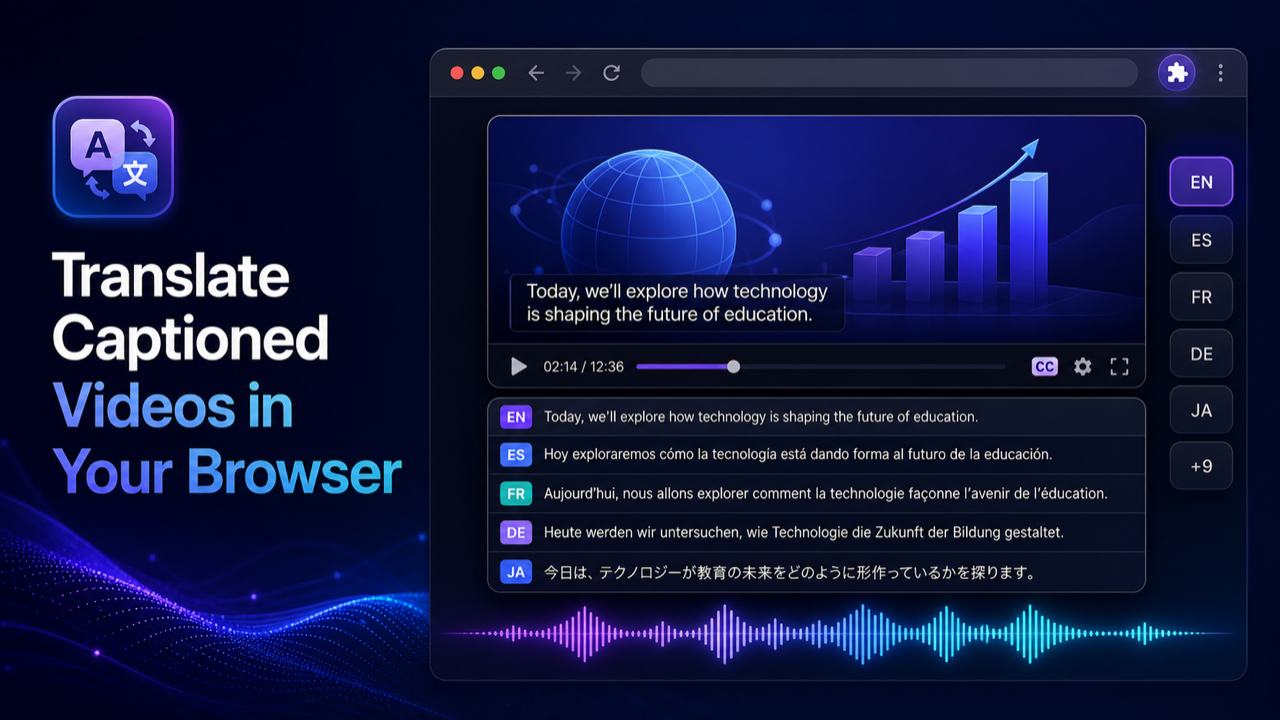
Plainly, once, so nobody has to guess: my extension is built around a complete caption track for recorded video, and I don't claim live-stream support. It reads the caption track the player already exposes, translates that text, and plays AI speech over the original audio or shows translated subtitles. On a stream in progress there is no finished track to read, so the tool has nothing to work from. That's a design boundary, not a bug queue.
I'd rather say that than sell you a live feature that truncates a keynote without telling you.
What actually works for a viewer today
Two things, and the second one solves more problems than people expect.
The first is source-language live captions, where the platform offers them. Many live streams carry automatic captions in the language being spoken. They lag, they revise themselves, and on a fast speaker they're rough, but if you read the source language at all they are genuinely useful for following along. In the desktop player the CC icon turns them on. Auto-translate is a separate menu item and it only appears when a caption track exists, so on many live streams it simply isn't there.
The second is to wait for the recording. That is the answer for most lectures, keynotes and conference streams, and it's unglamorous enough that people skip past it. When a stream ends, YouTube keeps it as a normal video. Captions get finalized, and automatic captions often appear within the hour, sometimes the next day. At that point it stops being a live problem and becomes an ordinary captioned video, which is the case that works well: full dubbing, full translated subtitles, in sync, nothing truncated.
That is where Unlimited YouTube AI Video Translator comes in. Open the archived stream, confirm the CC button offers a caption language, and translate it like any other video. You lose the ability to ask a question in chat. You gain a translation that is actually complete, plus pause, rewind and the freedom to slow a dense section down. For a technical talk that trade is usually worth making on purpose.
Worth knowing about the third case: a channel can upload its own multi-language audio tracks, which show up in the gear menu under the audio track option. When you see a stream or video offering several spoken languages, that's the uploader's own dub, not machine translation, and it's the best audio you'll get because a human made it.
YouTube live translate: what people expect the button to do
Search for youtube live translate and you'll find a lot of pages implying a single control that dubs a live stream into your language on demand. There is no such button, in the player or in any extension, and the sections above are why.
What people picture is closer to a broadcast with an interpreter booth attached: you pick a language, you hear the talk in it, live, in sync. What exists is translated subtitles on recorded video, source-language captions on some live streams, and uploader-provided audio tracks where a channel has paid for them. YouTube's own Auto-translate, when it appears, gives translated subtitles only. It never produces spoken audio, live or otherwise.
If your mental model is the interpreter booth, that instinct is right. It's just that the booth has a person in it.
The professional route for events that genuinely need it
Conferences that must be understood in several languages don't buy machine dubbing. They hire simultaneous interpreters and give each language its own audio channel, so attendees choose a channel and hear a human speaking their language a couple of seconds behind the stage.
That still beats machine output on a live stage, and the reasons are the ones this page has been circling. A human interpreter hears intent, not just words. They can hold a clause in memory while waiting for the verb that decides the sentence, compress a rambling answer without losing the point, recognise that a joke won't survive and substitute one that lands, and say "the speaker is referring to the previous slide" when a pronoun has nothing to attach to. They also know their own uncertainty and can flag it, which no current dubbing pipeline does. If an event's reputation depends on being understood, that cost is the cheapest part of the budget.
For everything below that bar, which is most streams most of the time, the archived recording plus a translator is the practical answer.
Related guides
The YouTube video translator page is the overview of every route for translating a YouTube video as a viewer, live or not. Real time video translator goes deeper into what "real time" means for a recording that is already playing, which is the case people confuse with this one. For getting the extension running, see the Chrome extension to translate YouTube videos guide. If you want the words as text rather than as audio, translate YouTube video to text covers transcripts, and YouTube subtitle translator covers the subtitle path and YouTube's own Auto-translate menu.
Frequently asked questions
Is YouTube live translation possible at all right now?
Not as spoken translation of a stream in progress, for a viewer. Recognition, translation and speech generation stack into roughly ten seconds of delay per sentence, so a live dub either runs far behind the speaker or drops content to keep up. Source-language live captions are available on many streams, and the archived recording can be translated properly once the stream ends.
Does YouTube's Auto-translate work on live streams?
Rarely, and only when the stream already has a caption track. Auto-translate is an entry under Subtitles/CC in the gear menu, and it appears only if captions exist. It also produces translated subtitles and never spoken audio, so even when it is available you are reading, not listening.
Can your extension dub a live stream?
No. It reads the caption track a recorded video already exposes, and a stream in progress doesn't have a finished one. I don't claim live-stream support. Once the stream ends and captions are available on the recording, the extension handles it like any other captioned video.
Why can't the software just translate each phrase as it is spoken?
Because live caption text is a draft that revises itself as more audio arrives, and many languages force early choices about tense, gender and word order that depend on words not yet said. Translating immediately produces fluent sentences that quietly differ from the source. Waiting for the text to settle means falling further behind.
How long until a finished live stream can be translated?
It depends on the channel and the video. Automatic captions on an archived stream often show up within an hour, sometimes the next day, and creator-uploaded captions take as long as the creator takes. Open the CC menu on the recording. If it offers a language, the track exists and you can translate it.
What do large conferences use instead?
Human simultaneous interpreters, one audio channel per language. Attendees select a channel and hear a person speaking their language a few seconds behind the stage. An interpreter can wait for a sentence to resolve, compress a long answer, and signal uncertainty, which is exactly what a machine pipeline on a live feed cannot do.