
Real Time Video Translator: What Live Means for a Video Playing Now
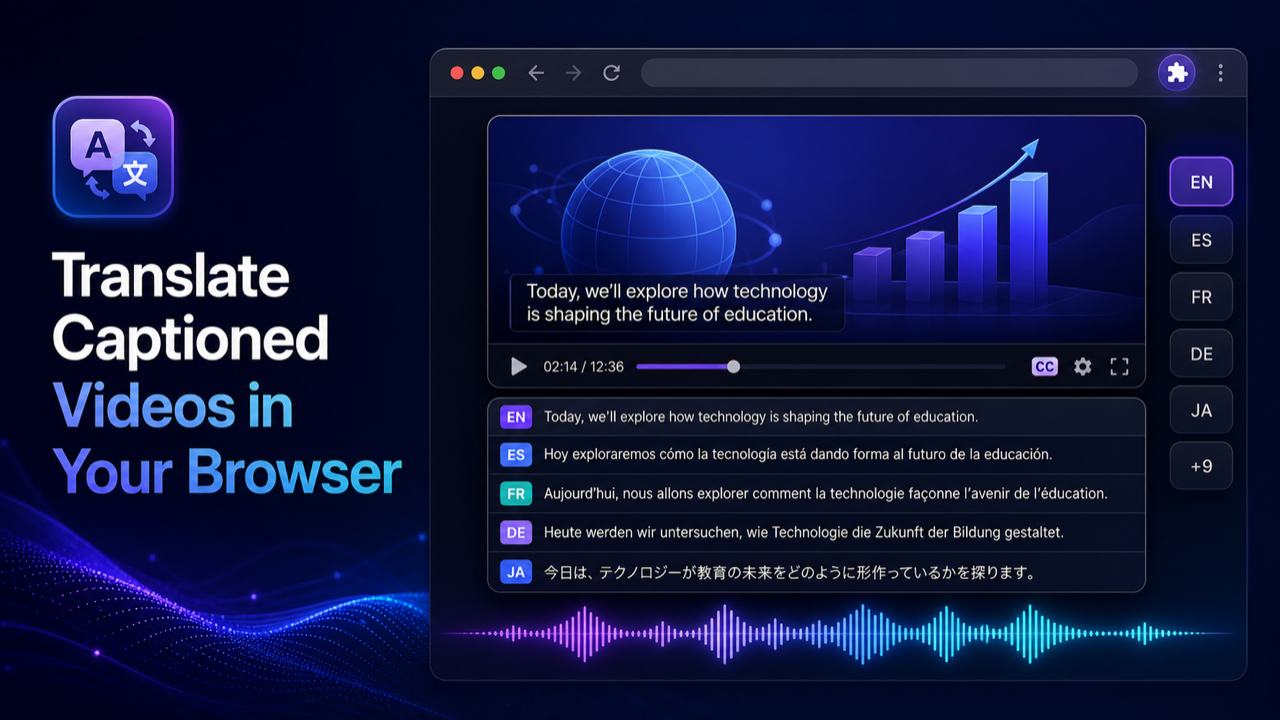
A real time video translator is what you go looking for when the video is already on screen and the waiting feels wrong. You pressed play, the speaker is three sentences in, and you want the translation now. The Unlimited Universal Video Translator extension gets closer to that than an upload-and-render service does, and the exact distance is worth spelling out before you install anything.
Two facts set the ceiling. The extension reads the caption track the page exposes and never listens to the audio, so a video with no detectable captions gives it nothing to work from. And translation plus speech generation both take time. What changes between modes is when that time gets spent, not whether it exists.
The hyphenated spelling, real-time video translator, and the unhyphenated one describe the same thing. Both are usually typed by somebody who has already sat through a progress bar once.
What real time video translation means for a recording
Real time video translation, applied to a recorded video, means the translated audio is produced while you watch. Nothing is rendered into a file first, nothing is queued on a server, and there is no download at the end. The player streams the video, the extension follows along in the caption track, and the translated voice plays on top with the original audio ducked underneath.
That is what live video translation means inside a browser tab. The word live describes your session, not the source. The video itself is a recording sitting on somebody's CDN. A real time translator for video playback is a viewing tool, and every design decision in it follows from that.
An instant video translator does not exist in any strict sense. Caption text has to reach a translation route and come back, then a speech engine has to turn the result into audio. Both steps cost real milliseconds, and milliseconds across a few hundred caption cues add up to seconds. The useful comparison is against the alternative: exporting the video, uploading it, waiting for a render queue, downloading a dubbed copy. Against that, a few seconds before the first spoken line is a different order of magnitude.
The two modes and what you actually wait for
The extension ships two ways of handling the wait.
Standard mode prepares the translated speech from the caption track and builds a synchronized track before playback. Once it exists, the track follows play, pause and seek. Browser speech can start quickly here, because the on-device voice does not have to call anywhere. Other standard voices may need the track generated first, which is the wait people complain about.
Realtime mode is a PRO option on supported engines. It starts speaking sooner instead of waiting for the full track to finish generating. You get the first line earlier and the rest keeps arriving as playback moves forward.
| Mode | What happens when you press play | Who gets it |
|---|---|---|
| Standard | The translated track is prepared, then played in sync | Free path, any supported voice |
| Realtime | Speech starts before the whole track is ready | PRO, on engines that support it |
This is the setting people mean when they search live translate video. It lowers the latency of the first line. It does not remove latency, and any pipeline that translates text and then generates speech has a floor it cannot go under.
What decides the delay
A live video translator has four variables, and three of them are on your side of the wire.
- Video length. A twelve minute tutorial has far less text than a two hour lecture, and standard mode is preparing the whole thing.
- Caption segment count. Cue density matters more than runtime. Fast dialogue chopped into short cues means more translation calls and more speech requests.
- Voice engine. An on-device voice starts fast and costs nothing. A cloud voice sounds better and adds a network round trip per batch of text.
- Machine speed. On-device synthesis runs on your CPU. An old laptop with forty tabs open will take longer, and there is no server to offload to.
That last point cuts both ways. Nothing is queued behind other users, so you never wait in line, but you also never borrow somebody else's hardware.
Live streams, and why the caption track decides everything
Here is the split that most pages about this topic blur. A recording playing in your browser and a broadcast happening right now are two different problems, and only one of them is solved by reading captions.
People who want to translate live video usually mean one of two things:
- A video file or platform upload that is playing at this moment. Captions usually exist. This works.
- A broadcast in progress, where the words are being said as you watch. Captions may not exist yet, and if they do, they arrive a few seconds behind the speaker and are often not exposed in a form an extension can read.
Searches for auto translate streaming video land on the same fork. Streaming in the Netflix-and-YouTube sense means a recording delivered over the network, and that case is fine as long as the page serves a caption track and DRM does not block detection. Streaming in the broadcast sense is the hard one. Many live players expose no stable caption track at all, so the extension has nothing to detect and the Dub control may simply not appear.
So the practical rule: captions decide. Turn them on in the player before judging anything. If the floating Dub button is missing, enable captions and reload the page. A player can show visible subtitles without exposing them in a form the extension can currently detect, and a live broadcast can show auto-captions that never reach the page as a track.
Translated subtitles are the lowest-latency option
If what you want is the fastest possible path from foreign speech to something you understand, skip the voice.
The extension does translated subtitles from the same caption text. That route drops the speech generation stage entirely. Text comes back, text goes on screen. No voice catalog, no waiting for a track to build.
The phrase real time video & audio translation bundles two jobs with very different costs. Translating a sentence is quick. Speaking it is where the seconds go, since a voice engine has to produce audio for every line. When you are in a hurry, or when the material is full of commands and library names that a voice will mangle, read instead of listen. The translate video subtitles guide covers that path in full, and video audio translator covers the spoken side including voice choice and pacing.
Many people run both at once on technical material. Hear the explanation, read the exact term.
Where the AI sits in this
Marketing for ai real time video translation tends to imply a model listening to the video and speaking over it. Two stages here genuinely run on models, and two do not.
Caption detection is ordinary code reading a track the page already serves. Timing comes from the cue start times in that track, which is also ordinary code. Translation is the first AI stage, using Google Translate on the free path or LLM translation on PRO. Voice generation is the second, using an on-device voice for free or premium local and cloud voices on PRO.
So ai live video translation, in this product, means AI translating caption text and AI speaking it, on a schedule the player sets. It does not mean a model transcribing audio. There is no speech-to-text step anywhere in the current release, which is the single most common wrong assumption people arrive with. The AI video translator breakdown walks through all four stages in detail.
What this is not
Call and conversation translation is a separate category, and this extension does not touch it: no microphone input, no phone line, no meeting bot, no interpreter mode. It works on a video element in a web page that exposes captions, and nothing else.
That matters because the search results for this topic mix two products. When someone types live translate from video, they usually mean a page or file already playing, which is the case handled here. When they mean the person sitting across the table, they need a speech translator on a phone, and no browser extension is going to help.
The other limits are worth stating plainly:
- It does not transcribe. No captions on the page means no dub and no translated subtitles.
- It does not import or export subtitle files. There is no SRT in and no SRT out.
- It does not render or download a translated video. Nothing leaves the browser as a file.
- It does not bypass DRM, and DRM-protected players can block caption detection entirely.
- It does not change lips, clone the speaker, or give different voices to different people in an interview.
On privacy, the video file is never uploaded. Caption text does travel: the translation route receives it, and any cloud voice you select receives the text it has to speak. On-device speech generation stays on your machine.
Free path versus PRO
The free path is standard mode, Google Translate for the text, and an on-device voice for the speech. No account, no watermark, no upload of the video. For understanding one lecture tonight that is the whole story, and free video translator sets out exactly where it stops.
PRO is what you buy when the wait or the voice quality is the thing bothering you:
- Realtime mode on supported engines, which starts speaking sooner.
- LLM translation for phrasing that holds context across cues.
- Premium local voices and cloud voices, which also extend language coverage.
- Bring-your-own-key support if you would rather run your own provider.
Start free. Move up when you can name the specific thing the free path refused to do.
How to set it up
- Install the extension from the Chrome Web Store.
- Open a captioned video and turn its captions on in the player.
- Confirm the floating Dub control appears and has found the subtitle track.
- Open the mode, engine and voice settings.
- Pick your target language, then choose standard mode or a realtime-capable PRO engine.
- Press play and give the first segment a moment to prepare.
Settings are kept per video, so a German lecture and a Japanese interview do not have to share one configuration. Installation details and browser requirements are in the Chrome extension guide, and how to translate a video is the hub page covering every route.
Frequently asked questions
What does a real time video translator do?
It translates the caption text of the video you are watching and either shows it as subtitles or speaks it over the original audio while playback continues. Nothing is exported. The translation exists for the duration of your viewing session.
Does real time mean zero delay?
No. Translation and speech generation take time. Realtime mode on PRO starts speaking before the full track is built, which lowers the wait before the first line. Standard mode prepares the track first, and browser speech can start quickly.
Is there an app to translate live video as it broadcasts?
Not this one, reliably. A broadcast in progress often exposes no caption track an extension can read, and its auto-captions already lag the speaker. Recorded uploads with captions are the dependable case.
Can I use it to live translate video on any website?
It works where the page serves captions the extension can detect: YouTube, standard HTML5 players, and course platforms such as Udemy and Coursera.
Can it translate a video call or a meeting?
No. There is no microphone capture and no meeting integration. That is conversation translation, which is a different category of tool.
Is realtime mode free?
No. The free path uses standard mode. Realtime mode is a PRO option and only on engines that support it.
Does it work on a video with no subtitles?
No. There is no speech recognition step, so an undetectable or missing caption track stops the process before translation starts.
Why did the first line take so long?
Most likely a long video with dense captions and a cloud voice. Try an on-device voice, or switch to translated subtitles to skip speech generation entirely.
Other ways people search for this
The same request arrives in a pile of word orders, and a few of them read strangely in a sentence. They all describe one thing: translated text or speech produced while a captioned video plays in your browser.
- Word order variants: video live translate, live translation video, video live translation, live video translate app
- AI phrasings: ai live translation video