
How to Add Translated Subtitles to Video, Two Different Jobs
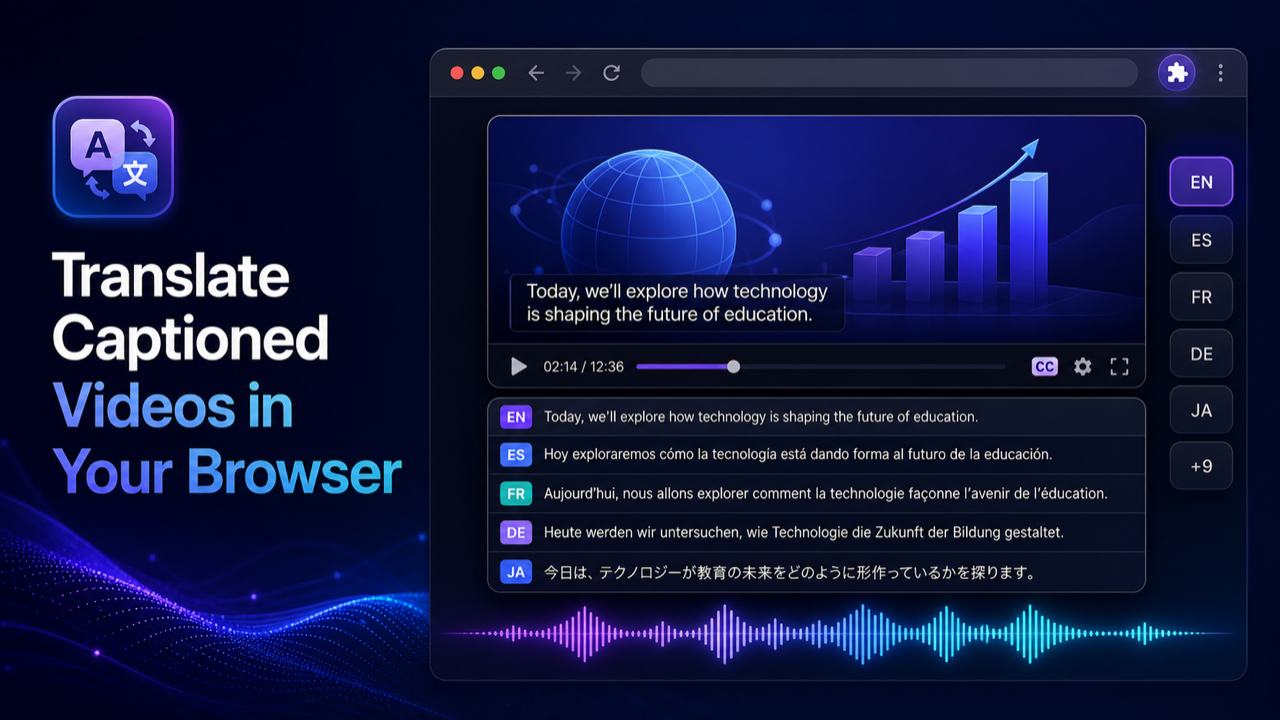
When people say they want to add translated subtitles to video, they are describing one of two jobs that share almost nothing. One is publishing work: you own a file, you need a Spanish or German caption track shipped with it, and the result has to survive being played by strangers on players you will never see. The other is viewing work: somebody else's lecture is in Portuguese, you want readable lines on screen tonight, and you are never going to touch the file at all.
Those two jobs need different tools, and most pages about them are vague on purpose. A publishing pipeline needs a subtitle editor and usually an encoder. A viewing tool needs a browser and a caption track the page already serves. Our extension, Unlimited Universal Video Translator, does the second one. It is not a video editor, it embeds nothing into your file, and it exports no subtitle file. If your goal is a deliverable, the rest of this page still tells you how the work is done, but the last step happens in software we do not make.
Two things "add subtitles" can mean
Sort yourself into a row before you pick anything.
| Question | Publisher route | Viewer route |
|---|---|---|
| Who owns the video | You | Someone else |
| What you end up with | A file or a caption track you can upload | Lines rendered over a player |
| Tools required | Subtitle editor, sometimes an encoder | A browser extension |
| Timing control | Yours to edit | Inherited from the source track |
| Works with no captions on the page | Yes, you make them | No |
How to add translated subtitles to a video you own
This is a text job wrapped in a file job. Five stages, and none of them happen in a browser tab.
1. Get the source captions. If your video already has a caption track, export it as SRT or WebVTT and skip ahead. If it does not, somebody has to transcribe the audio, either a person typing or a speech-to-text pass you then correct. This stage is where accuracy is won or lost. A mis-transcribed product name becomes a mistranslated product name, and nothing downstream can catch it.
2. Translate the text, keep the timecodes. An SRT cue looks like this:
14
00:01:23,456 --> 00:01:26,120
Open the config file and change the port.
Only the third line gets translated. The index and the timecode line stay untouched, byte for byte. You can do this in any plain text editor if the file is small, and a subtitle editor is worth it the moment the file is not. The failure people hit here is a comma turning into a period in the timecode, or a translation route helpfully "fixing" 00:01:23,456 into something an SRT parser rejects.
3. Fix the lines that got longer. Translation changes length. German and Russian commonly run a fifth to a third longer than the same English sentence, and a cue that read fine in two lines now needs three or hangs off the frame. You re-break the lines, or you cut words. Both are editorial decisions a machine will not make for you.
4. Choose soft subs or hard subs. Soft subtitles ride alongside the picture as a separate track, either inside the container or uploaded next to the video. Viewers can toggle them, switch language, and the text stays selectable and machine-readable. Hard subtitles are drawn into the pixels during encoding. Nobody can turn them off, and every language needs its own render.
| Soft subs | Hard subs | |
|---|---|---|
| Viewer can switch off | Yes | No |
| One file per language | No, one video plus N tracks | Yes, N videos |
| Needs a re-encode | No | Yes |
| Survives re-uploads and screen recording | Often not | Always |
| Styling control | Limited by the player | Exact |
Publish to a platform that accepts caption uploads, use soft subs. Ship to social feeds that autoplay and strip tracks, hard subs are the only thing that reliably arrives.
5. Export and check on a real player. Load the finished pair in the player your audience uses, not the editor's preview. Scrub to three places: the first cue, a fast exchange in the middle, and the last cue. Drift shows up at the end.
That is the whole shape of it. To add translation to video as a published artifact, you need an editor for stage 2 and 3 and often an encoder for stage 4. A browser extension is not part of that pipeline, and any page telling you otherwise is selling you something it cannot do.
Platform reality if you are publishing
Per-platform menus move constantly, so keep this at the level that stays true.
YouTube accepts uploaded subtitle tracks per language, which means the soft-sub route works end to end: you upload the video once and attach caption files for each language. Course platforms handle captions their own way, and several generate a caption track for uploaded lectures automatically, which gives you a source file for stage 1 without transcribing anything. Social feeds are the awkward case, because a lot of them play muted with no caption control at all, which is why hard subs dominate there.
Check what your destination accepts before stage 4, not after.
How to add translated captions to a video you are watching
Now the other job. You do not own the video, you do not want a file, you want to understand what is being said.
The extension reads the caption track the page exposes, translates each segment, and renders the translated lines over the player on the timings the source track carried. Steps:
- Install the extension from the Chrome Web Store.
- Open a supported video that has captions.
- Turn captions on in the player. If the Dub control does not appear, reload the page.
- Pick your target language.
- Enable translated subtitles. Add dubbing if you would rather listen than read.
Settings are kept per video, so a Japanese interview and a Spanish course lecture can be configured differently without reconfiguring anything each time. The video file is never uploaded. The caption text does travel, because the translation route has to receive it, and a cloud voice on PRO receives it too. Decide with that in mind before running an internal training recording through any translation route, free or paid.
Two limits worth stating before you install. Captions must exist and must be switched on, because there is no speech-to-text model in the extension. Live streams, DRM-protected video and caption-free uploads may not work at all.
What the viewer route does not give you
The two jobs get conflated constantly, and the conflation costs people an evening.
The extension adds nothing to the video file. Nothing is written, muxed, burned or re-encoded. The translated lines exist while the tab is open and the video is playing, and that is the end of their life.
It produces no downloadable subtitle file. There is no SRT or VTT export, no subtitle editing surface, no way to hand the result to a colleague as an artifact. If you need a file, you need the publisher route above.
It is not a video editor. No timeline, no render queue, no output settings. It does not re-time or re-segment what the page gave it, which is also why a badly timed source track produces badly timed translated lines.
Readability rules that apply to both routes
The craft constraints are the same whether a human is editing cues or a machine is rendering them.
Two lines maximum, ever. A third line eats the picture and readers stop tracking it.
Around 42 characters per line is the usual ceiling, and roughly 17 characters per second is the usual reading speed budget. Past that, viewers are still on line one when the cue disappears. This is the constraint that bites after translation, since the text got longer and the timecode did not.
Cues follow the speech, not the sentence. A cue that starts half a second before the speaker does reads as a spoiler; one that lingers three seconds after reads as a bug.
Names, code identifiers, flags and product names stay in the source form. Machine translation will confidently localize a function name, and you cannot tell from the output that it did. When the material is dense with identifiers, keep the original caption track visible alongside the translated one and compare the line you are about to act on.
Numbers and units get checked before you quote them. Automatic captions mishear digits, and a translation route renders the misheard digit as fact.
The free question
Free means different things on each route. Searches for add translated subtitles to video online free usually mean the viewer job, and there the free path is genuinely free: Standard mode, Google Translate for the text, an on-device voice if you want audio, no watermark, no account, no trial clock. PRO adds LLM translation, premium local voices, cloud voices, Realtime mode and bring-your-own-key.
On the publisher side free is real but it costs time. Editing an SRT in a text editor costs nothing and a free machine translation tier will process the text. You pay in QC: line breaking, reading speed, terminology, playback check. Searches for add translation to video online free usually end at something that did stages 1 and 2 badly and skipped 3.
Related guides
Translate Video Subtitles goes deeper on what happens to an existing caption track and why quality is inherited rather than created. How to Translate a Video is the hub covering every route including upload-based software. AI Video Translator explains the detect, translate, speak, sync pipeline. Free Video Translator sets out where the free path stops. For the words as text rather than an overlay, read Translate Video to Text. To install, see the Chrome extension guide.
Frequently asked questions
Can this extension add translated subtitles to my video file?
No. It renders translated lines over a player while you watch and writes nothing to the file. Adding a caption track to a file you own is an editor job, and the extension has no editor, no export and no render step.
How do I add subtitle translation to video that I publish?
Export or create the source captions, translate only the text lines while leaving timecodes untouched, re-break the lines that grew, choose soft or hard subs, then export and check playback on a real player.
Is it better to add translated captions to video as a separate track or burn them in?
A separate track if your platform accepts caption uploads, since viewers can toggle and switch languages. Burned-in if the destination strips tracks or autoplays muted, which is common in social feeds.
Can I download the translated subtitles the extension shows me?
No. There is no SRT or VTT export. The translated text is rendered for watching, in place, and disappears when you leave the page.
What if the video has no captions at all?
The viewer route stops there, because the extension reads a caption track rather than the audio. For a video you own, transcribe it first and you have a source file for the publisher route.
Why do my translated lines run off the screen in my own subtitle file?
The translation is longer than the source. Re-break the cue into at most two lines of about 42 characters, or cut words until it fits the reading speed budget.
Other ways people search for this
The same two jobs arrive under a long list of phrasings, and several of them read like autocomplete rather than English. None is a different product, so here they are as people type them.
- Question forms: how to add translated subtitles to a video, how to add translated captions to a video
- AI phrasings: ai add translated subtitles to video
- Free variants: add translated subtitles to video free, add translated subtitles to video online free, add translation to video online free
- Word order variants: add subtitle translation to video, add subtitles to video translate, add translated captions to video, add translation to video