AI Video Translator with Voice Cloning: How Cloning Works and When It Matters
An ai video translator with voice cloning promises one specific thing: the translated audio keeps the original speaker's timbre. Same grain of voice, different language. Impressive trick, and also the feature most often bought for the wrong reason, because what people want from a translated lecture is usually not the instructor's voice. It is a voice that does not make them stop watching.
I work on a browser video translation tool, so cards on the table in the first hundred words. The extension I build, Unlimited Universal Video Translator, uses standard synthetic voices and does not clone the original speaker's voice. That is a deliberate tradeoff, and the second half of this article explains what you get in exchange.
How voice cloning works, stated plainly
A cloning pipeline has two halves that are easy to confuse.
The first half is analysis. The system takes reference audio of one person speaking and reduces it to a compact numeric fingerprint, usually called a speaker embedding. That vector encodes what makes the voice recognizable: pitch range, breathiness, resonance, the shape of the vowels. Older systems needed half an hour of studio audio to build one. Current models manage it from well under a minute, which is why the feature spread so fast and why the consent question got urgent.
The second half is synthesis. A text-to-speech model generates the translated script conditioned on that embedding, so the output carries the borrowed timbre. Nothing from the original recording is reused as audio. The speech is new, built from the fingerprint plus the new text.
The load-bearing word here is clean. An embedding is only as good as the reference audio it came from, and the model cannot tell your voice apart from whatever is mixed into the same waveform. Background music, a room with slap echo, a laptop fan, an intro sting under the first sentence, compression from a screen-recording codec: all of it lands inside the fingerprint. Lecture and screencast audio is rarely clean in that sense. Feed it to a cloning model and you do not get the instructor in Spanish, you get a slightly muffled approximation in the uncanny middle, which is harder to sit through for forty minutes than an honest synthetic voice.
Three different things, and buyers merge all three
Most of the frustration here comes from one conflation. Three separate properties cost different amounts and matter in roughly the reverse order of how they get marketed.
| Property | What it means | What it costs |
|---|---|---|
| Voice cloning | Translated audio has the same timbre as the original speaker | Clean reference audio, per-minute GPU time, consent |
| Voice consistency | One chosen voice stays identical across an entire series | Almost nothing, if the tool lets you pin a voice |
| Voice quality | Prosody good enough that it sounds like a person reading | Depends on the engine tier you pick |
Voice cloning is identity preservation. It matters when the speaker's voice is part of the product: a public figure, a brand spokesperson, an actor.
Voice consistency is continuity. Working through a forty-lecture course over three weeks, the failure mode that actually annoys you is the voice changing between lecture 12 and lecture 13, or drifting mid-video when an engine falls back to another one. Fixing it needs nothing more than pinning a voice per target language.
Voice quality is prosody: sentence-level stress, pauses at clause boundaries, numbers and acronyms read the way a human reads them. A bad voice spells acronyms letter by letter, stresses the wrong syllable, and flattens every question into a statement. This is what decides whether you can listen for an hour.
For watching a translated lecture the order is quality first, consistency second, cloning a distant third. Cloning moves to the front only when you are producing content for other people, and even then it runs into the rights problem below.
Consent and rights are the actual bottleneck
Cloning a course instructor's voice so you can watch their lecture in your own language feels private and harmless. Legally it is not a neutral act, and it is worth understanding why before you go shopping for a pipeline.
A recorded voice carries two overlapping claims. One is copyright in the recording, which usually sits with the platform or producer under a licence you accepted at signup and which typically forbids derivative works. The other is the speaker's personal right in their own voice as an attribute of identity, handled as right of publicity, personality rights or likeness protection depending on where you are.
The practical consequence is that a synthetic voice trained on a real person, used without that person's permission, is exposed on both fronts at once. That risk does not disappear because the output stayed on your laptop, and it grows sharply the moment you publish or share.
This is the real reason serious platforms put consent gates on the feature: verbal confirmation recorded in the speaker's own voice, signed releases, identity checks, sometimes a human review queue before a cloned voice is approved. A service that lets you paste any URL and clone whoever is speaking has not solved a technical problem the others could not solve. It has skipped a compliance step, and the account taking that risk is yours.
What my extension does instead, and why that tradeoff holds
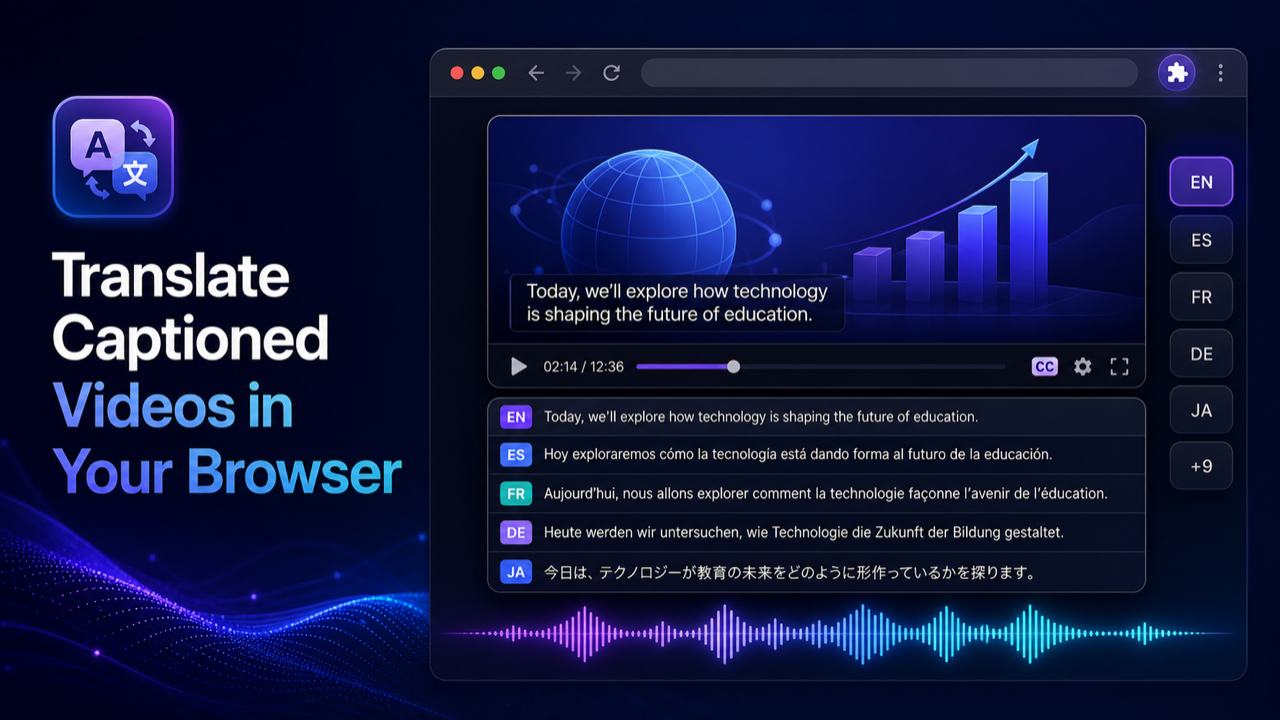
The extension reads the caption track the video already exposes, translates that text, and plays AI text-to-speech dubbing over the original audio while showing translated subtitles. It uses standard synthetic voices. It does not clone the speaker, does not do lip sync, and does not transcribe audio, so a video with no caption track is not supported at all.
Here is what that buys, in the viewing use case:
- Nothing is uploaded for processing. No audio extraction, no reference clip leaving your machine, no copy of the lecture in someone's job queue. Cloning requires the opposite by construction.
- Playback starts in seconds. Translated audio begins while the video plays in the tab. A cloning pipeline is a render pipeline: export, upload, queue, wait, download.
- Nothing to store. No rendered file means no second copy of a 90-minute lecture to keep and eventually delete.
- No consent problem to manage. A synthetic voice reading a translation impersonates nobody.
If you want to publish a dubbed version of your own video with your own voice preserved, this is the wrong tool and I will say so directly. If you want to understand a captioned video someone else made, cloning adds cost, latency and legal exposure for a property you stop noticing in the fifth minute.
Arabic and right-to-left targets: the ai video translation voice cloning arabic platform question
Arabic comes up more than any other single language in this context, and searches for an ai video translation voice cloning arabic platform are asking about three problems that have nothing to do with cloning quality.
Dialect versus Modern Standard Arabic. Most synthetic Arabic voices speak Modern Standard Arabic, the register of news broadcasts and textbooks. It is understood everywhere and spoken conversationally almost nowhere. Egyptian, Levantine and Gulf voices exist but coverage is thin across engines, so an excellent clone of an English speaker's timbre can still land as oddly formal to an Egyptian viewer. Machine translation drifts toward MSA by default, so script and voice pull in the same formal direction. Check register before you evaluate timbre.
Subtitle direction. Arabic is written right to left, and a subtitle line often mixes it with left-to-right runs: a product name, a version number, a URL. That needs proper bidirectional text handling in the renderer rather than a reversed string. The tells show up in five seconds of playback: trailing punctuation jumping to the wrong end of the line, a parenthesis facing the wrong way, an English term embedded backwards.
Text expansion and line timing. Arabic translations routinely run longer in rendered width than the English source, while the caption cue keeps the duration it inherited from the original track. So subtitle lines wrap to a third row and cover the slide, and spoken audio for that cue crowds the next one. The fix is a shorter translation, since speeding up synthesis degrades the prosody you were paying for. German, Finnish and Tamil hit the same arithmetic.
Why an ai voice cloning video translator free tier is really a trial
Search for an ai voice cloning video translator free and you will find plenty of them, all shaped the same way: generous on features, tight on minutes. Five minutes of output, or ten, or one voice and a watermark. That shape is not a marketing choice, it comes from the cost structure.
Cloned synthesis costs GPU time per minute of audio produced, every single time, and the bill scales with output volume rather than with account count. Subtitle translation is cheap text processing you can absorb across a large free tier. A standard TTS voice is cheap enough to give away at volume. A cloned voice is neither, so free access gets metered in minutes, because minutes are what actually cost money.
So the useful reading of any free cloning offer is: how many minutes, and what happens at the boundary. Some services also claim rights over voices created on the free tier, or delete them when the trial ends. Read that part.
A genuinely free path with no minute cap is a non-cloning one. My extension is free to start with standard voices and has a paid unlimited tier, and the free video translator guide lays out where the free path stops.
How to evaluate an ai voice cloning video translator before paying
If cloning really is what you need, five checks separate working pipelines from demo reels.
- Reference audio requirements, in seconds, and whether the documentation says clean and isolated. A tool that accepts any file without comment has not thought about your music bed.
- A consent verification step. Its absence says something about the operator, not about their technology.
- Per-minute cost priced against a real project rather than the demo.
- Retention: how long your reference audio and embedding are kept, and whether you can delete both.
- How the voice reads a formula, a version number and an initialism. Technical material falls apart here whether the voice is cloned or not.
Test with your worst source file. The best case is what the vendor already showed you.
Related guides
- AI video translator covers the full stage-by-stage pipeline: caption detection, translation, speech.
- AI video translator with lip sync handles the other feature people expect to come bundled with cloning.
- Video audio translator goes deeper on the spoken side: voice choice, pacing, ducking the original audio.
- Best AI video translator for businesses is the buyer-side view when a team, not one viewer, is the user.
- Best practices for translating video content for global audiences covers register, terminology and line timing across languages.
- Free video translator sets out what a free path can and cannot do.
Frequently asked questions
Does an ai video translator with voice cloning need the original audio?
Yes. Cloning needs reference audio of the target speaker to build a speaker embedding, and the cleaner and more isolated that audio is, the closer the result. A subtitle-based translator needs no audio at all, which is why it can run during playback instead of as a render job.
Can it clone a voice from a video with background music?
Badly. The model cannot separate your voice from what is mixed into the same waveform, so music, room echo and mic noise all end up inside the fingerprint. Some pipelines run source separation first, which helps and also softens the voice. Use a clean isolated recording if you have one.
Is cloning a course instructor's voice legal?
Treat it as a licensing and likeness question rather than a technical one. The recording is usually covered by platform terms that forbid derivative works, and the speaker separately holds rights in their own voice in many jurisdictions. That is why serious platforms gate the feature behind recorded consent.
Does your extension clone voices?
No. It uses standard synthetic voices, reads the caption track the page already exposes, and plays translated speech and subtitles during playback. No lip sync, no voice cloning, no transcription, and no support for videos without a caption track.
What should I optimise for if I just want to watch a lecture?
Voice quality first, then consistency across the series. Pick a voice you can listen to for an hour and keep it pinned per language. Whose timbre it is stops registering within a few minutes, while bad prosody irritates you for the whole course.
Why do free cloning tiers run out so fast?
Because cloned synthesis burns GPU time for every minute of audio it produces, so the cost tracks output volume directly. Free tiers therefore cap minutes rather than features. Check the minute allowance and what happens to your voice model when the trial ends.