
Best practices for translating video content for global audiences
Most of the best practices for translating video content for global audiences are decisions you make before anyone translates anything. By the time a viewer in Brazil or Poland opens your video, the cost of translating it is already fixed by how you wrote the script, whether you burned text into the frame, and whether the page exposes a caption track at all.
I work on a browser video translation tool, Unlimited Universal Video Translator, so I see the failure cases from the viewer's side: the lecture with no captions, the slide where the only words are pixels, the sentence that runs forty percent longer in German than the original line has room for. What follows is the checklist I would hand a publisher, in the order the decisions actually happen.
1. Write sentences that can be cut apart
Translation happens one caption cue at a time, not paragraph by paragraph. A sentence that spans four cues gets translated with only partial context, and in languages where the verb lands at the end the translator has to guess.
Concrete habits that pay off:
- One idea per sentence. If you need a comma plus "which" plus "although", split it into two sentences.
- Say numbers and units out loud. "Set it to twelve pixels" survives translation; "set it to this value" with 12px only on screen leaves nothing to translate.
- Drop idioms. "Out of the box", "low-hanging fruit", "ballpark" all come out literal and wrong.
- No puns that depend on on-screen text. A joke that needs the word in the frame to rhyme with the word in the audio cannot be carried into another language.
- Name the thing again instead of using a pronoun three cues later. "It" has a gender in half the target languages, and the translator picks one.
This costs nothing at recording time and removes most of the sentences a reviewer would otherwise flag later.
2. Leave room for text expansion
Translated text does not keep the length of the original. English to German or Russian commonly runs 20 to 35 percent longer; Chinese and Japanese take fewer characters but each one carries more. Two things break because of this.
Subtitles break on line length. If your source caption already fills two lines at the platform's character limit, the German version has nowhere to go. It either gets truncated, reflows to three lines and covers the lower third of the picture, or drops words. Keep source cues short, around 35 to 40 characters per line and two lines maximum, so a longer translation still fits.
Dubbed audio breaks on duration. Text to speech has to fit the translated sentence into roughly the slot the original line occupied, because the picture underneath does not wait. When the translation is longer, the voice either speeds up or runs past the cue. So leave real pauses in your delivery. A half second of silence between sentences is headroom the dub can use; wall-to-wall speech gives the dub nothing.
3. Keep text out of the picture
This is the single most expensive mistake, and it is not obvious until you try to localize. Any text that is part of the rendered video frame, titles, labels on a diagram, lower thirds, animated callouts, is not text any more. It is pixels.
No caption-based translation tool can touch it. Browser extensions cannot, subtitle editors cannot, and the viewer's own translator cannot. The only ways out are optical character recognition with an overlay, which misreads and covers the frame, or re-rendering the whole video once per language, which means maintaining twelve video files instead of one plus twelve text files.
A caption track is the opposite: plain text with timestamps, translatable in seconds, fixable after publication without touching the video. So put the words in the audio and in the captions, keep the frame for things that are genuinely visual, and if you must label a diagram, say the label out loud too.
4. Publish a caption track, and get the source language right first
Every downstream translation inherits the source caption file. Its segmentation becomes the translation's segmentation. Its typos become mistranslations, because a machine translator will happily translate a misspelled word into a plausible wrong one. A missing speaker change stays missing in all twelve languages.
So the source-language caption is not a formality to tick off. Read it once against the audio and fix three categories: proper nouns and product names, numbers, and cue boundaries that cut a clause in half. Everything you fix here you fix in every language at once.
There is also a hard dependency worth stating plainly. Tools that translate during playback, including mine, read the caption track the page exposes. They do not transcribe audio. A video published with no captions is not translatable by that route, no matter how good the translation engine is. Auto-captions from the platform count, and they are better than nothing, but they are also where most of the proper-noun errors come from.
5. Segment captions at clause boundaries, not at character counts
Automatic captioners split on time or on a character budget, which produces cues like "we are going to install the" / "dependency before running the". A human reads through that without noticing. A translator does not: it translates each fragment as a unit, and fragments have no grammar.
Split where a clause ends. One cue, one clause, ideally one subject and one verb. Then check reading speed: roughly 15 to 17 characters per second for Latin scripts is comfortable, and above about 21 the viewer is reading instead of watching. If a cue is over the limit, it is usually because the sentence was too long to begin with, which takes you back to the first practice.
Keep each cue on screen at least one second, even for a two-word line, and avoid cues that straddle a shot change.
6. Fix a glossary before the first translation
Decide once, in writing, how the recurring terms are handled: which product names stay in English, which technical terms get translated, and what the preferred translation is for the ten or twenty words that carry your domain. Include your own feature names, the names of the UI elements you point at, and the acronyms you expand on first use.
Inconsistency is worse than awkwardness here. A learner who meets three different words for the same panel across a course stops trusting the translation and starts doubting whether the lesson is about what they think it is about. An awkward but consistent term costs them one moment of adjustment; three synonyms cost them the mental model.
Keep the glossary next to the source captions, and hand it to whoever reviews a language. If you use a machine pipeline that supports term lists, load it there too.
7. Decide per video whether viewers need subtitles, dubbing or both
Do not apply one policy to the whole catalogue. The split follows what the viewer's eyes are doing.
Subtitles win when the screen carries information: code, spreadsheets, a settings panel, anything the viewer must read exactly. Written text also preserves the source spelling of commands and library names, which a synthetic voice will mangle.
Dubbing wins when hands and eyes are busy, or when the viewer's reading speed in the target script is the bottleneck. Someone following a hardware build, a cooking step, or a whiteboard argument cannot spend the session at the bottom of the frame.
Both at once is the default for long technical material: hear the explanation, read the term. That is also how most viewers configure a playback translator when nobody tells them what to pick.
Be honest about what synthetic dubbing is and is not. Standard text to speech voices are not voice clones, there is no lip sync, and the voice does not act. If you need a performance, you are hiring a voice actor and that is a production project, not a settings change. The related guides below go into the lip sync question and voice cloning specifically.
8. Measure watch time per language, not a quality score in the abstract
Translation quality scores are hard to act on. Retention per language is not. Pull watch time and the drop-off curve for each language you publish in, and compare each one against the source language for the same video. Two patterns tell you almost everything:
- A drop in the first 30 seconds means the language is wrong for that audience, the voice is unpleasant, or the captions did not load.
- A drop in the middle of one specific section, in one language only, points at the terminology in that section. Go read those two minutes of captions.
This is also where tooling categories matter, and the honest framing of top translation tools to boost video viewer interaction is by category, not by brand. There are three, and they do different jobs:
- Caption editors, which is where you fix source segmentation, timing and reading speed. Publisher side, before anything is translated.
- Subtitle translators, which take a finished caption file and produce a target-language file you publish alongside the video. Publisher side, one file per language.
- In-browser playback translators, which translate the caption track live in the tab and can speak it. Viewer side, no files, no export, and no work for the publisher beyond having captions at all.
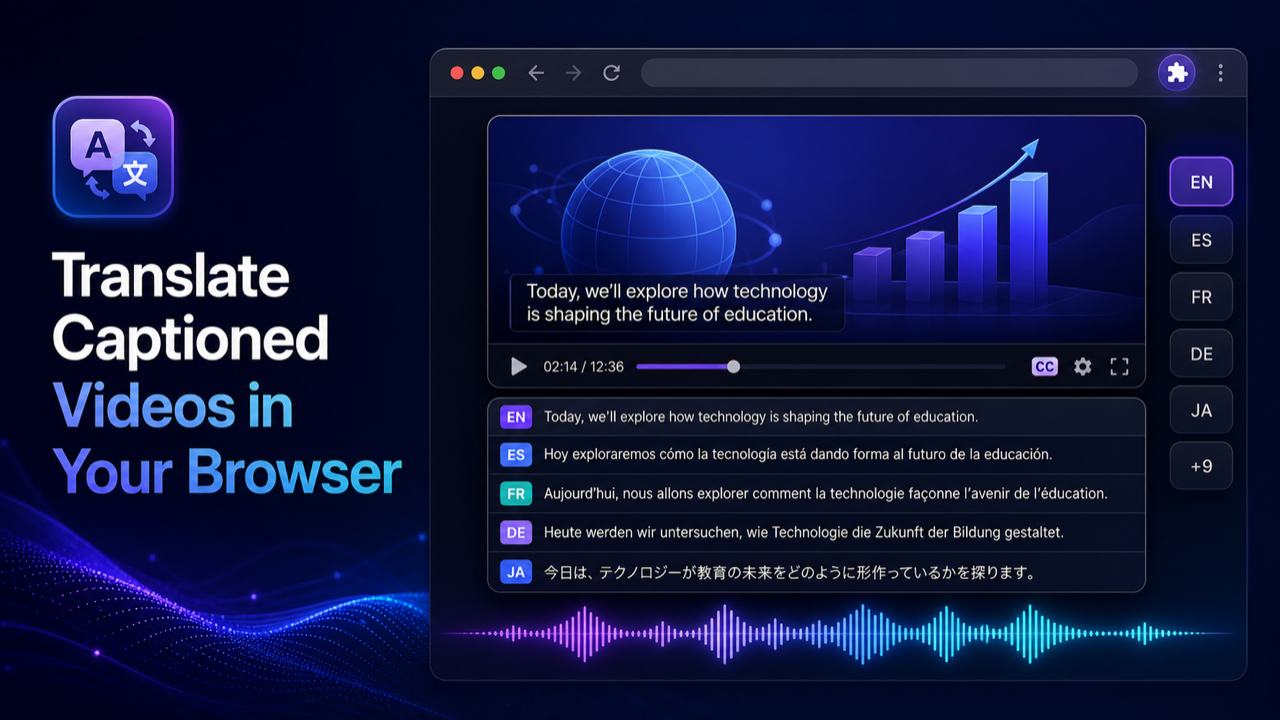
Choose by which side of the video you are on. A publisher needs the first two. A viewer facing a catalogue nobody localized needs the third, and that is the category my extension is in: it reads the existing caption track in the page, translates it, and plays AI text to speech over the original audio with translated subtitles on screen. It does not create captions, does not export a file, and does not render a translated video.
9. Run a two-minute human QA pass
Full review of every language does not happen, so spend the review budget where errors cluster. Ask one native speaker per language for ten minutes, and point them at exactly two places: the first two minutes of the video, and the densest terminology section you identified from the retention curve.
The opening decides whether anyone keeps watching, and it contains the introductions, the product name and the promise, which are the phrases most likely to be mistranslated. The dense section is where the glossary either held or did not. Ask for three specific things: wrong terms, sentences that mean the opposite of the original, and subtitles that were unreadable at speed.
Fix those in the caption file, not in the video.
Related guides
- How to translate a video walks through the playback side step by step.
- Best practices for large teams covers the publisher and business angle.
- Video translation services compares service models against in-browser translation.
- Add translated subtitles to video is the practical subtitle workflow.
- Translate video subtitles explains how caption-based translation works underneath.
- AI video translators for e-learning content is the course-specific version of this checklist.
Frequently asked questions
What is the first thing to fix when translating video for other languages?
The source-language caption track. Every translation inherits its segmentation and its errors, so a typo in a product name or a cue that splits a clause in half gets multiplied by the number of languages you publish. Fix it once before any translation runs.
Why should on-screen text be avoided in video meant for global audiences?
Text rendered into the frame is pixels, so no caption-based tool can translate it. Localizing it means re-rendering the video once per language, while a caption track can be translated and corrected as plain text. Say the label out loud and keep the words in the audio.
Should I use subtitles or dubbing for translated video?
It depends on where the viewer's eyes need to be. Subtitles are better when the screen shows code, settings or exact spellings; dubbing is better when hands and eyes are busy. For long technical video, running both is the common choice.
How much longer does translated text get?
English to German or Russian typically runs 20 to 35 percent longer, while Chinese and Japanese use fewer characters. Keep source cues near 35 to 40 characters per line with two lines maximum, and leave short pauses in your speech so a longer dubbed line still fits the original timing.
Can a browser extension translate a video that has no captions?
No. Playback translators read the caption track the page exposes and do not transcribe audio, so a video without captions is not supported by that route. Platform auto-captions are enough to make it work, though they are also the usual source of proper-noun errors.
How do I know whether the translation is working?
Compare watch time and the drop-off curve per language against the source language for the same video. An early drop points at the language choice, the voice or captions failing to load; a drop inside one section in one language points at the terminology in that section.