AI Video Translator With Lip Sync: What Gets Repainted, and What You Actually Need
Someone searching for an ai video translator with lip sync has usually watched a dubbed clip and felt the mismatch: the voice says one thing, the mouth is clearly shaping another. I work on browser extensions that translate video during playback, including the Unlimited Universal Video Translator, so I get asked about lip sync a lot. The honest answer splits in two: what lip sync is as a piece of engineering, and whether the discomfort you felt actually came from the lips at all.
What lip sync means when a video gets translated
Visual lip sync means a model repaints the mouth region of the speaker's face so the visible articulation matches the phonemes of the translated audio. A face detector tracks the head across frames, the mouth and jaw area is masked out, and a generative video model renders new pixels there, frame by frame, conditioned on the new speech. The rest of the picture is left alone.
That is generative video work, and it has consequences that follow from the definition. It needs the whole video as an input file, it produces a new video as an output file, and it runs on a server with a GPU. Queries like ai video translation lip sync often come from people who assume this is a checkbox on a translation setting. It is a rendering pipeline with a rendering pipeline's cost and failure modes.
Three other things are sometimes sold under the same phrase, and they are not the same:
- Timing sync. The translated line is stretched or compressed so it starts and ends where the original line did. Nothing in the picture changes.
- Phoneme-aware voice timing. The speech engine places stresses closer to the visible mouth openings, still without touching a single pixel.
- Avatar replacement. The original speaker is swapped for a synthetic presenter. Lips match perfectly, because the face was never real.
Only the first of those affects the audio you hear. Only the third and the mouth-repainting kind change the video.
Timing sync versus visual lip sync
Here is the part worth slowing down on, because it decides whether you need an expensive tool or a cheap one.
Translated speech rarely has the same length as the original. German swells, Chinese contracts, English sits in the middle. A twelve-word English sentence can come back as eighteen words of Spanish. If nothing corrects for that, the dubbed voice runs past the end of the shot, collides with the next line, or finishes early and leaves a hole. That is a length and scheduling problem, and it is what makes most dubbing feel wrong.
Repainting the mouth fixes none of that. If your translated audio is drifting a second behind the speaker, a perfectly rendered mouth will drift with it, and you will have paid GPU minutes to render a lie in sync with itself.
So when someone types ai translate video lip sync into a search box, I read it as a complaint about drift about eighty percent of the time. The test is easy. Watch a dubbed clip with your eyes closed. If it still feels wrong, the problem is timing, pacing, or voice choice, and no amount of mouth rendering will help. If it only feels wrong with your eyes open, on a close-up face, that is genuine lip sync territory.
What real lip sync costs to produce
Any service offering ai video translation with lip sync is running roughly this chain: ingest the source file, transcribe or read the script, translate it, synthesize speech, align the speech to the timeline, detect and track the face, render new mouth pixels, re-encode, deliver a download. Each stage adds latency and money.
The practical implications:
- You get a file, not a viewing session. There is an upload, a queue, a render, and a download. You cannot press play on a page and have lips change in the tab.
- Pricing is per minute of video. GPU rendering is metered because it genuinely costs the provider. Long-form material gets expensive fast, which is why a two hour lecture is a bad candidate.
- Fast speech degrades first. Rapid delivery means more phonemes per second, less time per mouth shape, and visible smearing.
- Profile and three-quarter shots are hard. Most mouth models are trained heavily on frontal faces. Turn the head and the jaw line starts to wobble.
- Occlusion breaks it. A hand over the mouth, a microphone in front of the chin, facial hair, a cut to a reaction shot, all of these hand the model something it was not trained for.
- Screen recordings are out entirely. A software tutorial, a conference talk shot wide, a slide deck with a voiceover, a coding screencast: there is no face on screen to repaint. Lip sync has nothing to act on.
That last point eliminates a large share of the video people actually need translated. Course material, internal training, technical talks and product walkthroughs are mostly screen with a voice on top.
What the extension I work on does instead
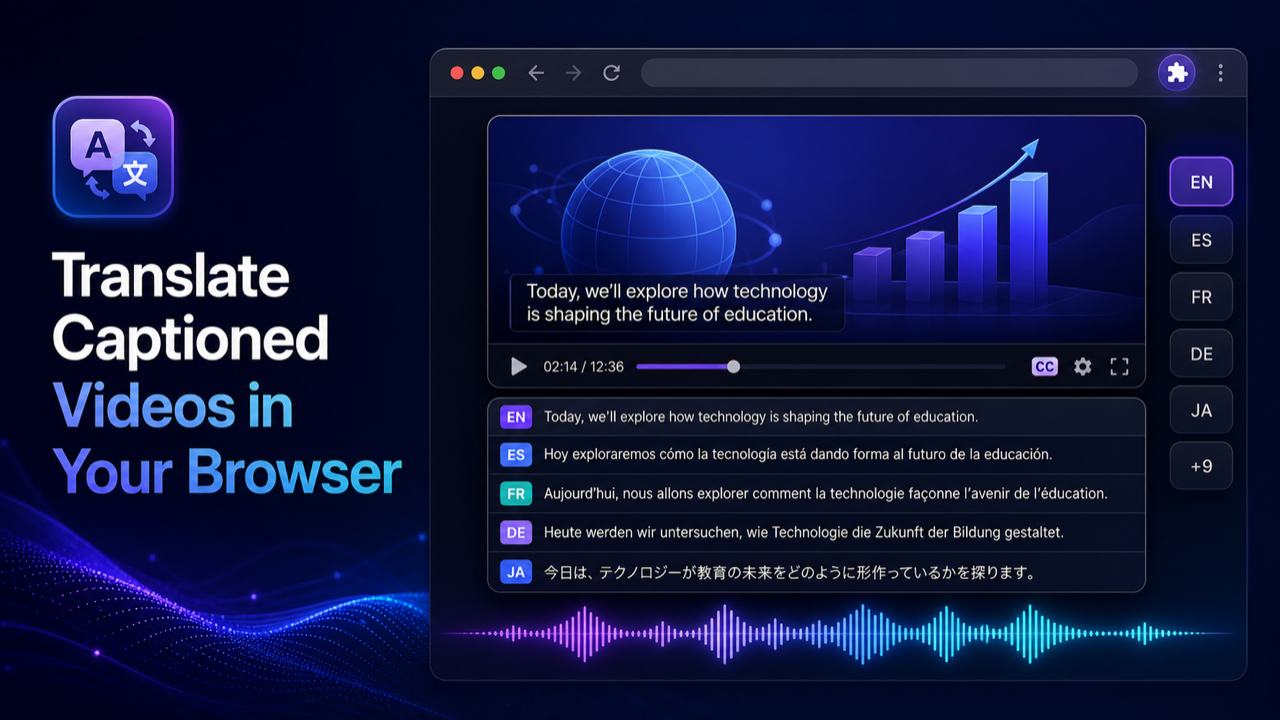
Plainly, once: the browser extensions I build do not do lip sync, and there is no version of them that could. They read the caption track a video page already serves, translate that text, and play synthetic speech over the original audio while showing translated subtitles. Translation happens for playback, inside the tab. No video file is ever produced, so there are no frames to repaint. They also do not transcribe audio, so a video with no caption track is not supported at all.
That is a narrower job, and it is chosen deliberately. It means no upload, no queue, no per-minute render bill, and results within seconds of pressing play. It also means I cannot sell you a mouth that matches. Those two facts come from the same architecture, and I would rather say so than imply a feature that does not exist.
The decision rule
Lip sync earns its cost in a short list of cases:
- Talking-head marketing where the presenter's face fills the frame.
- Drama, film and scripted narrative, where a visible mismatch breaks immersion.
- Short ads localized into many markets, where the per-minute price is small and the polish is the product.
- Anything where a viewer will watch the speaker's face on a large screen for minutes at a stretch.
It is irrelevant for lectures, screencasts, conference recordings, tutorials, webinars and internal training. In that material the viewer is looking at slides, a terminal or a whiteboard, and the speaker's face is a small thumbnail or absent. Spending render money on mouths nobody is watching is the most common mistake I see in this category.
So the real question behind best ai video translator with lip sync is whether your footage is a face or a screen. Face-forward and short, go pay for rendering. Screen-forward and long, translate the caption track during playback and put the budget somewhere it shows.
How to judge lip sync output before you pay for it
If you do need it, test with your own footage, not the vendor's demo reel. Demo reels are cast for the model: frontal, well lit, evenly paced, studio audio. Your webinar is none of those things.
Run the sample clip through and check six things:
- Profile angles. Scrub to any moment where the head turns past thirty degrees. Look at the corner of the mouth and the jaw line for wobble or a soft seam.
- Fast speech. Find the quickest sentence in the clip. Rapid delivery is where mouth shapes turn into a blur.
- Plosives. P, B and M require the lips to close completely. Freeze on those consonants. If the lips stay parted, the render is approximating instead of articulating.
- The mouth-region blur. Pause and look at the boundary between rendered and original pixels. A visible rectangle of softer detail around the mouth is the giveaway, and it is worse on high-contrast beards and lipstick.
- Source resolution. A 480p source gives the model little to work with, and upscaled mouths look waxy. Check what the original actually is before blaming the service.
- Cuts and reaction shots. Multi-camera edits force re-detection on every cut. Watch the first half second after each cut for a face that snaps into place.
Evaluating video translation software with lip sync technology on those six points takes about twenty minutes and saves the subscription. Also confirm the boring commercial details: per-minute pricing, maximum input length, output resolution and codec, whether the source file is retained, and how long the queue runs at peak.
Related guides
- AI video translator covers the stages of an in-browser translation pipeline.
- How to translate a video walks through the routes available depending on what you have.
- AI video translator with voice cloning is the other half of this question, the voice rather than the mouth.
- Best practices for translating video content gets into timing, line length and reading speed.
- Real time video translator explains what changes when translation happens during playback.
- Best AI video translation tools 2026 frames the categories without ranking brands.
Frequently asked questions
Does an ai video translator lip sync the speaker automatically?
Only if it is a rendering service that outputs a new video file. Browser and playback-based translators change the audio and subtitles, never the picture. If a tool works inside a page while the video plays, it cannot be repainting frames.
Is lip sync the same as matching the dubbed audio to the original timing?
No, and this is the most common mix-up. Timing sync fits translated speech into the original line's duration and touches no pixels. Visual lip sync regenerates the mouth region. Most complaints about dubbing being off are timing complaints.
Can lip sync work on a screen recording or a slide presentation?
No. There is no face in the frame for the model to track and repaint. For screencasts, lectures and webinars the useful levers are translation quality, voice pacing and subtitle readability.
Why does lip sync look blurry around the mouth?
The mouth area is generated pixels composited back over the original frame, so it carries its own detail level and softens at the seam. Low source resolution, fast speech and head rotation all make the seam more visible.
How much does lip sync translation cost?
It is billed per minute of video because it consumes GPU render time. That makes short marketing clips reasonable and long-form course material expensive, which is the main reason lectures are usually dubbed without it.
Other ways people search for this
Two questions sit under every phrasing of this search: whether the mouth can be made to match, and whether that is worth paying for. Someone typing ai video translator lip sync is usually asking the first one and has not yet priced the second.
A ranking query like best ai lip sync video translation 2026 expects a leaderboard, and I do not have an honest one to give. Rendering quality moves between releases, and the only comparison that survives contact with your material is the six-point check above run on your own footage: a profile shot, a fast-speech passage, and a clip at the resolution you actually publish at.