
Video Audio Translator: Dub the Speech in a Captioned Video
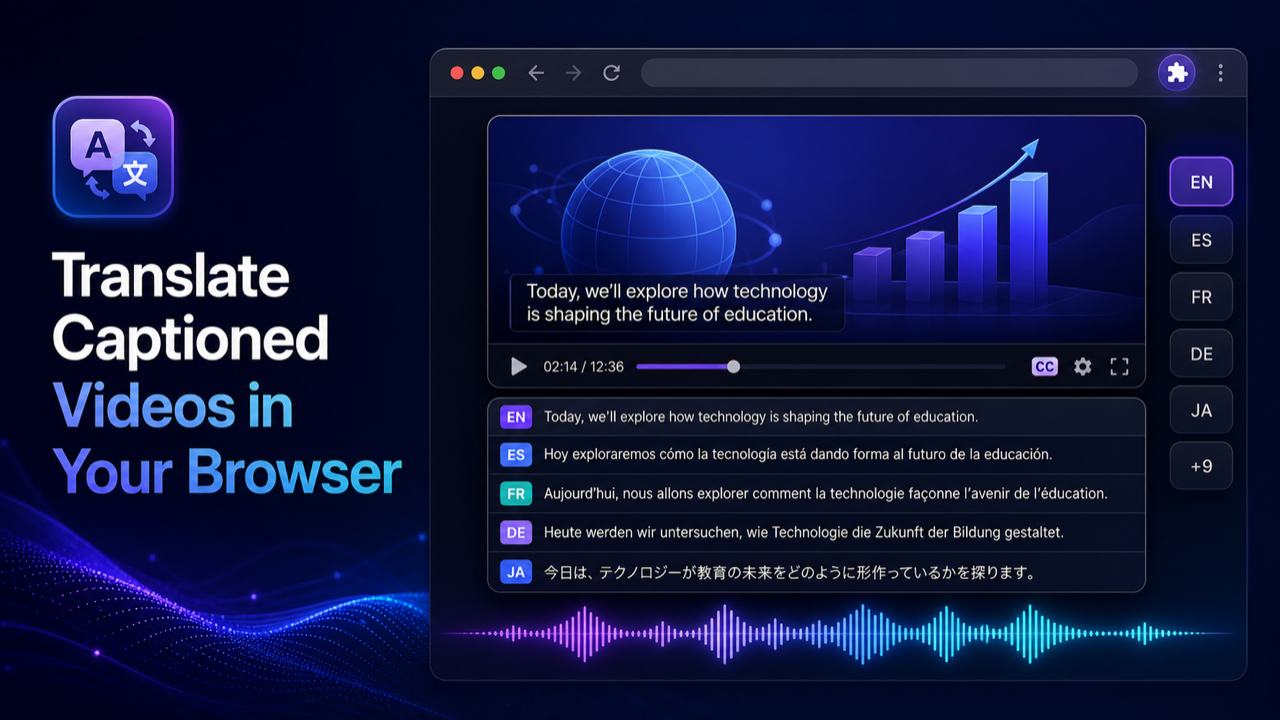
A video audio translator is what you go looking for when subtitles stop being enough and you want to hear the video in a language you actually speak. The Unlimited Universal Video Translator extension does that inside the tab where the video is already playing. One detail decides whether it fits your video, so it goes first: the audio you hear is the output, and the input is the caption track the page exposes.
Nothing here listens to the original sound. The extension reads the caption text, translates it, speaks the translation with a text-to-speech voice, and plays that voice over the video with the original audio turned down. No captions on the page means nothing to work from.
Everything below follows from that one constraint: how the spoken track gets its timing, where the voice catalog runs out, what the pacing feels like under a fast speaker, and the cases where translated subtitles are the better call.
What a video audio translator does here
Four steps, in order:
- Detect the caption track the player exposes.
- Translate that text into your target language.
- Generate speech from the translated text with a speech engine.
- Play that speech in sync with the video while the original audio is ducked underneath.
Steps three and four are what people mean by video dubbing, and they are the only steps that touch audio at all. Both of them produce sound rather than read it.
That shapes how the search terms land. Someone asking which language in this audio video translation is being handled is really asking about step one, and the answer is whatever language the caption track happens to be written in. Audio video translation in a browser tab starts from text every single time.
Why the captions are the input
The extension does not transcribe. It runs no speech-to-text model of any kind, so the waveform of the original video is never analysed. Ask it to translate sound from video that carries no caption track and it has nothing to read.
People type translate audio from video and picture something closer to a dictation app: point it at a noise, get words back. This is the other shape of tool. When the phrasing is translate audio in video, what happens under the hood is that the extension translates the caption line matching that moment of audio, then speaks the result. The audio itself is only ever the thing the dub sits on top of.
The practical rules that come out of this are short:
- Captions must exist, and you have to turn them on in the player so the extension can detect them.
- Live streams, DRM-protected video and caption-free uploads may not work.
- Creator-written captions beat auto-generated ones, because auto captions mishear names and technical terms and the dub will repeat the mistake confidently.
- The video file is never uploaded or downloaded. Caption text does travel: the translation route receives it, and cloud voices receive it too if you pick one.
For lectures, tutorials, conference talks and course videos, captions are usually there. Course platforms add them for accessibility and YouTube auto-generates them for most uploads, which covers the bulk of what anyone wants dubbed.
How to translate audio from a video that has captions
- Install the extension from the Chrome Web Store and open the video.
- Turn captions on in the player. If the Dub button is missing, reload the page with captions already enabled.
- Click the floating Dub button that appears on the video.
- Pick your target language, the mode, the speech engine and the voice.
- Press play and listen.
Settings are kept per video, so a German lecture and a Korean interview do not have to share one configuration. After the first setup it is one click per video, and you can keep dubbing video after video with the same choices.
How the dubbed voice is produced and synced
The speech comes from text-to-speech. The free path uses an on-device voice that runs inside your browser, which is why there is no meter running and no per-minute cost. PRO adds premium local voices and cloud voices, plus LLM translation for the text step and a real-time mode that starts speaking sooner instead of waiting for a full track to generate.
Timing comes from the caption cues. Each caption segment carries a start time, so the extension knows when its translated line should be spoken and the dub lands roughly where the original speech lands. This is also why the sync quality tracks the quality of the caption timing. Sloppy cues produce a sloppy video dub, and there is no way for the tool to correct cues it did not create.
While the generated voice plays, the original audio is ducked rather than muted. You still hear the speaker's tone, the room, the music bed and the moment someone points at something on screen and raises their voice. For a screencast that keeps the demo clearly in earshot under the narration.
How to translate video audio to English
English is the most common target, and it is the easy direction. Text coverage is wide, and the on-device voice catalog has decent English options, so a dub into English usually works on the first try.
Going the other way is where the two halves of the system separate. The translation route supports a long list of languages. The voice catalog supports fewer. If you set a target, see translated subtitles appear, and hear nothing, the language you chose has no voice installed on your device. Premium and cloud voices on PRO exist mostly to fill that gap.
So the order to check is: source captions on, target language set, voice selected and actually speaking. When one of those three is missing, the symptom looks like a broken extension and is usually a missing voice.
Choosing a voice for a video voice translator setup
The voice does more work than people expect. A clear, slightly slower voice is easier to follow across a 40-minute lecture than a fast, expressive one, even when the fast one sounds more impressive in a 10-second sample. Pick a regional variant of your language when one is offered, since a Brazilian Portuguese voice reading Brazilian Portuguese text sounds noticeably better than a European one.
Two things people reasonably expect from an ai video voice translator are worth separating. Voice quality is what the speech engine gives you, and you can improve it by moving to a premium or cloud voice. Voice matching is not on offer: the dub does not clone the original speaker, and it does not give each person in an interview a different voice. One selected voice reads the translated caption lines.
If you are comparing this against desktop video voice translator software that renders a finished file, that is a different category with a different cost. An in-browser audio translator for videos is built for watching, so it produces a track that plays now, not an asset you export later.
When translated subtitles beat dubbing
Dubbing wins for long-form listening. Subtitles win in four situations, and they are worth knowing before you fight the dub:
| Situation | Better choice | Why |
|---|---|---|
| Code, commands, library names | Translated subtitles, or the original captions | A voice reads npm i -D vite as words and it becomes unusable |
| Dense numbers and units | Subtitles | You need to reread, and a voice moves on |
| Very fast speaker | Subtitles | The generated line runs past the next segment |
| Music or singing | Neither | Lyrics are not what this tool is built for |
The extension does both from the same caption text, chosen per video, so switching costs you one click. Many people run the dub and the subtitles together on technical material: hear the explanation, read the exact term. The translate video subtitles guide covers the text-only path in detail, including why it is not the same job as transcription.
Pacing, length and other audio realities
Translated speech is rarely the same length as the source segment. German runs long into English, English runs long into Japanese, and a caption line that took four seconds to say can take six to speak. When that happens you hear one of two things: the line finishing slightly over the start of the next one, or a pause while the video moves ahead of the voice.
A few habits make this less annoying:
- Drop the player speed to 0.9 on dense sections. The site's own speed control keeps working underneath the dub.
- Use a slower voice rather than a faster video when the speaker is already quick.
- Keep the original audio loud enough to catch the rhythm of the delivery, which helps you track where you are.
- Expect a short wait on the first play in standard mode while the track is generated. Browser speech can begin quickly; other standard voices may need the track built first, and the PRO real-time mode starts speaking sooner.
None of this is unique to one extension. Any tool that speaks a translation over a fixed-length video hits the same arithmetic.
What this tool does not do
Being direct about the gaps saves you an evening:
- It does not transcribe. No captions, no dub. There is no speech recognition step anywhere in the pipeline.
- It does not translate a microphone. Live conversation, a phone call, a meeting in the room around you: none of that is in scope. The extension works on a video element in a web page with a caption track.
- It does not export. You cannot download the dubbed audio or a rendered video, and you cannot save an SRT file. Audio and video translation as a deliverable, meaning files you hand to a client, belongs to a rendering pipeline.
- It does not handle DRM-protected playback or live streams reliably.
- It does not sing. Audio translation from video that is mostly music will produce a voice reading translated lyrics over the track, which is not what anyone wants.
If you need files, use a transcription and subtitle-editing workflow instead, and see translate video to text for where that line sits.
Related guides
AI Video Translator walks through the detect, translate, speak, sync pipeline in general terms. Free Video Translator sets out exactly where the free path stops. Installation and browser requirements live in the Chrome extension guide, and how to translate a video is the hub page for the whole topic.
Frequently asked questions
How do I translate audio from a video?
Open the video, turn its captions on, install the extension, then pick a target language and a voice. The extension translates the caption text and speaks it over the video with the original audio ducked. It does not process the audio track itself.
Can it translate voice from video with no captions?
No. There is no speech recognition in the extension, so a video with no detectable caption track cannot be dubbed. Generate a transcript with a separate transcription service first, then translate that text in a subtitle editor.
How to translate video audio to another language?
Set that language as the target in the Dub panel. Check that a voice exists for it: text coverage is broad, voice coverage is narrower on the free on-device catalog, and premium or cloud voices on PRO extend it.
Can I translate voice in video during a live stream?
Usually not. Live streams often expose no stable caption track, and DRM-protected players can block detection entirely. A recorded upload with captions is the reliable case.
Does the ai dubbing video translator give me an audio file?
No. The dub plays over the video in your browser and there is nothing to download, which is also why there is no watermark anywhere. For a deliverable file you need a rendering tool.
Is the free voice good enough for a two-hour course?
For most people, yes. The on-device voice is clear rather than expressive. If you sit through long material daily, premium local voices and cloud voices are the upgrade that actually changes the experience.
Does it change the video quality or my playback speed?
No. It adds a translation layer on top of normal playback, so the site's quality, speed and captions controls keep working. You are changing what you hear, not how the video plays.
Other ways people search for this
This one job arrives under a pile of near-identical names, plus a few typed exactly as autocomplete left them. They all describe the same thing: translated caption text spoken over a video. Here they are as people type them.
- Word order variants: video audio translate, translate audio video, audio translate video, video sound translator, voice translation video, translate video voice, translate video dubbing
- With ai in front or behind: ai video audio translator, video audio translator ai, ai translate video audio, auto translate video audio, auto translate audio from video, video voice translator ai, video voice translate ai, ai voice translator video, ai video translator voice, ai voice video translator, ai voice translator for video, ai translate video voice, ai video translate voice, ai translate voice video
- Dubbing phrasings: ai dubbing & video translator, ai dubbing and video translator, ai dub video translator, ai dubbing translate video, ai video dubbing translation, ai video translation and dubbing, ai video translation dubbing, ai video translator & dubbing
- General wording: audio and video translation, audio translation from video, ai powered video & voice translation
- Left as typed: al dubbing translate video and voice with.the best voiceover tool