
Best AI Video Translator for Businesses: The Criteria That Decide It
Anyone tasked with finding the best ai video translator for businesses is usually handed one line of requirements and a budget. The line is wrong, because "for businesses" is four separate purchasing decisions wearing one label. This page is the criteria list I would use, not a ranked table. I work on a browser video translation tool, so I have an interest in one corner of this market and I will mark that corner clearly.
Split the requirement before you shortlist anything
Write down which of these four jobs you are actually buying for. Each one fails on a different axis.
Internal training and onboarding video. Mostly third-party material: recorded courses, vendor webinars, conference talks, product enablement sessions your own team recorded once and never touched again. Nobody reviews the translation line by line. The employee needs to understand the content this week. Volume is high, stakes per minute are low.
Customer-facing marketing video. A product launch, an ad, a website hero clip. Every word is read by legal and by the regional marketing lead. You need a file you can archive, version and re-cut. One wrong term in a voiceover is a public error.
Sales and support recordings. Discovery calls, escalations, QA review of a support session. Here the video often contains customer names, pricing and account details, so the data question outranks the quality question.
Compliance, HR and safety material. Anti-harassment training, a works council briefing, machine safety instructions. The translation has to be reviewable and attributable. Somebody will eventually ask who approved the German version, and "an AI voice read it" is not an answer.
A product built for the first job will be a bad purchase for the fourth. Most disappointment in this category comes from a shortlist assembled before that split was written down.
Where the data goes
Ask exactly one question and insist on a precise answer: what leaves our network, and what is retained after processing?
There are three honest answers. The whole media file is uploaded and stored for some retention period. The media file is uploaded, processed and deleted on a stated schedule. Or the media never leaves the machine and only text is sent to a translation endpoint. Only the third is compatible with a recorded support call containing customer data without a data processing agreement covering the recording itself.
Follow-up questions that separate a real answer from a reassuring one: which subprocessors receive the text or audio, in which regions, whether your content is used to train models, and how deletion is confirmed. A security review will bounce on these, so collect them during the trial.
Do you get a file, or a translated playback?
A rendering pipeline gives you an artifact: a new video file or an audio track plus a subtitle file. You own it, you can review it, you can put it through approval, you can ship it to a partner. It costs processing time and it multiplies storage, and every change to the source means rendering again.
Playback-time translation gives you understanding, immediately, and gives you nothing to keep. There is no deliverable, no version to archive, no approval workflow. For an employee watching a captioned third-party course, that absence is the point. For compliance material it is disqualifying, because you cannot attach a reviewed artifact to an audit record.
Pricing units, and which one explodes
Per-seat pricing is predictable and gets expensive when you want the whole company covered for occasional use. Per-minute pricing is cheap for a pilot and brutal for a video library, because training content is long. A single forty-hour recorded course is 2,400 minutes, and one department can hold a dozen of them.
A per-minute contract signed on the strength of a marketing-video pilot and then applied to internal training is the common way this goes wrong. Marketing video is minutes. Training video is hundreds of hours. Run the arithmetic on your real library size before you pick the unit, and ask whether a second target language bills twice.
Also ask what happens at the cap. Hard stop, overage rate, or silent quality downgrade to a cheaper voice. The third one is the unpleasant surprise.
Admin, seats and who can turn it on
Can seats be assigned and revoked centrally, or does each employee sign up with a personal account? Is there single sign-on, and if not, what happens to access when someone leaves? Can IT deploy the client through existing management tooling instead of asking 300 people to install something? Is usage visible per team for cost allocation? Browser extensions can be pushed through enterprise policy, which is worth confirming before you commit.
Terminology control across a library
One video translated well is luck. A library translated consistently requires control over vocabulary.
Product names, internal role titles, regulated terms and units have to come out the same way in every video, or your German training set will call the same feature three different things. Ask whether a candidate supports a glossary that applies across a whole project rather than per file, and whether you can override a specific line after the fact. Playback-time tools generally have none of this, which is fine for comprehension and not fine for anything published. Voice consistency belongs here too: if each module of a course gets whatever voice the system picked that day, learners notice.
Turnaround time
Two very different clocks. A rendering pipeline is measured in queue plus processing, and the queue is the part vendors discuss least. A playback translation is measured in seconds before the first spoken word. A marketing asset can wait overnight. An employee who opened a recorded session because a customer is waiting cannot. If a candidate serves both jobs, test both clocks, and test the render queue at a busy hour.
Language coverage versus language quality
Vendors publish one number for languages supported, and it usually counts text translation. Speech is a second, smaller number, and quality inside it is uneven: major European languages and Mandarin get careful attention, and a long tail gets a voice that technically exists.
So do not compare totals. Take your actual list of target markets, check whether each one has a synthetic voice, and have a native speaker score thirty seconds of it at your content's speaking pace. A bad voice in the one language your Warsaw office needs makes the rest of the list irrelevant.
The honest split between the two architectures
Pipeline products that render localized masters. The media is uploaded, audio is transcribed, the transcript is translated, speech is generated, the result is mixed and rendered into a file you download. Strengths: works on video with no captions, produces a reviewable artifact, supports glossaries and per-line editing, handles approval workflows. Costs: the media leaves your network, you pay per minute or per render, you wait in a queue, and storage grows. This is the right architecture for marketing, for anything public, and for compliance material that needs an audit trail.
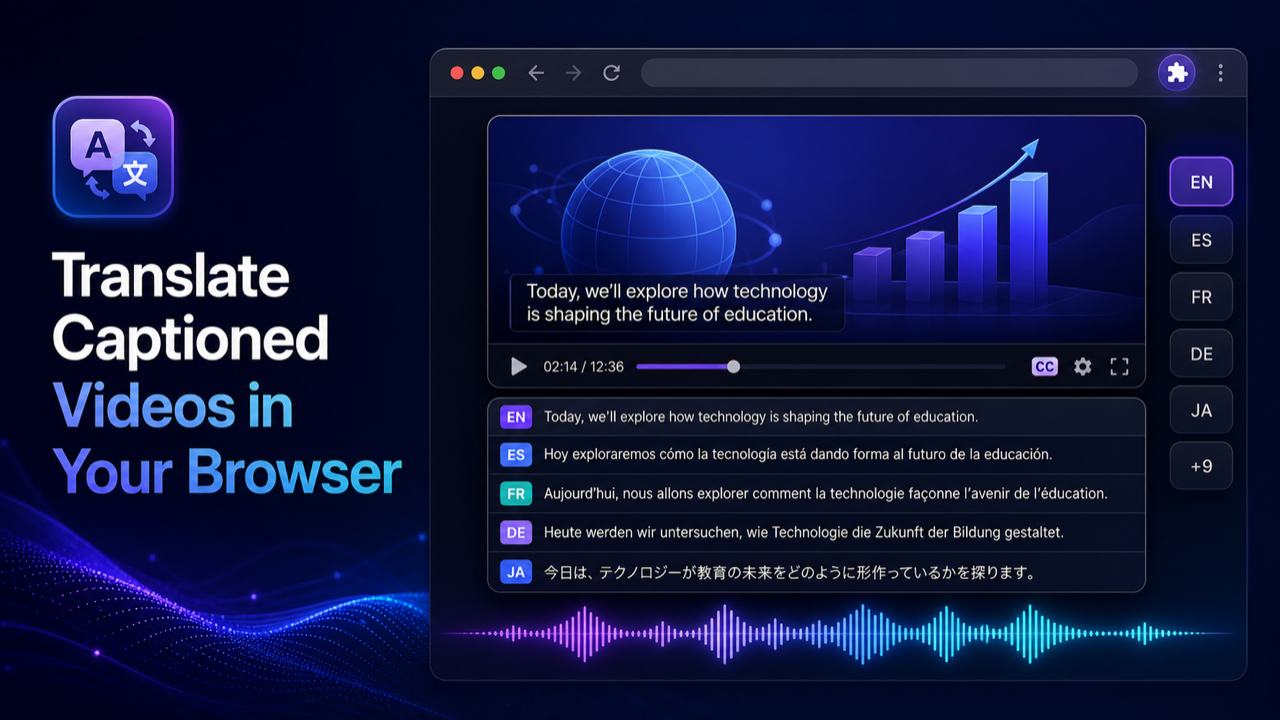
In-browser playback translation. An extension attaches to the player in the tab, reads the caption track the page already exposes, translates that text, speaks it with a synthetic voice over the original audio and shows translated subtitles. Strengths: starts in seconds, works on third-party video you do not own and could not upload, the video file never moves, cost per viewer is flat rather than per minute. Costs: no deliverable, no approval workflow, weak terminology control, and a hard dependency on the video having captions at all.
Neither is better. They answer different questions, and a company with both marketing localization and a large internal training habit will buy one of each.
What to ask for in a trial
Do not evaluate on the vendor's sample video. Pick three of your own and use the same three with every candidate. One should be your worst real recording: accented speech, domain jargon, fast delivery. One should be representative of your highest-volume content type. One should be short and public, so you can share results without a data review.
Then measure the same things every time. Did the domain terms survive, judged by someone who knows the domain. Does the speech land on the original timing, checked at the start and again ten minutes in, because drift appears late. Is the original audio still audible underneath. How long from request to usable output. What did the run cost, converted to your real annual volume.
Put these in writing before signature: retention period for uploaded media and for transcript text, named subprocessors and regions, whether content is excluded from model training, deletion confirmation, data location, and what happens to your material if you cancel. A vendor that cannot answer retention questions during a trial will not answer them faster after you have paid.
Where our extension fits, and where it does not
Narrow and honest: the Unlimited Universal Video Translator is for the first job on the list, employees consuming captioned third-party video. It reads the caption track the player already exposes, translates it, plays AI text-to-speech over the original audio and shows translated subtitles, in the tab where the video already plays. The video file is not uploaded anywhere, because nothing is rendered.
What it is not: a localization pipeline. It does not transcribe audio, so a video with no caption track is out of scope. It does not import or export subtitle files, does not produce a translated video file you can hand to an agency, does not read text burned into the picture, does not do lip sync and does not clone voices. The voices are standard synthetic ones. If you need a reviewed German master for a product launch, this is the wrong tool.
For training and enablement the arithmetic is simple: nothing to upload, nothing to render, no per-minute meter on a 40-hour course. Free to start, with a paid unlimited tier.
Best ai video translator for businesses 2026: what changed and what did not
Two things genuinely improved over the last couple of years. Translation quality on technical speech got better once LLM-based translation replaced phrase-based machine translation, which matters when a speaker says "reduce" about a function rather than about cost. And synthetic voices in the major languages stopped sounding like an airport announcement, at least for steady narration.
Three things are still unsolved. Cost per minute for rendered output decides whether a localization programme scales past marketing. Voice quality outside the top dozen languages is thin, and fast conversational delivery exposes the synthesis. And caption-based translation, the approach that makes browser tools instant, cannot help with a video that has no captions, which is most internal recordings made without a transcription step.
Shortlists labelled best ai video translator for businesses 2025 2026 look across two buying cycles: the 2025 crop was mostly upload-and-render with per-minute meters, while 2026 lists add caption-based playback translation as a separate line item rather than a cheaper version of the same thing. Treat the 2025 material as context, not as current pricing.
Related guides
For the mechanics behind any of this, AI Video Translator covers how detection, translation, speech and timing fit together, and how to translate a video compares the routes. For e-learning, see AI video translators for e-learning content. Video translation services covers the human-in-the-loop option, best practices for translating video content covers process, and the criteria-based tool guide has the per-video test.
Frequently asked questions
What should a company evaluate first when choosing a video translator?
Which of the four jobs you are buying for: internal training, marketing, sales and support recordings, or compliance material. That choice decides whether you need a rendered file or playback translation, and it rules out half the market immediately. Feature comparisons before that point waste time.
Is per-seat or per-minute pricing better at company scale?
Per-minute is cheaper for a marketing pilot and expensive for a training library, because training video is measured in hundreds of hours. Per-seat is predictable and gets costly when you want everyone covered for occasional use. Price both against your actual library size, and ask whether a second target language bills twice.
Can we use a browser extension under an enterprise security review?
That depends on what it sends out. Ask whether the media file is uploaded at all, what text goes to which subprocessor, in which region, and what is retained. An extension that reads an existing caption track sends text and never the video, which is a smaller review than an upload pipeline, but it still needs documenting.
Does this work for videos with no subtitles?
Not with a caption-based tool. Playback translation reads the caption track the player already provides, so a recording with no captions needs a pipeline that transcribes audio instead. That single question splits the market cleanly, so ask it first.
How do we keep terminology consistent across a whole video library?
Use a tool with a glossary or term list that applies across a project rather than per file, and lock the voice per series. Playback-time translation generally has neither, which is acceptable for comprehension and not acceptable for anything published. For public material, budget a human review pass on the translated text.