
Best AI Video Translation Tools 2026 and How to Test Them Yourself
Search for the best ai video translation tools 2026 has to offer and you get ranked lists. Most of them were written without running a single video through a single product. I am not adding another one. I work on a browser-based video translation tool, so I will stick to the criteria that change what comes out of the speaker.
This page is a decision guide instead of a leaderboard. It covers what "best" depends on, the two architectures behind this category, the criteria that separate usable output from output you switch off after forty seconds, and a test you can run on your own video.
What "best" depends on before any comparison starts
Two very different jobs hide behind the same search box.
The first job is watching. Someone published a lecture, a conference talk or a tutorial in a language you do not read, and you want to follow it tonight. You do not own the file and you do not want a project folder. Speed decides everything here, and a finished deliverable is worthless to you.
The second job is producing. You made the video, and you need a localized master to hand a client, upload to a second channel, or ship inside a course. Now you need a file back, control over individual lines, one voice held steady across a whole series, and a review pass before anything goes public.
A product that wins the first job usually loses the second. Any best ai video translation tools comparison that ignores this split will recommend the wrong thing to half its readers. Pick your job first, then read specs.
The two architectures
Every ai video translation tool sits on one of two designs, and the design predicts the limits better than any feature list does.
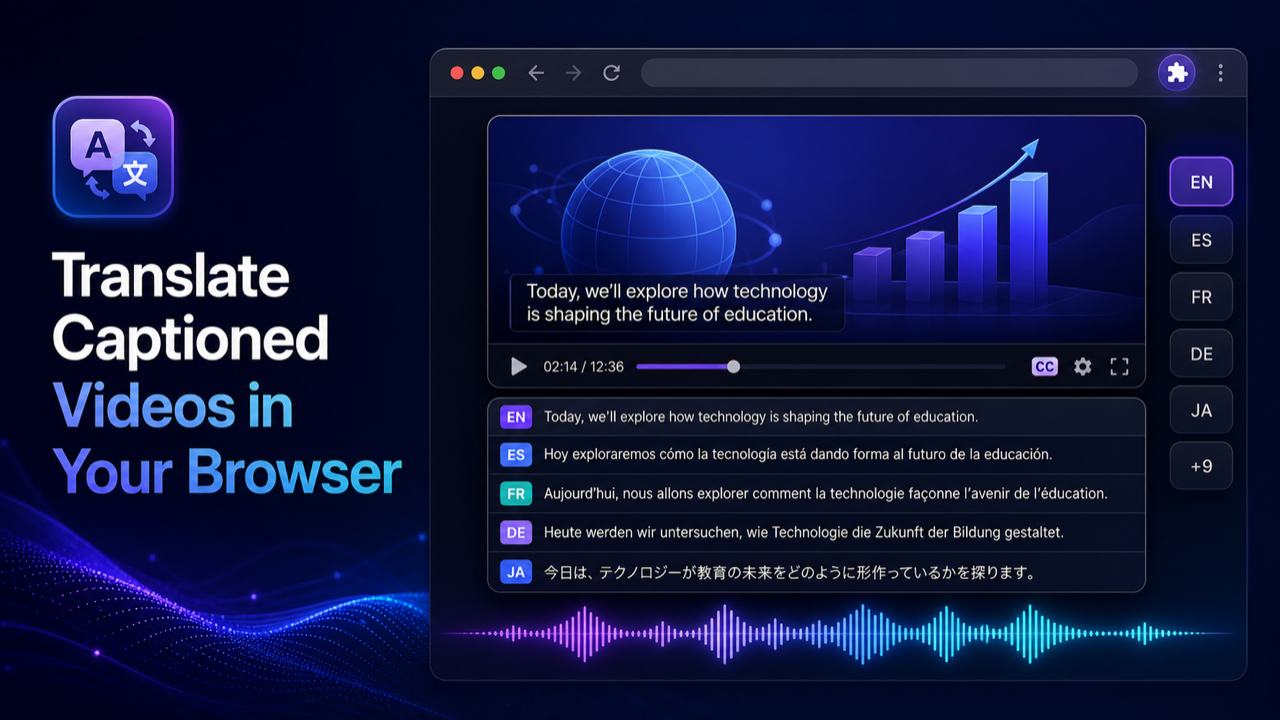
In-player and caption-driven. A browser extension attaches to the player, reads the caption track the page already exposes, translates that text, generates speech from it, and plays that speech over the video while lowering the original audio underneath. Nothing renders and nothing moves. It works on video you did not make, and it needs captions to exist and to be switched on.
Upload and render. You export or upload the file, a server transcribes the audio, translates the transcript, generates voice, mixes it against the original bed and renders a new file you download. This route does not care whether captions exist, because it listens to the audio. It does care about your minutes, your queue position and your bandwidth.
The first design answers "help me understand this now". The second gives you a deliverable. Most of the disappointment here comes from buying one and expecting the other.
| Question | In-player, caption-driven | Upload and render |
|---|---|---|
| Works on video you do not own | Yes | Rarely, and often against the platform's terms |
| Needs a caption track | Yes | No |
| Returns a file | No | Yes |
| Time before you hear anything | Seconds | Queue plus render |
| What leaves your machine | Caption text | The whole video |
Criteria that actually decide quality
Marketing pages compete on language counts. Output quality is decided by six or seven narrower things.
The translation engine
Plain machine translation handles conversational speech well and mangles domain vocabulary. An LLM-based route keeps context across a sentence and gets closer on technical phrasing, which matters when the speaker says "reduce" about a Python function rather than about costs. Anyone hunting for the most accurate ai video translation software is asking about this axis, and it is testable in ninety seconds with one jargon-heavy clip.
Voice quality and language coverage
Text coverage and voice coverage are different numbers, and vendors publish only the first. A translation route can cover a long list of languages while the voice catalog that speaks the result covers far fewer. On-device browser voices are free and clear enough for a lecture, with a narrow catalog. Cloud voices reach more languages and sound better, and they cost money because someone pays for the synthesis. Before you judge any best ai video translator, check that your target language has a voice at all. If subtitles appear and nothing speaks, that is almost always why.
Timing and sync
A dubbed line has to land where the original line lands. In a caption-driven tool that timing comes from the cue times in the caption track. The failure mode is length: a translated sentence is often longer than the source, so listen for drift and for the ducking. Good ducking keeps the original voice quiet but present.
Caption dependency versus transcription
Ask one question of any ai tool for video translation: does it read text the page provides, or does it listen to audio? A caption-driven tool cannot help with a caption-free upload, a live stream or DRM-protected video. A transcribing tool can, and pays for it in processing time and in handing over the media. Only one of those answers matches your library.
What happens to the source file
This is the criterion buyers skip and then regret. In a caption-driven browser tool the video file is never uploaded, while the caption text does travel, because the translation route receives it and so do cloud voices. In an upload pipeline the entire recording sits on a server you do not control. For an internal training session or a client deliverable under NDA, that decides it.
The cost model
Per-minute pricing rewards short clips and punishes course-length content. Flat subscriptions do the opposite. Free tiers usually stop at a preview length, a watermark, or an account wall, and it is worth finding which before you invest an evening. A free path with no account and no watermark is doing something structurally different, generating speech on your device instead of renting a server.
Latency
Time to first spoken word is the number you feel. Some engines start speaking almost immediately. Others generate the whole track before playback begins, which is fine for a five-minute clip and tedious for a ninety-minute lecture. A real-time mode exists to shorten that wait.
How to run your own five-minute evaluation
No best video translation tools 2026 roundup can do this for you, because the answer depends on your language pair and your content.
- Pick your worst real video, not the vendor demo. Heavy accent, technical vocabulary, fast delivery.
- Check the source. Are captions available and switched on? Auto-generated captions on a noisy recording cap the quality of everything downstream.
- Translate ninety seconds and listen to the first twenty. If the opening sentence is already wrong, nothing later will save it.
- Score three things by ear: did the domain terms survive, does the voice land on the cue, and can you still hear the original underneath.
- Jump to the ten-minute mark and listen again. Drift shows up late, never at the start.
- Switch the target language, then come back the next day. A tool that forgets your per-video settings annoys you daily.
- Read the pricing and privacy pages last.
Where our extension fits, and where it does not
The Unlimited Universal Video Translator is a browser extension built for the watching job. It reads the caption track a page exposes, translates it, speaks it with an AI voice and plays it over the video with the original audio ducked. The free path uses Google Translate for the text and an on-device voice that runs inside your browser, with no account and no watermark. PRO adds LLM translation, premium local and cloud voices, a real-time mode that starts speaking sooner, and support for your own provider key. It works on YouTube, standard HTML5 players and course sites like Udemy and Coursera, and it keeps your settings per video.
Here is what it deliberately does not do. It does not transcribe audio, so it needs the caption track and you need to switch captions on in the player. Live streams, DRM-protected video and caption-free uploads may not work. It renders nothing, so there is no dubbed file to hand a client. The video file is never uploaded, though caption text does reach the translation route and, if you pick them, the cloud voices. If your job is a localized master with a review pass, you want a rendering pipeline, and I would rather say so than sell you the wrong tool.
What to ignore in marketing copy
Language counts on their own. Ask how many of those languages have a voice.
Accuracy percentages with no test set behind them. Without a published corpus, the number is a marketing decision.
Badges about being the leading ai translation tool for video makers or the top ai translator in video creation industry. Nobody checks those claims, and an ai video translator with best reviews on a listicle usually paid for the placement. The same goes for anything sold as the best rated ai translator for video content.
"Studio quality" applied to text-to-speech. Listen to a sample in your target language, at your content's speaking speed.
Ranked lists in general, including this category's endless best video translation ai posts. The tool that wins on your language pair and your content is not knowable from a table.
Related guides
For the mechanics rather than the buying criteria, AI Video Translator walks through the detect, translate, speak and sync pipeline, and how to translate a video compares the three routes end to end. Free Video Translator sets out where the free path stops, and the Chrome extension guide covers installation. Platform behaviour lives in the YouTube guide, and the latency question in the real-time comparison.
Frequently asked questions
What should I look for in ai video translation tools?
Check the translation engine, whether your target language has a voice, where timing comes from, whether the tool needs captions or transcribes audio, what leaves your machine, the pricing unit, and the delay before the first spoken word.
Which is the best video translator for watching content I did not make?
An in-player, caption-driven one. It attaches to the player you already have open and starts in seconds. The trade is that the video must have captions you can switch on.
Is there a single best ai video translation for every use case?
No. Watching a foreign lecture and producing a localized master have different winners. Decide which one you are doing, then apply the criteria above.
How do I find the most reliable ai video translator 2026 for my language?
Test it on the language pair you care about. Translate ninety seconds of your hardest real video, listen for domain terms and timing, then check the ten-minute mark for drift.
What makes the best ai translator for videos on technical content?
An LLM-based translation route, because it carries sentence context instead of translating word runs. Straight machine translation is usually fine for conversational speech and weak on jargon.
Does a free ai tool to translate video exist?
Yes. A browser extension that reads captions and speaks them with an on-device voice can run at no cost, with no account and no watermark, because nothing is processed on a paid server.
Can any ai tool to translate videos work without captions?
Only one that transcribes audio, which means uploading or processing the media. Caption-driven browser tools cannot help with caption-free uploads, live streams or DRM-protected video.
What is the best ai for video dubbing and translation 2026 if privacy matters?
The design matters more than the brand. A caption-driven tool sends caption text and never the video file. An upload pipeline receives the whole recording, which is wrong for anything under NDA.
Other ways people search for this
This one job arrives in a lot of phrasings, and none of them is a different product. Left as people type them:
- Tool and software variants: video translation tool, video translation tools, ai video translation tools, ai video translation tool, ai video translation tools 2026, best video translation software, best video translation software 2026, best video translation tools, best automatic video translation tools 2026, best ai-powered video translation tools 2026
- Comparison phrasings: best ai video translation tools comparison, ai video translation tools comparison, best ai video translation tools 2026 comparison, best ai video translation tools comparison 2026
- Translator phrasings: best ai video translator, best ai video translator 2026, best ai video translator tool, best ai video translator tool 2026, best ai video translator tools 2026, best ai video translators 2026, best ai video language translator, best ai-powered video translator 2026, best ai for translating videos 2026
- Content-focused phrasings: best ai-powered translator for video content, best ai powered translator for video content, best ai-powered translator for video content 2026
- Dubbing and subtitle phrasings: best ai video translation dubbing tools 2026, best ai video translation tools for dubbing and localization 2026, best ai video translation tools for dubbing and subtitles 2026, best ai video translation tools for dubbing and subtitling 2026, best ai video translation tools for dubbing subtitles 2026, best ai tools for video translation and dubbing 2026, best ai tools for translating videos dubbing subtitles 2026, best ai tools for translating videos dubbing subtitles 2026 comparison
- Short queries: ai tool for video translation, ai tool that translates videos, ai tool to translate video, ai tool to translate videos, ai tool to translate video language, ai tool translate video