
Bilibili Video Translator: What Can Be Translated and How
Most people searching for a bilibili video translator live outside China and have found something they want to watch that only exists on Bilibili: a Chinese-language programming tutorial, a speedrun breakdown, a fan animation, a university lecture someone uploaded years ago. For a lot of that material there is no mirror and no English version. Bilibili is the only host.
Whether you can translate one of those videos depends mostly on what kind of text it carries. That comes first below, followed by the places where Chinese-to-English machine translation goes wrong on this kind of content, and then the routes that work.
Three kinds of text on a Bilibili video
A Bilibili video can show text in three ways, and only one of them is something a caption translator can use.
Some videos have a proper subtitle track: timed text stored separately from the picture, which the player can switch on and off. Creators upload these themselves, and the platform generates them for some videos. This is the only one of the three that counts as a caption track in the technical sense.
The comments that fly across the screen from right to left, often called bullet comments or danmaku, are viewer messages pinned to a moment in the video. They are drawn as a separate overlay on top of the player. They do not describe what is being said, and a tool that reads caption tracks will not treat them as subtitles. On a popular video there can be far more of them than spoken lines.
Many uploads also have Chinese subtitles painted directly into the video frames, along with on-screen titles, code in an editor, or slides. That text is part of the image. Reading it takes OCR (optical character recognition), and caption-based tools do not do OCR.
So check which of the three the video has before looking for a tool. If the only Chinese text is burned into the picture, a caption translator has nothing to work with.
Where Chinese-to-English machine translation struggles
Even with a clean subtitle track, machine translation from Chinese has predictable weak spots on the videos Bilibili is known for.
Internet slang and memes are the first. Bilibili has its own vocabulary: running jokes, number codes that stand for phrases because of how they sound when read aloud, and phrases borrowed from anime and games. A general translation model often renders these word by word, and you get grammatical English that makes no sense. When a translated line looks absurd, the cause is usually a meme rather than a bug.
Gaming vocabulary is the second. Game videos use Chinese names for characters, skills, items and mechanics, and those names often differ from the official English localization. The machine output may describe the item literally instead of using the name English-speaking players know, so you can follow the action but a later search for the term may find nothing.
Names cause a third kind of error. Chinese personal names, usernames and place names are written with ordinary characters that also have meanings, and many given names are built from words like spring or dragon. Machine translation sometimes translates the meaning instead of transliterating the sound. If a sentence suddenly has an odd noun doing something only a person would do, suspect a name.
Tutorial terminology suffers too. In programming, engineering or math tutorials, one English term can have several Chinese renderings, and creators mix Chinese and English terms freely. The translation may use a different English word each time the concept comes up, which makes the lesson harder to follow than the original. Pausing on the screen with code or formulas helps, because the symbols do not need translating.
A translated Chinese tutorial is still useful for following the structure and the reasoning. Check key terms against the on-screen text.
Practical routes that work
Bilibili is not in the tested platform list of our extension. We have not verified that it works there and we do not promise that it does. These are the options.
If the video has a subtitle track in the desktop browser player, a caption-based translator can read it when the web player exposes it. On some Bilibili videos that may be enough, but it is untested, it can break when the player changes, and it will not help with videos that only have bullet comments or burned-in subtitles.
Many Bilibili creators also publish on YouTube, sometimes under the same name, sometimes on a second channel. Search YouTube for the creator's name in pinyin or for the video title. YouTube is a tested platform, and the steps for translating a captioned YouTube video are in the YouTube video translator guide. A YouTube copy also gives you YouTube's own auto-translate for captions.
For burned-in subtitles, pause on the frame, take a screenshot, and run it through a translation app that can read text from images. It is slow and works one frame at a time. For a key slide, an error message in a coding tutorial or a diagram label, it is the most reliable of these routes. The guide to translating text in a video covers this approach in more detail.
A note on access
Some Bilibili content is limited by region, and some videos or features require an account. What you can see from outside mainland China may differ from what the creator sees, and a video you found through a link may not play in your region. Any translation route depends on the video playing in the first place, so check that before spending time on tools.
What our extension does, and where it is tested
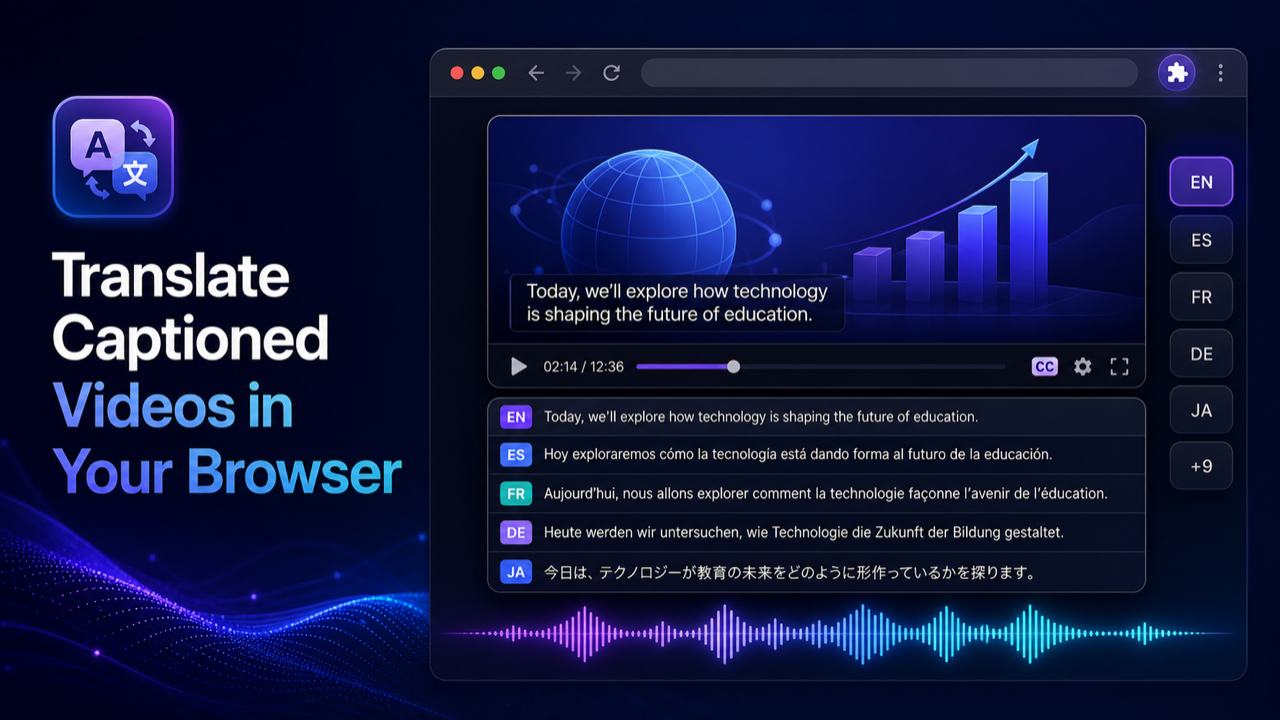
Unlimited Universal Video Translator is a Chrome extension for desktop Chrome. It reads the caption track of a video that is already playing in the tab, translates it, and then plays AI text-to-speech dubbing over the original audio, shows translated subtitles, or both.
It does not transcribe audio, so a video without a caption track will not work. It does not do OCR on burned-in text, it does not translate bullet comments, and it does not download or export a translated file. There is no lip sync, no voice cloning and no mobile version, and DRM-protected video is out of scope.
The platforms it has been tested on are Udemy, Coursera, YouTube, YouTube Shorts, edX, TikTok, TED, Vimeo, Khan Academy, gamedev.tv, Zenva and Domestika. Many other captioned HTML5 players may also work. It is free to start, with a paid unlimited tier. For how this kind of tool works in general, see the video translator extension overview.
Related guides
- YouTube video translator
- Translate text in video
- Translate a TikTok video
- Translate video to English
- Translate video subtitles
Frequently asked questions
Is there a bilibili video translator that works on every video?
No. Translation depends on the video having a subtitle track. Videos that only have bullet comments or subtitles burned into the picture cannot be handled by caption-based tools, because there is no separate text to read.
Does the extension translate Bilibili bullet comments?
No. Bullet comments are an overlay of viewer messages drawn on top of the player. The extension reads caption tracks only, so they are ignored.
Can I translate Chinese subtitles that are burned into the video?
Not with a caption-based tool. Burned-in text is part of the image and needs OCR. The practical workaround is to pause, take a screenshot and use a translation app that reads text from images.
Why does the English translation of a Bilibili video sound strange?
Chinese internet slang, memes, gaming terms and names written in ordinary characters often get translated literally, so each word is right and the sentence still misses the meaning. Check names and technical terms against the on-screen text.
What is the easiest way to watch a Bilibili creator in English?
Check whether the creator also posts on YouTube. If a captioned copy exists there, you can use YouTube's caption auto-translate or a tested extension, and both behave more predictably than anything on Bilibili itself.