
Translate Text in Video: When the Words Are Inside the Picture
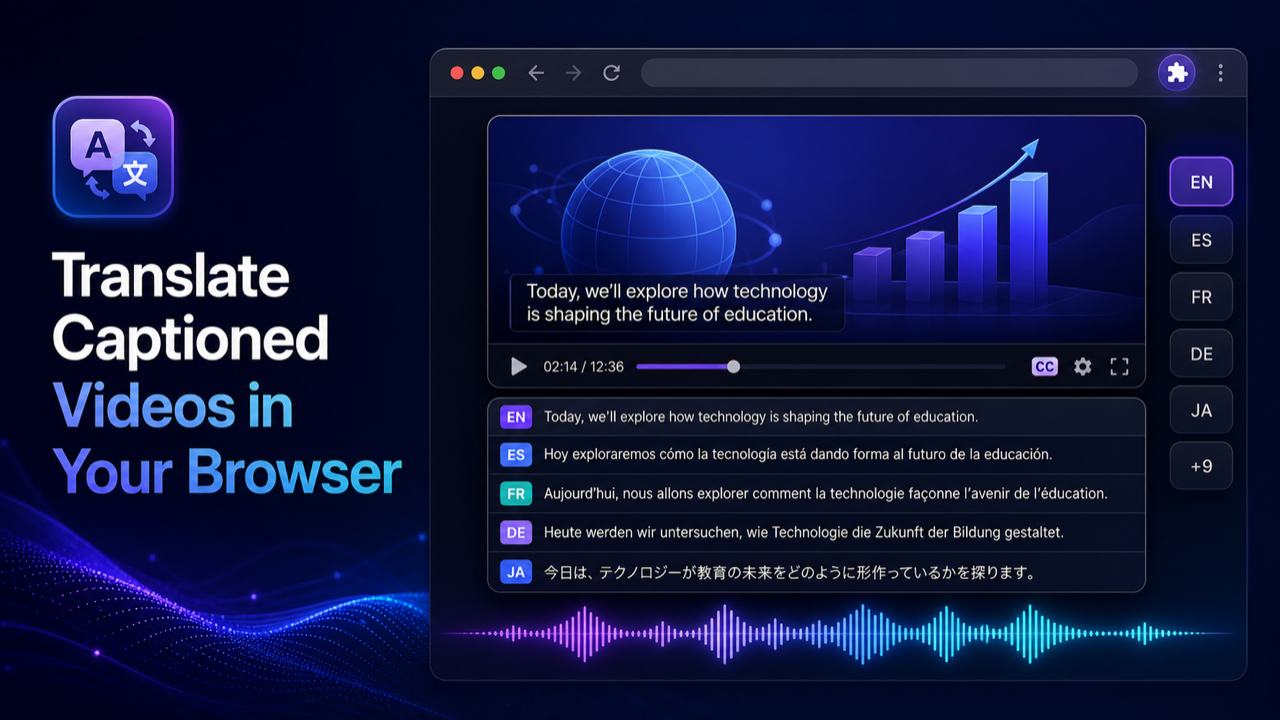
People who search for how to translate text in video usually have one of three different problems, and the fix is different for each. In one case the words are spoken and a caption track carries them. In another they are painted into the frame: a slide, a terminal window, a settings dialog, a street sign. The third case is subtitles the uploader burned into the video before exporting it, so they look like subtitles and behave like wallpaper.
Only the first case is text. The other two are pixels, and that changes what any tool can do with them.
This page sorts out which case you have, why the picture cases are hard, and what gets a Japanese slide deck or a Portuguese code demo understood today.
The three jobs behind one question
| What you are looking at | What it technically is | What can read it |
|---|---|---|
| Spoken narration | A timed caption or subtitle track the page serves | A caption translator in the browser |
| Slides, code, UI, signs, labels | Coloured pixels in each video frame | Optical character recognition on an image |
| Hardcoded subtitles | Coloured pixels in each video frame | Optical character recognition on an image |
The middle and bottom rows are the same job. A burned-in subtitle carries no timing data, no character codes and no track you can switch off. It is a drawing of letters. Software has to guess the letters back out of the drawing before anything can be translated, and that guessing step is what people mean when they talk about on screen translation.
The Unlimited Universal Video Translator extension works on the top row. It reads the caption track the page exposes, translates it and can speak it with a text-to-speech voice. It does not read text from the video picture. There is no optical character recognition anywhere in it, so a slide full of German bullet points stays German no matter what target language you pick.
Saying that plainly saves you an hour of clicking. What follows is what to do instead.
Why reading text out of a frame is genuinely hard
Text on a web page arrives as characters. Text in a video arrives as brightness values, and the video pipeline has already damaged them:
- Compression spends its bits on motion, not on the thin strokes of 12 point type. A 720p re-upload of a screencast turns small text into grey mush.
- Overlays move. Lower thirds slide in, slides transition with a crossfade, and the recogniser gets half of the old slide and half of the new one in the same frame.
- Backgrounds fight the letters. White text over a photo, yellow subtitles over sand, a code editor with a syntax theme that puts dark blue on black.
- Motion blur and camera shake smear anything handheld, which is most conference footage shot from a seat.
- Slides change fast. Three bullet points appear over four seconds and the recogniser needs a clean still of each state.
- Monospaced code has no forgiveness.
land1,Oand0,-and_, a curly brace against a parenthesis. One wrong character in prose reads as a typo. In a command it changes what the command does, and a translation on top of a misread line produces confident nonsense. - A still frame carries no timing. Captions come with start and end times, which is how translated subtitles stay in sync. A screenshot is one moment with no idea when the next one arrives.
In-frame text is readable. It is a picture problem with its own failure modes, handled by different software than a caption translator.
What works today for slides, code and signs
Ranked by how often each one actually works.
1. Let the narration carry the slide. In lectures, conference talks and course videos the presenter reads or paraphrases what is on screen within a few seconds of showing it. Translate the captions, listen or read along, and the slide stops being a wall. This covers far more videos than people expect. How to translate a video walks through that route.
2. Stop and go find the original text. Course platforms attach slide decks, PDFs and resource links. Conference talks have a speaker page with the deck. Documentation demos are showing a docs page that exists on the open web, and pasting a URL into a page translator gives you clean, selectable text. This beats every recognition method because you are translating characters again.
3. Use the platform transcript and description. Many players expose a full transcript panel beside the video. Code samples, product names and URLs often appear in the description because the creator pasted them there. A ten second scroll can replace a fight with a blurry frame.
4. Screenshot, then recognise the screenshot outside the browser. Stop on a clean frame at the highest quality the player offers, capture it, and run the image through whatever optical character recognition your machine already has. Every desktop operating system ships something that pulls text out of an image, and a captured still is a better input than moving video. Paste the recovered text into a translator and read it there. For the four slides in a talk that matter, two minutes of manual work.
5. Retype short strings. For a single command, a filename or a menu label, typing eight characters yourself is faster and more accurate than any pipeline. Obvious, and still the right answer most of the time.
About screen translator tools
There is a whole category of software built to translate from screen: you draw a box over part of your display, it recognises the text inside the box and shows a translation. On Windows these get searched for as a live screen translator pc utility, and the same idea exists on other desktops and inside game overlays. The category is real and some of it works well on the right input.
We have no verified data on any specific one, so there are no recommendations here. What you can do is test any candidate yourself before you trust it with a course you paid for:
- Feed it the exact content you care about, at the size it appears. A tool that nails large white-on-black slide titles can fail completely on 11 point syntax-highlighted code.
- Check a still frame and a moving frame. Some tools only sample on demand, which is fine for slides and useless for fast-changing overlays.
- Read the language pair carefully. Recognition and translation are two separate language lists, and the recognition side is usually shorter, especially for non-Latin scripts.
- Look at what leaves your machine. A box on your screen is a screenshot, and a screenshot of your desktop may include far more than the video.
The related idea is pointing a phone at the monitor. Searches like live camera translate, live camera translator and free camera translator come from menus, signs and packaging, where a camera is the fastest route. Aimed at a screen it fights glare, moire patterns from the pixel grid and your own hand shaking. It sometimes works on a slide held steady, never on a scrolling terminal.
Hardcoded subtitles are the same problem
A video with subtitles burned into the image looks like the easiest case and is one of the harder ones. The letters sit in a fixed band, so you know where to look. Everything else works against you: the font is small, often semi-transparent, it changes every two seconds, and it sits on whatever the scene happens to be.
Two checks before you give up. Turn the player's own caption menu on anyway, because plenty of uploads carry both a burned-in translation and a real caption track. Then look for the same video from its original source, where a selectable track often exists. If one shows up, translating video subtitles in the browser is a two click job.
What the extension does cover
The honest boundary, stated once more: caption track yes, video picture no.
Inside that boundary the extension detects the caption track the page serves, translates each segment, shows the translated lines on screen, and can generate a synchronized voice that plays while the original audio is ducked underneath. Settings are kept per video, so a Korean lecture and a Spanish tutorial do not share one configuration.
The limits that come with it:
- Captions must exist on the page, and you have to enable them in the player so the extension can detect them.
- It does not transcribe. No speech recognition step exists, so a caption-free upload gives it nothing to read.
- It does not import or export subtitle files, and it does not render or download a translated video.
- Live streams, DRM-protected players and caption-free uploads may not work.
- The video file is never uploaded. Caption text does travel: the translation route receives it, and cloud voices receive it too if you choose one.
For the caption path itself, AI Video Translator covers the detect, translate, display and speak sequence, Free Video Translator sets out where the free tier stops, and video audio translator goes into dubbing. For a paid course, Udemy subtitle translator is the platform version.
Frequently asked questions
Can this extension translate text in video frames like slides or code?
No. It reads the caption track the page exposes and translates that. Text drawn into the picture needs optical character recognition on the image, which the extension does not do.
How do I translate from screen on a desktop?
Capture the region or the frame you stopped on, run the image through an optical character recognition tool on your computer, then translate the recovered text. Screen translator utilities automate those steps for a selected box on your display.
Why does recognised code come out wrong?
Monospaced fonts at small sizes confuse similar characters, and video compression makes it worse. Verify anything you are going to run, character by character, against the original frame.
Are burned-in subtitles translatable?
Only as an image. Check the player's caption menu first, because a real track may exist alongside the burned-in text, and a real track is far easier to translate.
Does on screen translation work on live video?
Poorly. A recogniser needs a stable frame, and live content rarely gives it one. Pausing is what makes the difference, which is why a recorded upload is the practical case.
What about the presenter's speech, not the slide?
That is the caption path, and it works in the browser today. Turn captions on, install the extension, pick a target language, then read or listen. See translate video to english for the most common direction.