
MP4 Translator: A File on Disk or a Video in a Tab
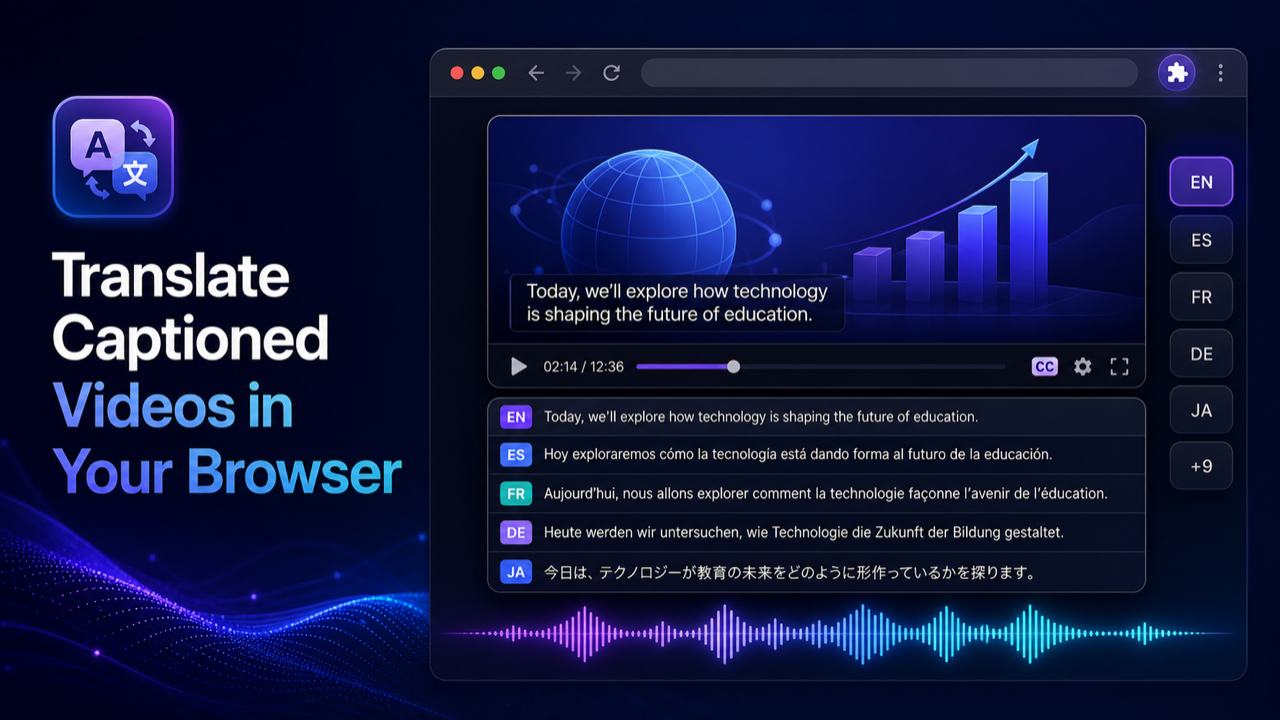
People who search for an mp4 translator are usually doing one of two different jobs, and the tools for them do not overlap. Job one: you have a file on disk, say a 40-minute lecture recording or a product demo in .mp4, and you want a translated file back that you can send to someone or upload somewhere. Job two: you are watching something in a browser right now, it is in a language you do not read well, and you want to understand it before the tab closes. The first job needs a rendering pipeline that produces a new file. The second needs something that sits on top of the player. I build the second kind, so I will be blunt about where it stops.
What an .mp4 actually is
An .mp4 is a container, not a video. The container is a box with several streams inside it: one video stream, one or more audio streams, and sometimes one or more subtitle streams. The file extension tells you about the box. It says nothing about what language the audio is in, whether a subtitle stream exists, or what codec was used to compress the picture.
That matters for translation because a tool cannot translate a box. It has to open it and work on the streams. For a file with no subtitle stream, a translator has to do the full chain:
- Demux: split the container into its separate streams.
- Speech recognition: turn the audio stream into timed text.
- Translation: turn that text into the target language.
- Output: either synthesize a new voice track from the translated text, or typeset the text as subtitles.
- Mux and encode: put the new stream back into a container and write a new file.
Every step in that chain can be done well or badly, and steps 2 and 5 are where most of the cost and quality loss live. Speech recognition on a noisy lecture recording produces errors that get translated faithfully into errors in the other language. Step 5 either copies the original video stream untouched (fast, lossless) or re-encodes it (slow, lossy), and which one a tool does is rarely printed on the pricing page.
Where a browser extension fits, and where it does not
The extension I work on, Unlimited Universal Video Translator, does not accept file uploads and cannot open a local .mp4 or .avi. It runs in desktop Chrome, reads the existing caption track of a video that is already playing in a web page, translates that text, and then either shows translated subtitles over the player or speaks the translation as AI dubbing on top of the original audio. The container is never opened and no file is ever produced. If your material is a file on disk, this is the wrong tool and I'd rather tell you that here than have you install it and find out.
The reason it works this way is the same container logic from above. A web player already did the demux. The caption track is already text with timestamps. The extension skips speech recognition entirely, which is why it can run in real time with no processing queue, and also why it can't help with a video that has no caption track at all. No captions, nothing to translate.
avi translator: what an older container changes
Searches for an avi translator come from people with older material: camcorder footage, DVD rips, training videos from the 2000s, conference recordings someone kept. AVI is a container from 1992, and in practice it has no standard subtitle stream. Some player-specific hacks exist, but the common arrangement is a separate .srt file sitting next to the .avi with the same name, which the player loads on its own.
This changes the job in two ways. First, if the subtitle is already a separate text file, you do not need a video tool to translate it. Any subtitle translation workflow that reads .srt will do, and the video file never needs to be opened or re-encoded. Second, if there is no .srt, you are back at the full chain, and the AVI codecs of that era (DivX, Xvid, old MJPEG) tend to survive re-encoding worse than modern H.264, so a tool that re-encodes will show more visible loss on this material than on a recent .mp4.
For the browser extension, AVI is doubly irrelevant: the extension only sees a video that a web page is playing, and Chrome's built-in player does not play .avi files anyway. If the same footage has been uploaded to a video platform and has a caption track there, the extension translates it there. The .avi on your drive stays untouched.
upload video to translate: what an upload actually costs you
Any tool that produces a translated file needs the source file. That means you upload video to translate it, and the upload has costs that are easy to forget when the landing page says "just drag and drop."
Transfer time. A one-hour 1080p recording is commonly several gigabytes. On a typical home upload link that is a long wait before processing even begins.
A processing queue. Speech recognition and speech synthesis are computed on the vendor's servers, usually in a queue shared with other customers. The time from upload to download is not something you control.
Per-minute pricing. Almost every file-based service prices by minute of source video, sometimes with a separate charge for each target language. A 40-minute lecture into two languages is 80 billable minutes. Read the pricing page for the per-minute rate and for what counts as a minute; some round up.
Your file on someone else's storage. This is the one people skip. Once you upload, a copy of your recording exists on infrastructure you do not control. Before uploading anything you would not want leaked, get answers to these questions:
- How long is the source file kept after processing, and is deletion automatic or on request?
- Is the transcript kept separately from the video, and for how long?
- Is the content used to train recognition or translation models?
- Where are the servers, and which jurisdiction's law applies to the data?
- Can you delete the account and get written confirmation that the files are gone?
If the vendor cannot answer these in plain language on a public page, that is an answer too.
The extension avoids all of this because nothing is uploaded. There is no file to transfer, because it works on a video that a web page is already serving to you, and the only thing that leaves your machine is the caption text sent for translation.
video translator converter: why "converter" is the wrong mental model
The phrase video translator converter shows up because people already know converters. You have an .avi, you want an .mp4, you run it through a converter, done. It is natural to expect translation to be the same kind of operation with a language dropdown instead of a format dropdown.
It's a different kind of operation. Format conversion does one of two things: remuxing, which copies the existing streams into a new container with no quality change, or re-encoding, which decodes the picture and compresses it again with a different codec. Neither creates anything new. The pixels and the sound are the same information in a different wrapper.
Translation creates new content. A new text track, a new audio track, or both. Those did not exist before and have to be generated, which is why a translation job takes minutes per minute of video while a remux takes seconds.
When one product markets itself as both, what it usually means is that it re-encodes your video as part of writing the output file. Re-encoding costs a generation of quality every time it happens. If the source was already a compressed upload, the output is now two compressions deep. That's fine for a clip you'll watch once and a bad idea for a master you'll keep re-publishing. The question to ask is whether the tool can copy the video stream unchanged and only add the new subtitle or audio stream. If the answer is "we output 1080p MP4" without mention of copying the source stream, assume a re-encode.
The honest workaround
If your file is a recording of something that also exists on a web platform with captions, the fast path is to open it there and translate it in the tab. YouTube auto-generated captions count as a caption track. Course platforms usually ship a caption track with each lecture. Conference talks published on a video platform often have one. In all of those cases the in-tab route gives you translated subtitles or dubbing immediately, with no upload, no queue, and no output file to manage.
If the file has no online counterpart, or you genuinely need a translated file to hand to someone, you need a pipeline tool with a file output, and I am not going to rank vendors for you. The category changes too fast for a ranking to stay honest for more than a few months, and I have no way to test every tool on your specific language pair and audio quality. What I can give you is the checklist I would run on any of them.
What to check in any file-based tool
Does it return a file you own? You should get a downloadable .mp4 (or a subtitle file) with no watermark, no account lock, and no requirement to keep paying to access it later.
Is the subtitle stream separate or burned in? A separate stream can be turned off, edited, and re-translated. Burned-in subtitles are pixels; they cannot be removed or corrected without going back to the source. Ask which one you get, and whether you can choose.
What happens to audio quality on re-encode? If the tool adds a dubbed track, does the original audio stream survive untouched as a second track, or is it replaced or re-compressed? For anything with music or a good microphone this is audible.
Does it copy the video stream or re-encode it? Covered above. Ask directly.
What is the per-minute price, per language? And is there a minimum charge, a rounding rule, a separate charge for the transcript, and a different rate for speech synthesis versus subtitles only?
Can you correct the transcript before translation? Speech recognition errors compound. A tool that lets you fix the source text before it is translated produces a noticeably better result than one that runs the whole chain unattended.
What is the retention policy? The five questions from the upload section, in writing.
Related guides
How to translate a video walks through the in-tab route step by step. If your subtitles are already a separate file, SRT translator covers translating the text without touching the video. Translate video to text explains where speech recognition fits when a video has no captions at all. For the difference between these tools and a publishing workflow, see Best video translator app, and for the wider category, Video translation services. Readers with a broken .avi that a browser will not play might find Movie translator more useful.
Frequently asked questions
Can the browser extension translate an mp4 file from my computer?
No. It has no file-upload mode and cannot open a local file. It works only on a video that is already playing in a web page in desktop Chrome, and only when that video has a caption track. If your material is a file on disk, you need a pipeline tool that outputs a file.
Does an mp4 need subtitles before it can be translated?
For the browser extension, yes: it translates the existing caption track and cannot transcribe audio. For file-based tools, no: they run speech recognition on the audio first, but that step is where most errors enter, so a file that already has a subtitle stream or a matching .srt produces a better result.
Is translating a video the same as converting it?
No. Conversion changes the container or codec and creates no new information; it can be lossless. Translation generates a new text or audio track that did not exist before. A tool that does both is re-encoding your video as part of writing the output file, which costs a generation of quality.
What should I do with an .avi that has a separate .srt next to it?
Translate the .srt as a text file and keep the .avi untouched. Most players load a subtitle file with the same name automatically, so you end up with the original video and a translated subtitle track without any re-encoding.
Is uploading a video to a translation service safe?
It depends entirely on the vendor's retention policy. Before uploading, find out how long the source file and transcript are kept, whether they are used for model training, where the servers are, and how deletion is confirmed. If that information is not published, treat the upload as permanent.
Why is there no upload mode in the extension?
Because it is built around a different job. Reading a caption track that a web page already provides lets it skip speech recognition and run in real time with nothing leaving your machine except the caption text. Adding uploads would mean building the whole demux, transcribe, encode pipeline, which is a different product with different costs.