
Movie Translator: What Works Tonight, What Needs a Studio, and Where DRM Stops You
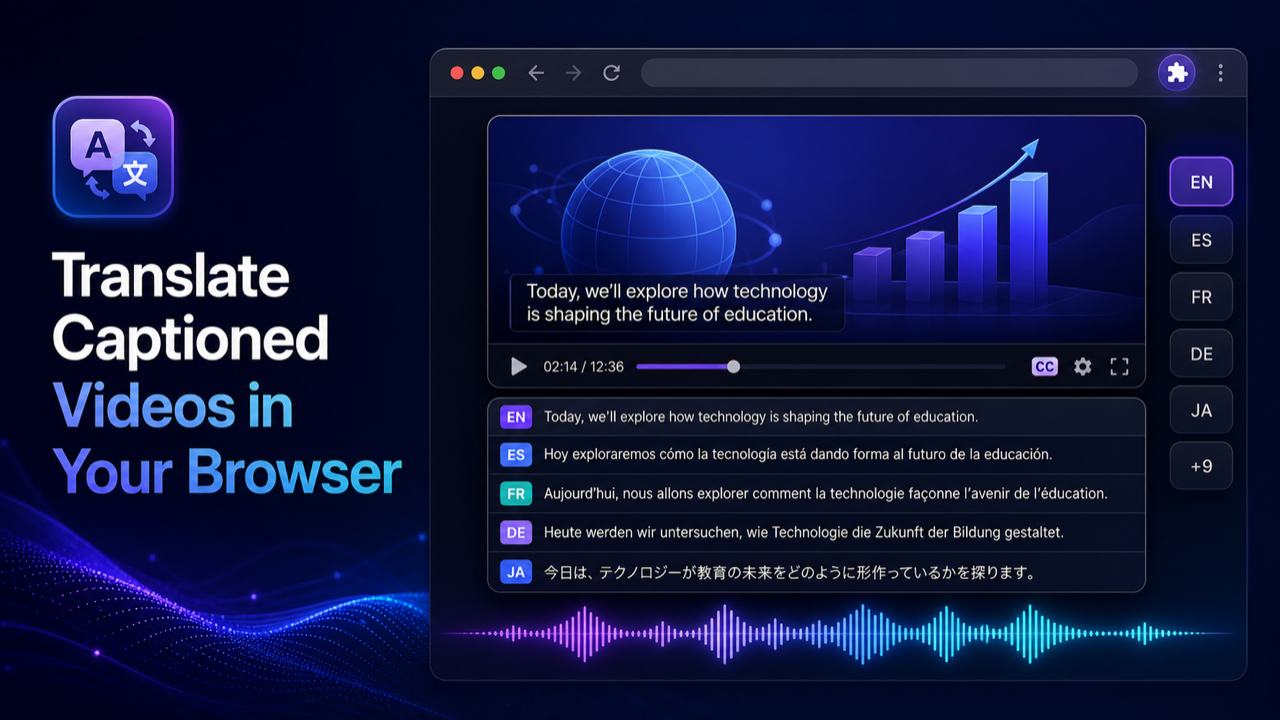
Movie translator is the kind of search that hides three people. The first has a foreign film queued up for tonight and wants to understand it in the next ten minutes. The second has a finished film and needs a localized version they can deliver to a distributor or a festival. The third is a person: the linguist who writes the subtitles or the dubbing script, and who is usually looking for work or for a colleague.
I build a Chrome extension that translates video in the browser, and I'll say up front that it serves the first person in a narrow set of cases, the second not at all, and the third only as a curiosity. This article is mostly about where the boundaries sit, because a film is the hardest case in video translation and the one where a vague promise costs you an evening.
Three intents, three answers
Watching tonight. You have a film open in a player, a file on disk, or a link. You want subtitles or a voice in your language, and you don't care if anything is saved. The answer depends entirely on where the film lives and whether it carries a caption track. That is the rest of this page.
Localizing a film as a deliverable. You need a subtitle file that passes a distributor's technical spec, or a dubbed audio stem mixed against the music and effects. Nothing in a browser does this. You need a subtitling workflow, a translator who works into the target language, and usually a mix engineer. The human-craft section below explains what you are paying for.
The profession. Film translation is a trade with its own conventions, and film translators are hired for prestige releases even now that machine translation is everywhere. If that's you, the craft section is the only part written for you.
The mistake that wastes the most time is reading an answer for one intent as if it applied to another. A tool that helps you follow a lecture in your browser does not produce a subtitle file, and an agency quote for a feature film is irrelevant to someone who wants to watch it once.
What film translators actually do
A subtitle is a condensation, never a transcript. Viewers read slower than actors speak, so a subtitler cuts each line down to what a viewer can read in the time the shot allows. The working limits in most broadcast and streaming specs are two lines per cue, roughly 37 to 42 characters per line depending on the script and the platform, and a reading speed somewhere around 15 to 20 characters per second for adults. A line that is technically correct but too long to read before the cut is a failed subtitle.
That is why film translation is a different job from translating a document. The translator decides what to drop. A three-way overlapping argument becomes two short lines that keep the insult and lose the filler. A pun gets replaced with a different joke that lands in the target language, or with a straight line if nothing works. Swearing gets calibrated to the rating of the release in the target market. Cues are timed to shot changes because a subtitle that straddles a cut reads as a flicker.
Dubbing scripts are a second discipline. The dialogue writer works from a translation and rewrites every line to fit the mouth movements, the breath pauses and the visible emotion on screen. The result is often less literal than the subtitles for the same film, on purpose.
Movie translation services for theatrical and streaming releases still hire humans for all of this, and they hire a second linguist to review. The reason is simple: a wrong number in a lecture confuses one student, while a mistranslated line in a film is printed on a thousand screens and quoted in reviews. When the budget is per title and the audience is public, the craft is cheap relative to the risk.
Paid streaming platforms and DRM: out of scope, plainly
Commercial subscription services deliver film under digital rights management. The video is encrypted, the decryption happens inside a protected media path, and the subtitle stream is delivered in a form that third-party code in the page is deliberately kept away from. This is by design, it is part of the licensing deal between the platform and the studio, and it is not a bug that a clever extension routes around.
So here is the sentence I would rather write once than have you discover after installing something: DRM-protected films on subscription movie catalogues are out of scope for in-tab translation, and my extension is not a DRM workaround. It does not touch the protected audio, it does not read a subtitle stream the platform has locked, and I am not going to pretend otherwise on a page built to rank for movie translator.
What those platforms do offer is their own subtitle and dub menu. Many catalogue titles ship with several subtitle languages and sometimes several audio languages. If the film you want has your language in that menu, the platform has already done the translation, with human subtitlers, and it will be better than anything generated on the fly. If it does not, no browser tool will add it, and the honest options are the ones in the practical section below.
Where in-tab translation genuinely works
Web video that exposes a caption track in the page is a different situation. That means lecture platforms, conference recordings, university course players, YouTube and sites built on similar players: video where the captions are text the page loads and renders, rather than an encrypted stream. On those pages the caption text is readable by an extension, and that is the whole basis of what I build.
Unlimited Universal Video Translator is a Chrome extension for desktop Chrome. It reads the caption track the video already has, translates that text, and then either plays an AI text-to-speech voice over the original audio, shows translated subtitles, or both, inside the tab where the video is already playing. Free to start, paid for unlimited use. A film qualifies only when it sits on an open web player with a caption track the page exposes: independent films on a public video site, archive footage, student films, festival screeners on a captioned player, and the occasional feature a rights holder has uploaded to YouTube with subtitles.
It does not transcribe audio, so a film with no caption track produces nothing: there is no text to translate. Subtitle file import and export, rendering a translated copy of the film, lip sync and cloning the actors' voices are all outside what it does. There is no mobile version, because Chrome for Android has never supported extensions and Chrome on iOS supports none either. If you were hoping for a movie translator that turns any film into a dubbed file, that is a different product category and I cover it honestly in video translation services.
Do you have a caption track? How to tell
A caption track is a timed text file the player loads alongside the video: a list of cues, each with a start time, an end time and one or two lines of text. Common formats on the web are WebVTT and SRT. Burned-in subtitles are different: those are pixels drawn into the picture, and to software they are indistinguishable from the rest of the image.
Ways to check:
- Look for a CC or subtitles button on the player. If it lists languages, there is a track. If it lists "auto-generated" on YouTube, that also counts as a track, with the accuracy caveats auto-generated captions carry.
- Turn the captions off. If the text on screen disappears, it was a track. If it stays, it is burned in.
- Try to select the subtitle text with the mouse. Track-based captions on many players are selectable; burned-in ones never are.
- On a local file, look for a sidecar .srt or .vtt with the same filename, or check the player's subtitle menu for embedded tracks.
If there is no track and no sidecar file, nothing caption-based can help, and I would rather you know that before you spend time. The only routes are transcription, which my extension does not do, or finding a copy of the film that ships with subtitles. SRT translator covers what translating a subtitle file as text gets right and what it breaks.
How people actually translate a movie, by situation
On a platform with a subtitle menu. Use it. When you translate movie audio yourself you are competing with a subtitler who had the script, the timings and a reviewer.
A film file on your computer. Most desktop players load a separate subtitle file. To translate movie to english this way you need the source-language subtitle file first, then a text translation of it, then a load into the player. Machine translation of a full film's subtitles is readable and often wrong on idiom.
A film on an open web player with captions. This is the in-tab case. Translate film dialogue while it plays, with a synthetic voice or translated subtitles, no file produced, within the limits described above.
A film on a subscription catalogue without your language. No third-party option in the browser. Check whether another service licensed your language for the same title, or whether a physical release carries the subtitle track.
Television. People also search translate tv, and the honest answer is shorter than any of the above. Broadcast tuners, set-top boxes and smart-TV apps are closed environments: a browser extension has no access to them at all, and their subtitle options are whatever the broadcaster or the app ships. The same applies to a phone or tablet: on iOS and Android there is no extension to install, and the only translation features are the ones built into the OS or the individual app, which I go through in how to translate a video on iPhone and Android live translate video.
People who want to translate movies in bulk, say a personal archive with subtitle files, are doing the file-on-computer route many times over, and the bottleneck is the quality of the source subtitles, since every downstream step inherits their errors and their timing.
What AI changes for film, and what it doesn't
An ai movie translator, in the sense people search for it, is a pipeline: speech recognition or an existing caption track, machine translation, synthetic voice. Where I build, it is the last two stages on top of an existing track. Where file-based tools build, it is all three stages plus a render. Both are far better than they were five years ago, and both still fail in the same place on drama.
That place is idiom, slang and subtext. A lecture is mostly terminology and declarative sentences: translate the terms consistently and the lecture survives. A film is the opposite. The lines that matter are the ones that mean something other than what they say, the insult that is affectionate, the yes that means no, the regional slang the screenwriter chose to signal a character's class. Machine translation renders these literally more often than not, and a literal rendering of subtext is a flat line. Sarcasm survives a human subtitler and rarely survives a model. Jokes are worse: a pun translated literally is a sentence with no joke in it.
There is also the delivery problem. AI voices are steady narrators, and a narrator's cadence over a shouted argument or a whispered confession is distracting in a way that a translated subtitle is not. For film I would generally choose subtitles over a synthetic voice even when both are available, the reverse of what I recommend for a two-hour lecture.
So when someone asks whether a movie translator app or a movie language converter will let them enjoy a foreign film the way a native speaker does, the accurate answer is that it will let them follow the plot, and it will lose a fraction of the lines the writer worked hardest on. That is a fair trade for a documentary or for a film you would otherwise not watch at all, and a poor trade for a comedy. Movie translation done by a person exists for exactly this gap, and the gap has narrowed less on drama than the marketing suggests.
Checklist before you promise yourself a film tonight
- Where does the film live: a subscription catalogue, a file, or an open web player?
- On a catalogue, is your language already in the subtitle or audio menu? If yes, stop here. If no, there is no browser route.
- On a file, is there a subtitle file or embedded track in the source language? If yes, translate that text and load it. If no, you need transcription, which is a separate job.
- On an open web player, is there a caption track the page exposes? If yes, in-tab translation works. If the subtitles are burned in, it does not.
- Is it a comedy? Lower your expectations for any machine route by one notch.
Related guides
The mechanics behind the caption-reading approach are in AI video translator, and the general routes for any video, files included, are compared in how to translate a video. For a film file with its own subtitle file, SRT translator and add translated subtitles to video cover the text route. If your film is an MP4 on disk, MP4 translator is written for exactly that case. The two features film people ask for most and this extension does not have are covered in AI video translator with lip sync and AI video translator with voice cloning.
Frequently asked questions
Can a browser extension translate a film on a paid streaming service?
No. Those services deliver video under DRM, and both the audio and the subtitle stream are kept away from third-party code in the page by design. The extension I build does not bypass this and is not a workaround for it. Use the platform's own subtitle and audio menu, which is the only translation available for those titles.
What if the film has no subtitles at all?
Then nothing caption-based can help, because there is no text to translate. The extension does not transcribe audio. Your options are to find a copy or a subtitle file in the source language, or to use a transcription workflow, which is a separate tool category and produces weaker results on films with music and overlapping dialogue.
Does the extension work with a movie file on my computer?
No. There is no file-upload mode. The extension works only on web video that plays in a Chrome tab and exposes a caption track. For a local file, the route is a desktop player that loads a subtitle file, plus a text translation of that file.
Is AI translation good enough for a foreign film?
Good enough to follow the plot of a drama or a documentary, and noticeably worse on comedy, slang and any line that means something other than what it says. A human subtitler condenses and rewrites for reading speed and subtext; a model translates the words. For anything you care about seeing properly, platform-native subtitles made by people are better.
Can I use it on a phone or a smart TV?
No. Chrome for Android has never supported extensions, Chrome on iOS supports none, and smart-TV apps and broadcast tuners are closed environments with no room for third-party code. The extension runs on desktop Chrome only.
Which films does in-tab translation actually work on?
Films on open web players that expose a caption track: features a rights holder has uploaded to YouTube with subtitles, independent films on public video sites, festival screeners on captioned players, archive footage. If the subtitles are burned into the picture, or the film sits on a DRM catalogue, it does not work.