Video Translation Services: Agencies, AI Platforms, and Browser Playback
Type video translation services into a search box and you get three unrelated businesses on one results page. One sells people: linguists, reviewers, voice actors, a signed deliverable. One sells software you upload a file to and get a localized file back. One sells translation that happens while the video plays, with nothing produced at all.
I work on the third kind, a browser extension that translates video in the tab where it already plays. That is a narrow product and I would rather draw the boundary than blur it. If you need a dubbed master for a product launch, I am not what you are shopping for, and a page that pretended otherwise would waste your afternoon.
The three delivery models
Human service with QA. A vendor takes your source video, transcribes it, translates it, has a second linguist review the translation, records or synthesizes voice, times the subtitles to broadcast conventions, and returns files with a named person accountable for them. You are buying judgment and liability.
Automated self-serve platform. You upload, pick target languages, wait for a queue, download a rendered video or a subtitle file. Machine transcription, machine translation, synthetic voice. You are buying throughput and price per minute.
Playback translation. Software attached to the player translates what is on screen while you watch. No file is produced, no upload happens, nothing is archived. You are buying comprehension for the next forty minutes.
Confusing these is the single most common way this purchase goes wrong. People buy throughput when they needed accountability, or pay for a QA pass on a lecture nobody will ever publish.
What an agency actually delivers, and what you pay for
A video translation company is a production shop with a linguistic department. Behind the quote there are real steps, and each one is a line item somebody has to do.
- Transcription of the source audio, usually corrected by a human even when a machine produced the first pass.
- Translation by a linguist who works into their native language, with a glossary for your product names and domain terms.
- Review by a second linguist who did not do the translation. This is the step that separates a service from a tool, and the step clients most often cut to save money.
- Voice: either recorded talent in a booth, or synthetic voice chosen and directed by an editor. A booth session brings casting, direction and re-records.
- Subtitle conformance: reading speed limits, characters per line, minimum and maximum cue duration, line breaks that respect grammar, and whatever spec your distribution platform enforces.
- Quality control on the final file, plus one or two rounds of client revisions written into the contract.
- A deliverable with liability attached. Somebody signs, and if the medical dosage in the dub is wrong, there is a company to answer for it.
Most video translation companies price per finished minute of video, per source word for the subtitle stage, or per language per project. Rates quoted publicly tend to spread very wide: subtitle-only work in a common European pair sits at the low end, and full dubbing with booked voice talent and a second reviewer sits many times higher per minute. Treat any number you see, including ranges on vendor pages, as a starting band rather than a price. Language pair, turnaround, source quality, volume commitment and whether you supply a clean script all move it.
Some vendors package this as on-demand video translation services: a portal where you drop files, pick a tier, and get a quoted turnaround without a sales call. That is the same production chain with the account management removed, and it works well for repeat work in languages the vendor already staffs. Listings advertising audio video translation services usually mean both tracks are in scope, the spoken audio and the on-screen text, which matters if your video has burned-in labels or animated captions that no subtitle file can reach.
What you are paying for, compressed into one sentence: a second pair of qualified eyes and someone to blame.
What an ai powered video translation service does in practice
The phrase ai powered video translation service describes a pipeline, not a capability. Audio goes into speech recognition. The transcript goes into machine or LLM translation. The translated text goes into text-to-speech. A mixer places the new voice over a reduced original bed, and a renderer writes a new file. Every stage is a model, and errors compound from left to right: a misheard product name becomes a mistranslated sentence becomes a confidently mispronounced dub.
Searches for the top ai powered video translation service assume one winner exists. It does not, because the stages are strong and weak in different places. The hyphenated form, top ai-powered video translation service, returns the same ranked lists written by the same affiliate pages. What actually varies between platforms is narrower than the marketing suggests:
| Stage | Where automated output is genuinely good | Where it fails |
|---|---|---|
| Transcription | Clean studio audio, single speaker, common language | Accents, overlap, background music, domain jargon |
| Translation | Conversational speech, general vocabulary | Regulated terminology, humor, idiom, brand voice |
| Voice | Neutral narration at a steady pace | Emotion, shouting, whispered lines, character work |
| Timing | Sentences of similar length across languages | Languages that expand 30 percent or more |
| On-screen text | Nothing. It does not see the picture | Any label, chart or caption rendered into frames |
These platforms earn their keep on volume. Two hundred internal training videos into six languages is work no agency budget survives, and machine output that is 90 percent right is worth far more than nothing at all, which is the realistic alternative.
Where a human pass is still needed: anything a regulator reads, anything a customer signs, anything with your brand's name pronounced aloud, and anything where a wrong number changes a decision. The cheap version of that pass is not a full agency engagement. It is one qualified reviewer with the transcript, the translation and the rendered video, correcting a machine draft. That hybrid is what most teams end up doing once they have shipped an unreviewed dub and heard about it.
Playback translation in the browser, honestly scoped
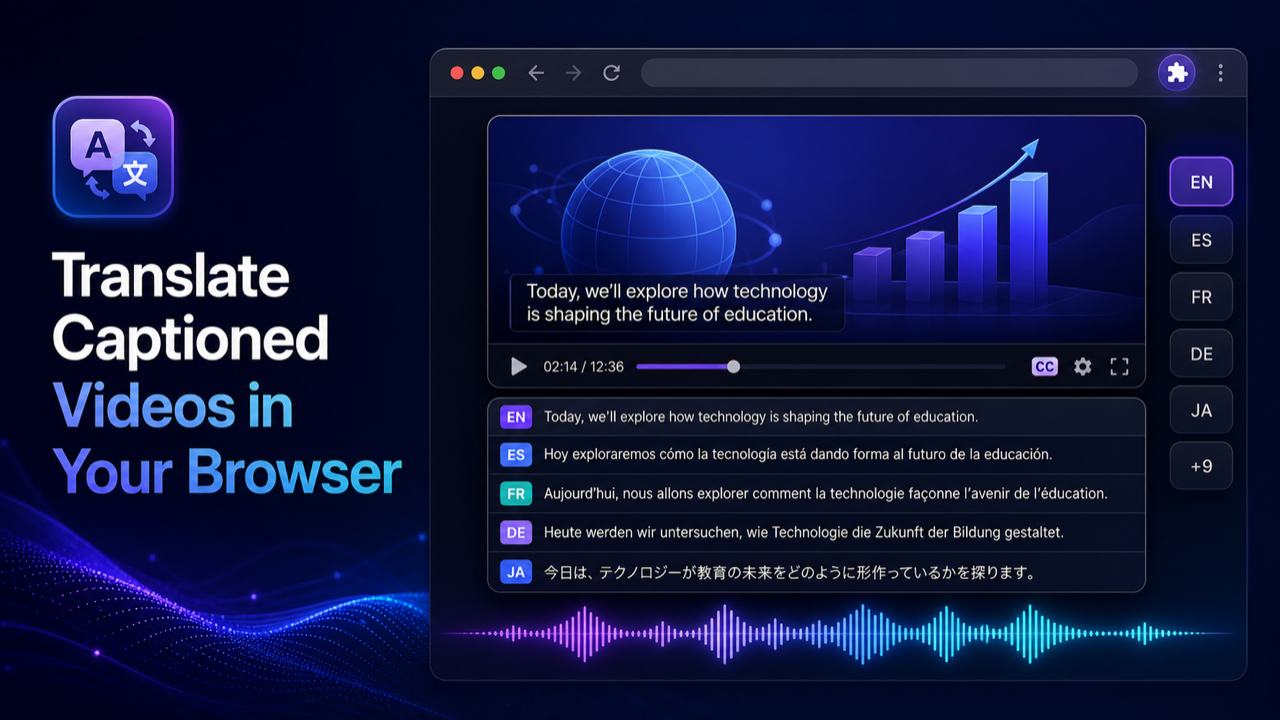
The third model is the one I build, and it is the narrowest of the three. Unlimited Universal Video Translator is a Chrome extension. It reads the caption track the page already exposes, translates that text, speaks the translation with an AI voice over the original audio, and shows translated subtitles. It is free to start, with a paid unlimited tier.
The limits are structural, not a roadmap:
- It does not transcribe audio. If the video has no caption track, there is nothing to translate and the extension cannot help.
- It produces no deliverable. No file to download, no subtitle export, no dubbed master to hand anyone.
- It does not import or export .srt or .vtt, does not edit video, and does not read text burned into the picture.
- No lip sync, no voice cloning. Standard synthetic voices.
- Nothing is uploaded into a production pipeline. Translation happens for playback, in the browser, while you watch.
That set of tradeoffs is right for exactly one job: you did not make this video, you do not own it, and you need to understand it now. A lecture, a conference recording, a course module, a tutorial. For that job, a quote and a three-day turnaround are absurd, and so is uploading someone else's copyrighted video to a rendering service.
Decision rules
Skip the comparison tables and answer one question: who is going to watch the result, and what happens if it is wrong.
| Your situation | Model to use |
|---|---|
| Public marketing video, ad, brand film | Human service with review and sign-off |
| Legal, financial, safety or medical material | Qualified human translator, review trail, no exceptions |
| Regulated product documentation on video | Human, with your approved glossary |
| Internal training, onboarding, all-hands recordings | Automated platform, spot-checked by a bilingual colleague |
| Large back catalog nobody has budget for | Automated platform, prioritize the top viewed 10 percent for human review |
| Support and help-center clips | Automated, with a human pass on the top articles |
| Watching a lecture or talk someone else published | Playback translation. Neither of the other two applies |
| Studying a paid course in another language | Playback translation, if the course exposes captions |
This is also the honest answer to what the best video translation services are: the ones whose delivery model matches the consequence of an error in your specific video. There is no ranking that survives that question.
Video translation services in healthcare
Anyone shopping for video translation services in healthcare is in the one category where the automated route has to stop. Machine output must not be used as a substitute for verified medical translation. Patient-facing material, informed consent, discharge instructions, clinical trial content, device training and anything a clinician acts on needs a qualified human translator, subject-matter review, and a documented review trail you can produce later.
The reasons are concrete. Dosage units, negation and drug names are exactly where speech recognition and machine translation fail hardest, and they are exactly where an error harms someone. Many jurisdictions and institutional policies also require documented linguistic validation for patient materials, which a rendered file with no reviewer attached cannot satisfy.
A machine pass can still shorten the work as a first draft that a qualified translator corrects, with the correction recorded. It cannot be the last step. The same caution applies to legal proceedings and to anything an auditor may read.
What to ask before you sign or subscribe
- Who reviews the translation, and is that person different from the translator?
- Is the quoted rate per source minute, per finished minute, or per word, and what counts as a revision?
- What is the turnaround on the language pair I actually need, not the headline one?
- Does the price include on-screen text and burned-in captions, or only the audio and subtitles?
- Where does my video sit while it is processed, who can access it, and when is it deleted?
The storage question decides more deals than pricing. A recording under NDA leaving your network is a contract problem, not a workflow preference.
Related guides
For the mechanics of the pipeline rather than the buying decision, AI Video Translator walks through detection, translation, speech and sync. How to translate a video compares the routes end to end, and best AI video translation tools 2026 covers the criteria that decide output quality. Team buyers should read the business guide and best practices for translating video content for global audiences. Two features vendors advertise and this extension does not have are covered in lip sync and voice cloning. For files rather than playback, see SRT translator.
Frequently asked questions
How much does a video translation service cost?
It depends on the model. Human services price per finished minute or per source word, and dubbing with recorded voice talent costs several times what subtitle-only work costs in the same language pair. Automated platforms price per minute of processed video or as a monthly plan. Playback translation in the browser is the cheapest because it produces nothing to store or render.
Are human video translation companies worth it over an AI platform?
For anything public, regulated or brand-bearing, yes, because you are buying a review step and accountability rather than output. For internal or high-volume content, no, because the budget will not stretch and unreviewed machine output beats leaving the video untranslated. Most teams run both and route by consequence.
Can an automated platform replace a certified translator?
Not for material where an error causes harm or has legal weight. It can produce a first draft that a qualified translator corrects, which is faster than starting from a blank file, as long as the correction is recorded. For healthcare, legal and safety content, the human step and the review trail are not optional.
Do I need a service at all to watch a foreign-language lecture?
No. If the video has a caption track, a browser extension can translate it and speak it while you watch, which takes seconds and costs nothing to try. You get no file and no deliverable, which does not matter when the goal is understanding one video once.
What happens if my video has no captions and no clean audio?
Then playback translation cannot help, and automated transcription will produce a weak first pass that poisons every stage after it. Fix the source first: a corrected transcript is worth more than any downstream tool. A human service will usually charge extra for difficult audio, and it is worth paying.
Other ways people search for this
The same three models get searched in a lot of phrasings, left here as people type them. Plural and singular variants such as video translations services describe the same purchase as the models above. A search for the best video translation services does not have a single answer, because the right model depends on who reads the result and what an error costs.